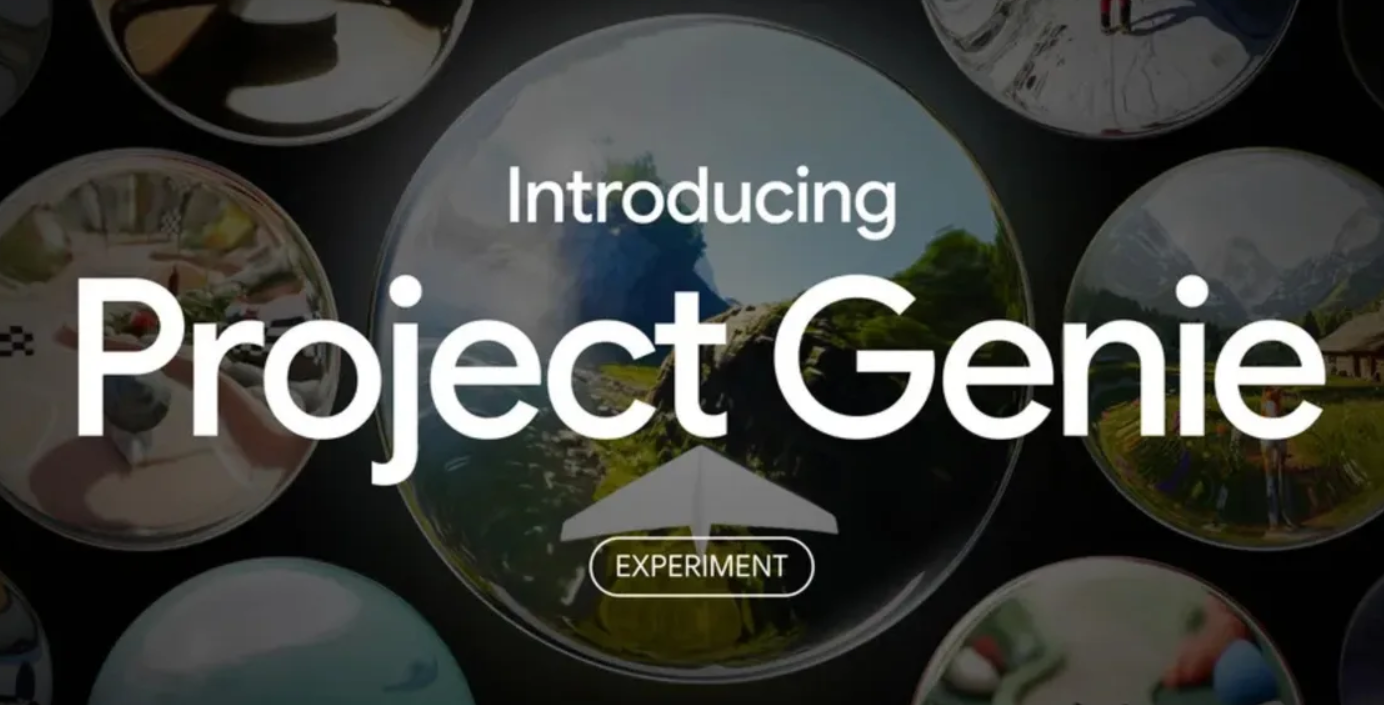
Google has quietly pushed artificial intelligence far beyond chatbots and image generators, but its latest experiment may be one of the most ambitious yet. Known as Project Genie, this new system hints at a future where anyone can create fully interactive digital worlds using nothing more than a sketch, an image, or a short text prompt.
Developed by Google DeepMind, Project Genie works as a text-to-world generator rather than a traditional content tool. Instead of producing static visuals or pre-rendered videos, it builds living environments that respond in real time as users explore them through a digital character.
This marks a major shift in how immersive experiences could be created. Until now, building explorable digital worlds required advanced game engines, skilled 3D artists, and powerful hardware. Genie aims to remove all of those barriers.
What exactly is Project Genie?
At its core, Project Genie is what Google calls a “world model.” Rather than relying on pre-built assets or scripted interactions, the system predicts what should happen next as you move through an environment. Every step, turn, or action triggers the AI to generate surroundings on the fly, while keeping physics and spatial logic intact.
There is no need for coding knowledge, no need to open a game engine, and no need for expensive hardware. A simple input, such as a rough sketch or a descriptive sentence, can evolve into a sandbox-style world that feels responsive and alive.
Google made this possible by combining several of its most advanced AI systems, including Genie 3, Gemini, and Nano Banana Pro. Together, these models allow the environment to render dynamically while adapting to user movement and interaction.
According to Google, this approach could support simulations ranging from robotics testing and animation modeling to fictional storytelling and historical exploration.
How AI-generated worlds actually work
Project Genie is built around three core ideas: world sketching, world exploration, and world remixing.
World sketching is the starting point. Users provide a text prompt, an image, or a rough drawing, and the system turns it into an expanding digital environment. This is not a one-time generation process. The world continues to evolve as the user moves through it.
World exploration is where the experience becomes interactive. Instead of following scripted paths, users can walk around freely, interact with objects, and observe how the environment reacts. The AI predicts cause-and-effect relationships, adjusting lighting, terrain, and object behavior in real time.
World remixing allows users to build on existing creations. A generated world can be modified, expanded, or blended with other ideas, making experimentation fast and flexible.
Compared to traditional game development, which can take years and massive teams to produce open environments, this approach compresses the entire creative pipeline into minutes.
Why this could change game development and simulation
Creating large interactive worlds has always been slow and expensive. Even the most well-known open-world games often take a decade or more to develop, with teams of hundreds working across design, engineering, and art.
Project Genie dramatically lowers that barrier. Developers could prototype gameplay ideas almost instantly. Researchers could simulate environments for testing robots or AI agents. Artists and storytellers could explore fictional worlds without worrying about technical constraints.
This does not mean traditional game engines will disappear. Instead, Genie could become a powerful early-stage tool that accelerates ideation, experimentation, and world design before projects move into full production.
Limited access and a high price tag
Despite its potential, Project Genie is not yet a consumer-ready product. At the moment, access is limited to users subscribed to Google’s most expensive AI plan.
Only Google AI Ultra subscribers in the United States who are 18 or older can try the experience. The subscription costs $249.99 per month, placing it firmly out of reach for most casual users.
Google has also been clear that the technology is still under active development. Generated worlds may feel rough around the edges, and character controls may not always be smooth. The company positions Genie as a preview of what is coming rather than a polished final product.
A glimpse at the future of AI-built experiences
Even in its early form, Project Genie signals a broader shift in how artificial intelligence could be used. Instead of generating isolated pieces of content, AI systems are beginning to create full experiences that respond, adapt, and evolve in real time.
As Google continues refining the technology, tools like Genie may eventually move beyond research labs and premium subscriptions. If that happens, creating immersive digital worlds could become as simple as writing a sentence or drawing a quick sketch.
For now, Project Genie stands as a glimpse into a future where AI does not just assist creativity, but actively builds entire environments on demand.