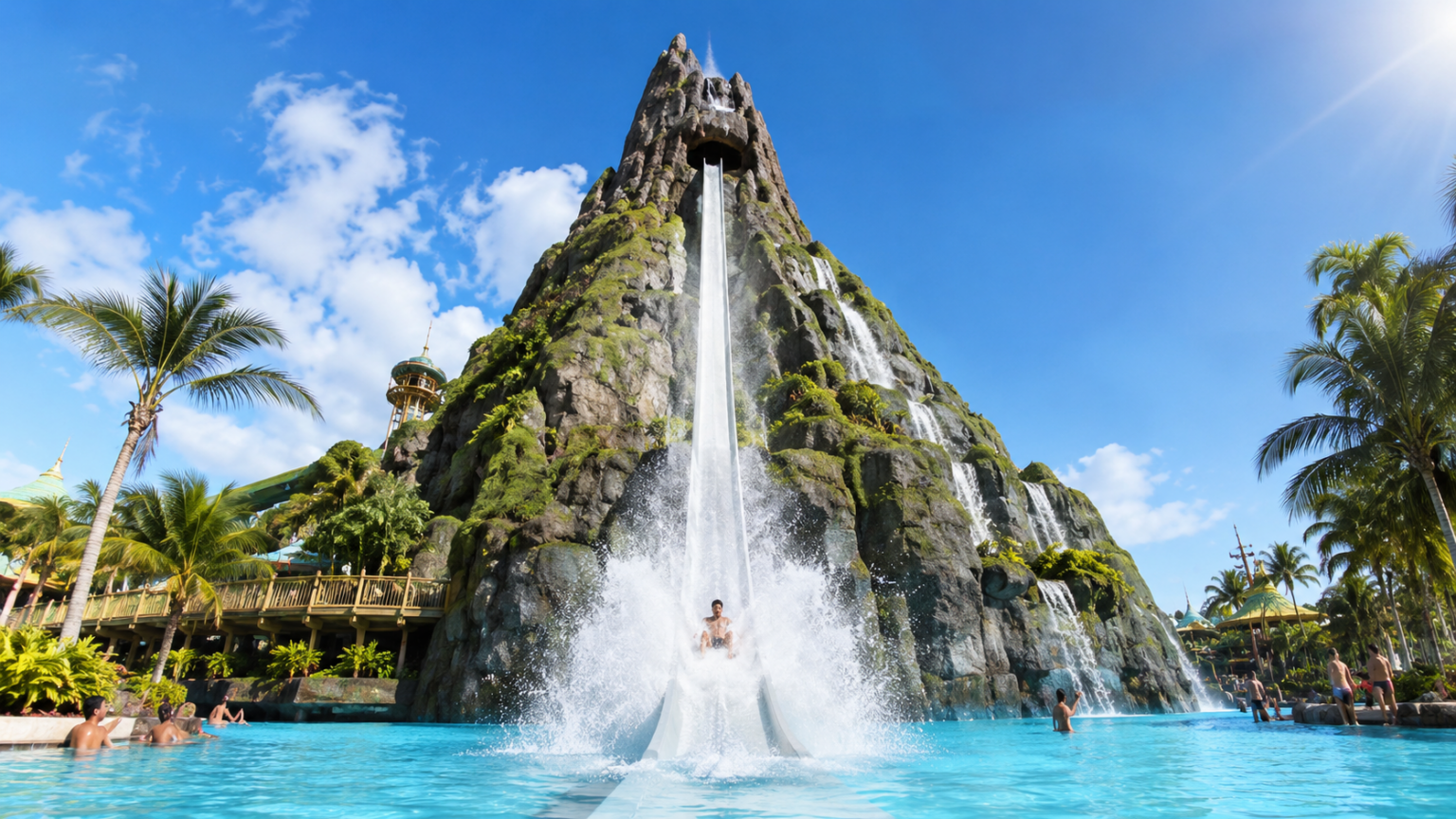
If you’ve seen a video of someone standing on a clear trapdoor 125 feet up, arms crossed, waiting for the floor to vanish — that’s the Ko’okiri Body Plunge. It’s the headline thrill at Universal’s Volcano Bay water park in Orlando, and for a lot of South Florida travelers it’s the single reason a Volcano Bay day makes the itinerary. This is a full trip-planning briefing, not a spec sheet: what it costs in 2026, how the line actually works now, who can ride, and how to fit it into a drive-up day from Miami, Fort Myers, or Tampa.
Overview: what the Ko’okiri Body Plunge actually is
Ko’okiri is a 125-foot trap-door body slide — the tallest of its kind in North America. You climb to a launch chamber near the peak of the Krakatau volcano, step onto a clear capsule floor, and the floor drops out from under you. From there it’s a near-vertical 70-degree plunge straight down through the volcano’s core.
The whole ride lasts roughly five seconds. That’s the honest answer to “how long is Ko’okiri Body Plunge” — the buildup is the experience; the drop itself is over almost before your stomach catches up. The slide uses ProSlide’s FreeFall/SkyBox trapdoor design, the same tech behind other AquaLoop-style launch drops, so the sensation is genuine free-fall, not a gradual lean-in.
For South Florida readers, this matters because Volcano Bay is an easy add-on to an Orlando trip you’re probably already considering. It’s a well-shaded, single-park day that pairs naturally with the theme-park side of Universal — and it’s the closest thing to a signature bucket-list drop the region’s water parks offer.
Location and access from South Florida
Ko’okiri sits in Wave Village, the central hub of Volcano Bay, at the top of the Krakatau volcano that anchors the whole park. You can see it — and hear the drum buildup — from the wave pool below.
Volcano Bay is part of the Universal Orlando Resort complex off Interstate 4. Rough drive times:
- From Tampa: about 1 hour 20 minutes — an easy day trip.
- From Fort Myers: roughly 3 hours each way. Doable in a day, but an overnight is kinder.
- From Miami: about 3.5 to 4 hours. We’d plan at least one night rather than driving back the same evening.
Volcano Bay does not have its own guest parking lot. You park at the main Universal Orlando parking structure and take the free resort shuttle to the water park, or walk over from the nearby on-site hotels. Build 20–30 minutes into your morning for the parking-and-shuttle shuffle, especially in summer. If you’re already staying at a Universal hotel, the shuttle or walking path is the simplest way in.
Hours, prices, and booking
Hours. Volcano Bay runs seasonal hours. Expect roughly 10 a.m. to 5 p.m. in cooler months, extending to 9 a.m. to 8 p.m. or later in peak summer. Because Florida afternoon storms shut water slides down for lightning, always check the official Universal app the morning of your visit — hours and ride status change day to day.
Prices. A single-day Volcano Bay ticket generally runs in the $80–$100+ per person range before tax, with lower gate prices on off-peak days and multi-park combos available if you’re also doing Universal Studios or Islands of Adventure. Occasional discounted Volcano Bay Nights evening events show up on the summer calendar at a reduced rate. Ko’okiri is included in standard admission — there’s no upcharge to ride it.
Express Pass. Volcano Bay offers a separate Universal Express add-on for its slides, priced dynamically (often $20–$80+ depending on the day). For a single-rider bottleneck like Ko’okiri, Express is the most reliable way to skip what can be a very long standby line on busy days.
How the queue works now. This is where older guides go stale. Volcano Bay’s original TapuTapu wearable virtual queue has been phased out in favor of a conventional physical line plus optional paid Express. You now walk up, climb the stairs, and wait in a real queue — no tapping a wristband and wandering off. Because Ko’okiri launches one rider at a time, that line moves slowly.
Booking tips. Ride Ko’okiri first thing at rope drop or in the last hour before close. Midweek days outside school breaks are dramatically calmer than weekends and holidays. If you can only go on a crowded day, the Express add-on pays for itself here more than almost anywhere else in the park.
What to expect: height, weight, and the drop
Height requirement: riders must be at least 48 inches (4 feet) tall. It’s checked at the base before you start the climb, so short riders aren’t disappointed at the top.
Weight limit: riders must be under 300 pounds. Universal doesn’t put you on a scale for most guests, but the limit is real and team members can decline a rider they judge to be over it — the trapdoor mechanism and slide are engineered around it. Plus-size guests who want a straight answer before the climb should ask a team member at the base; they field the question routinely.
The climb. There’s no elevator and no shortcut: it’s 200-plus stairs to the launch chamber near the top of the volcano. That climb is part of why the line feels long and why the ride isn’t accessible to everyone (more on that below).
Inside the chamber. You step into an enclosed capsule and stand on a clear floor, arms crossed over your chest, ankles crossed. A team member counts down, a drum-beat buildup plays — the anticipation everyone describes as the scariest part — and then the floor releases.
The drop. You fall nearly straight down at roughly 50+ feet per second through a chute in the volcano, hit a brief runout, and splash into the exit lane. It’s intense but short. “Is Ko’okiri Body Plunge scary?” — yes, mostly in the two seconds before the floor goes. If you’re comfortable on a steep drop coaster, you’ll be fine. If free-fall makes you queasy, this is the wrong slide.
Nearby options if Ko’okiri isn’t your speed
Not everyone in your group will want the vertical drop, and that’s fine — Wave Village has milder alternatives right next door:
- Kala and Tai Nui Serpentine Body Slides: a pair of intertwining 125-foot trapdoor slides — same launch height as Ko’okiri, but twisting rather than straight-down, which reads as more of a thrill ride and less of a free-fall.
- Ohyah and Ohno Drop Slides: shorter drop slides that end with a plunge into a pool. Milder, quicker to queue, and a good confidence-builder before committing to the big one.
- The rest of the park: the Waturi Beach wave pool, the Kopiko Wai and TeAwa lazy/whitewater rivers, and family raft rides round out an easy full-day plan for mixed groups.
If you’re building a broader Orlando itinerary around the visit, our verified guide to 18-and-up clubs in Orlando and the wider Tampa beach-resort roundup are good companions for turning a slide day into a weekend. Zoo-goers pairing an animal day with the parks can check our 2026 guide to top-ranked U.S. zoos for options in the region.
Visitor tips from people who’ve done the climb
Wear secure swimwear. The drop force is real — loose bottoms and untied trunks come off. Snug, well-tied suits only. No jewelry, no phones in pockets, nothing loose.
Use a locker. Rent a locker at the self-service kiosks near the entrance for phones, keys, and shoes; you’ll ride barefoot and want your hands free for the climb and the safety bars.
Accessibility — read this before you go. Ko’okiri is not wheelchair accessible. There’s no elevator, no ride transfer, and riders must climb the 200-plus stairs and exit the splashdown pool unassisted. Guests who can’t do the climb or self-exit the water can’t ride, and there’s no accommodation that changes that. If mobility is a concern for anyone in your party, the lazy river and wave pool are the accessible-friendly parts of the park to plan around instead.
Beat the wait. The single-rider trapdoor is the bottleneck. Ride at open or close, go midweek, or buy Express — those are the only three levers that meaningfully cut the wait.
For first-timers with nerves: keep your eyes forward, follow the arms-and-ankles-crossed position exactly, and know that the drum buildup is the hardest part psychologically. Once the floor goes, it’s over in five seconds.
Bottom line: Ko’okiri Body Plunge is worth the drive and the stair climb if a genuine free-fall drop is on your list. Plan your hours around the weather, get there early or buy Express, and pack the right swimwear — do that, and North America’s tallest trap-door slide is a five-second story you’ll tell for years.
FAQs
How tall and fast is Ko’okiri Body Plunge?
Ko’okiri Body Plunge is a 125-foot slide — the tallest trap-door body slide in North America — with a 70-degree, near-vertical drop. Riders reach speeds of roughly 50-plus feet per second, and the whole ride lasts about five seconds.
What are the height and weight requirements?
You must be at least 48 inches (4 feet) tall and under 300 pounds to ride. Height is checked at the base before the stair climb, and the under-300-pound weight limit is enforced by team members because the trapdoor mechanism is engineered around it.
Is Ko’okiri Body Plunge wheelchair accessible?
No. There is no elevator, no ride transfer, and no wheelchair access. Riders must climb 200-plus stairs to the launch chamber and exit the splashdown pool unassisted, so guests who can’t do the climb or self-exit the water are unable to ride.
Is it scary, and who should skip it?
It’s genuinely intense, but the scariest part is the drum buildup in the last two seconds before the floor drops. If steep drop coasters make you sick, or free-fall triggers anxiety, skip it and try the milder Ohyah and Ohno drop slides or the twisting Kala and Tai Nui body slides instead.
What does ‘Ko’okiri’ mean?
The name comes from the park’s Pacific-island theming and evokes a sudden launch or bursting-forth motion — fitting for a slide where the floor drops out from under you. Volcano Bay’s ride names draw on that broader island-mythology naming style.
How much does Volcano Bay cost and what are the 2026 hours?
A single-day Volcano Bay ticket generally runs about $80–$100+ before tax, with Ko’okiri included at no upcharge; a separate Universal Express add-on is available. Hours are seasonal — roughly 10 a.m.–5 p.m. in cooler months and up to 9 a.m.–8 p.m. or later in peak summer. Check the Universal app the day of your visit.