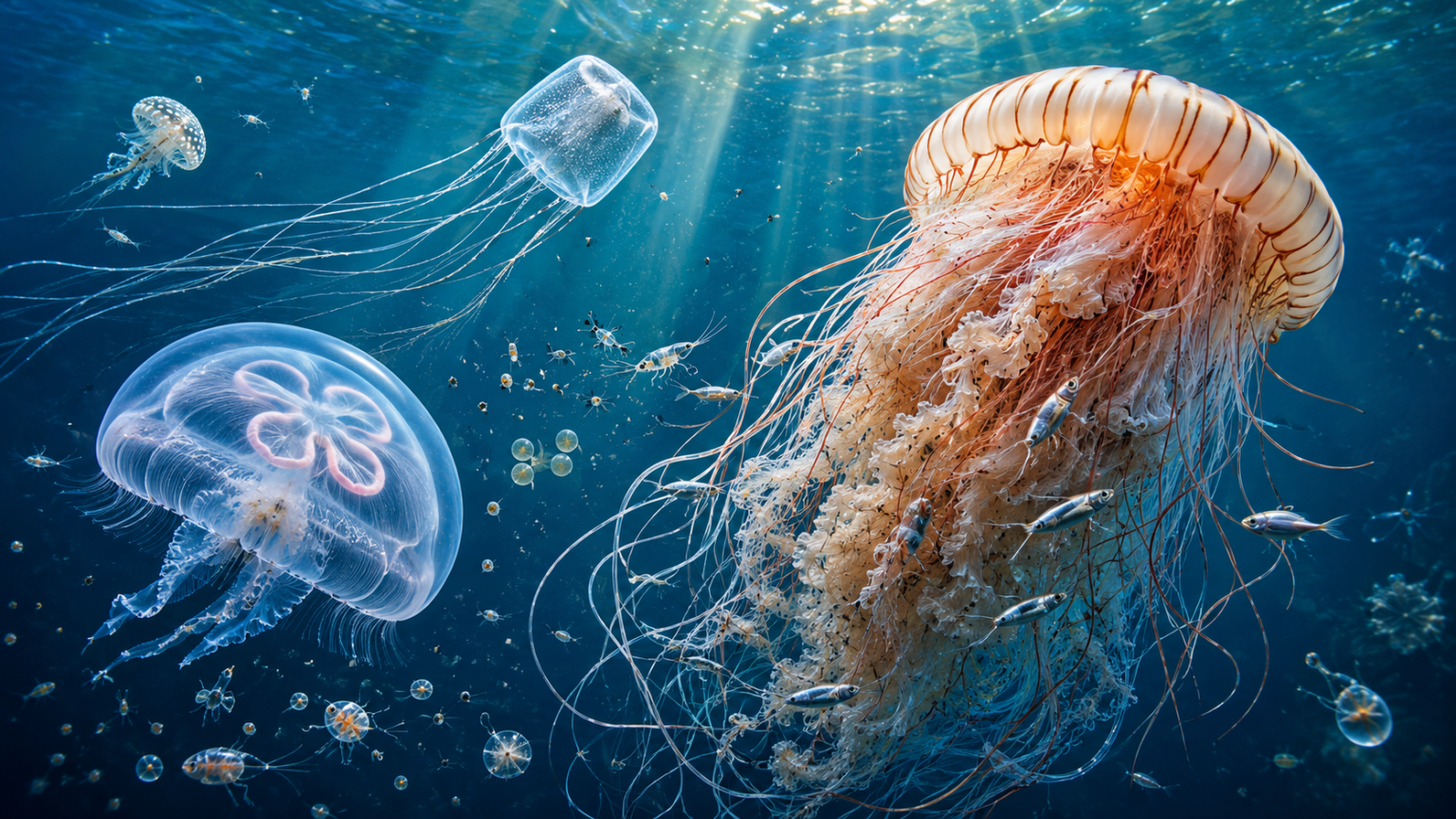
Jellyfish are carnivorous, opportunistic drift-feeders. They eat whatever small prey floats into their tentacles — mostly zooplankton, small fish and fish larvae, crustaceans like copepods, krill and shrimp, fish eggs, and even other jellyfish. A few species also get energy from algae living inside their tissue. The one rule that explains almost everything about a jellyfish’s diet: it scales with size. A pinhead-sized jelly eats microscopic plankton; a lion’s mane with 100-foot tentacles can take fish and other jellies.
That single-paragraph answer covers most searches. Below we go further than the standard reference pages — with a species-by-species diet table, a plain-English look at how a brainless animal actually hunts, what keepers feed captive jellies, and which species you’ll meet on a Florida beach.
What It Means: How Jellyfish Eat With No Brain and No Teeth
Jellyfish don’t chase food. They drift, and their tentacles do the work. Those tentacles are lined with thousands of stinging cells called nematocysts — tiny pressurized capsules that fire a barbed, venom-loaded thread the instant they touch prey. The venom stuns or kills small animals in a fraction of a second. The tentacles then pass the catch to the oral arms and into a single opening in the middle of the bell.
That opening leads to the gastrovascular cavity, which is both stomach and exit. Food goes in, enzymes break it down, nutrients absorb into the body wall, and waste leaves through the same hole. Yes — jellyfish eat and poop through one opening.
So how do they do this without a brain? Jellyfish have no centralized brain at all. Instead they run on a nerve net — a decentralized web of nerve cells spread through the bell that detects touch, chemicals and light and triggers stinging and swallowing automatically. It’s reflex-driven eating, no thinking required. Digestion is fast, usually about 1 to 3 hours, which keeps the animal light enough to stay buoyant.
Key Facts and Context: Diet of a Jellyfish by Species and Size
“What a jellyfish eats” isn’t one answer — it depends heavily on the species and how big it is. Here’s how the diet breaks down across the jellies people ask about most:
| Species | Typical size | What it eats |
|---|---|---|
| Moon jellyfish | Bell up to ~15 in | Zooplankton, fish eggs, larvae, tiny crustaceans |
| Cannonball jellyfish | Bell ~7–10 in | Mostly veligers (larval snails) and zooplankton |
| Box jellyfish | Bell up to ~8 in | Small fish and shrimp — an active, fast hunter |
| Portuguese man o’ war | Float ~6 in, tentacles up to 30 ft+ | Small fish and fish larvae |
| Lion’s mane | Bell up to ~7 ft | Fish, larger crustaceans, other jellyfish |
| Upside-down / spotted jellies | Bell ~6–12 in | Plankton plus sugars from symbiotic algae |
Two things stand out. First, some jellyfish are part-time farmers: upside-down jellies (Cassiopea) and spotted jellies host symbiotic algae called zooxanthellae in their tissue and absorb the sugars those algae produce through photosynthesis. That’s the closest a jellyfish gets to eating “plants.” Second, cannibalism is normal. Bigger jellies routinely eat smaller ones, including their own kind, because a drifting jelly is just another slow, soft, protein-rich meal.
How much do they eat? A lot, relative to their body — jellies feed more or less continuously whenever prey is available, and during plankton-rich blooms a moon jelly can process many times its body weight over a day. There’s no set mealtime; if food touches the tentacles, it gets eaten.
Jellyfish are prey, too. Sea turtles (especially leatherbacks), ocean sunfish, some sea birds, and other jellyfish all eat them — which is a big reason ocean plastic is so dangerous, since a floating bag looks a lot like a moon jelly to a hungry turtle.
Examples: What Jellyfish Eat in the Wild vs. in a Tank
In the open ocean, jellyfish eat whatever the current delivers — plankton clouds, fish larvae, drifting eggs, small crustaceans. In captivity, keepers reproduce that as closely as they can. Public aquariums and home hobbyists typically feed jellies baby brine shrimp, frozen mysis shrimp, rotifers, and prepared planktonic foods, often target-fed with a pipette or dosing pump because jellies won’t pursue food that drifts out of reach.
If you keep jellyfish in a home tank, the practical rule is: small, soft, meaty, and delivered right to the bell. Baby jellies (ephyrae) and newly hatched species start on the smallest live foods — freshly hatched brine shrimp and rotifers — before graduating to larger fare. Overfeeding fouls the water fast in a closed system, so most keepers feed once or twice a day and remove leftovers.
One quick clarification for a common search: “what do jellyfish eat in Minecraft” is a game question, not a biology one. Minecraft doesn’t have a standard feedable jellyfish mob — that’s mod-specific behavior. Everything on this page is about real, living jellyfish. For more real-animal explainers, our guide to whether dogs have nightmares and the 2026 guide to the top-ranked zoos in the United States dig into animal behavior the same way, and you’ll find more science coverage in our Technology section.
Florida Relevance: Jellyfish You’ll Actually See on Florida Beaches
Florida is one of the most jellyfish-heavy coastlines in the U.S., with warm Gulf and Atlantic waters that support big seasonal blooms. Three species show up most often, and all three eat versions of the same plankton-and-small-prey diet described above:
- Moon jellyfish — extremely common, translucent with a four-leaf-clover pattern. They eat plankton and fish eggs and deliver only a mild sting most people barely feel.
- Cannonball jellyfish — the round, firm, brown-rimmed jelly that washes up by the hundreds. They feed mainly on tiny larval snails and plankton and are nearly harmless to swimmers.
- Portuguese man o’ war — not a true jellyfish but a colonial siphonophore, with a blue-purple float and long trailing tentacles that catch small fish. This one stings hard, even after it washes up dead, so give the blue balloons on the sand a wide berth.
The takeaway for beachgoers: what these animals eat (small drifting prey) has little to do with the sting risk. That risk comes from the venom in their tentacles doing its normal job of catching food — you’re just an accidental target. Planning a beach trip? Our honest guide to Tampa resorts on the beach covers where to stay along the Gulf.
The Bottom Line
Jellyfish eat small prey they can trap and sting: plankton, crustaceans, fish, fish eggs and larvae, and other jellyfish — with the exact menu scaling to the animal’s size and, in a few species, supplemented by algae. They pull it off with no brain, no teeth and no bones, using a nerve net and a single stomach-and-exit opening. Simple machinery, remarkably effective diet.
FAQs
What is the diet of a jellyfish?
A jellyfish’s diet is carnivorous and opportunistic: zooplankton, small fish and fish larvae, crustaceans (copepods, krill, shrimp), fish eggs, and other jellyfish. Some species also absorb sugars from symbiotic algae living in their tissue.
How do jellyfish eat without a brain?
Jellyfish have no centralized brain. They use a decentralized nerve net that senses touch and chemicals and automatically fires stinging cells to catch prey, then passes it into a single stomach opening. It’s reflex-driven, not thought-driven.
Do jellyfish eat fish, crabs, or other jellyfish?
Yes to all three, depending on size. Larger species like box jellyfish and lion’s mane eat small fish and crustaceans, and cannibalism is common — bigger jellyfish routinely eat smaller ones, including their own species.
Can jellyfish eat humans?
No. Jellyfish can’t consume anything close to human size; their prey is tiny drifting animals. Stings happen because tentacle venom is designed to stun small prey, not because a jellyfish is trying to eat you.
What do jellyfish eat in a tank or captivity?
Keepers feed captive jellyfish baby brine shrimp, frozen mysis shrimp, rotifers, and prepared planktonic foods, usually target-fed with a pipette. Baby jellyfish start on the smallest live foods like freshly hatched brine shrimp.
Do fish eat jellyfish, and what else does?
Yes. Sea turtles (especially leatherbacks), ocean sunfish, some fish and seabirds, and other jellyfish all eat jellyfish, making them an important part of the ocean food web.