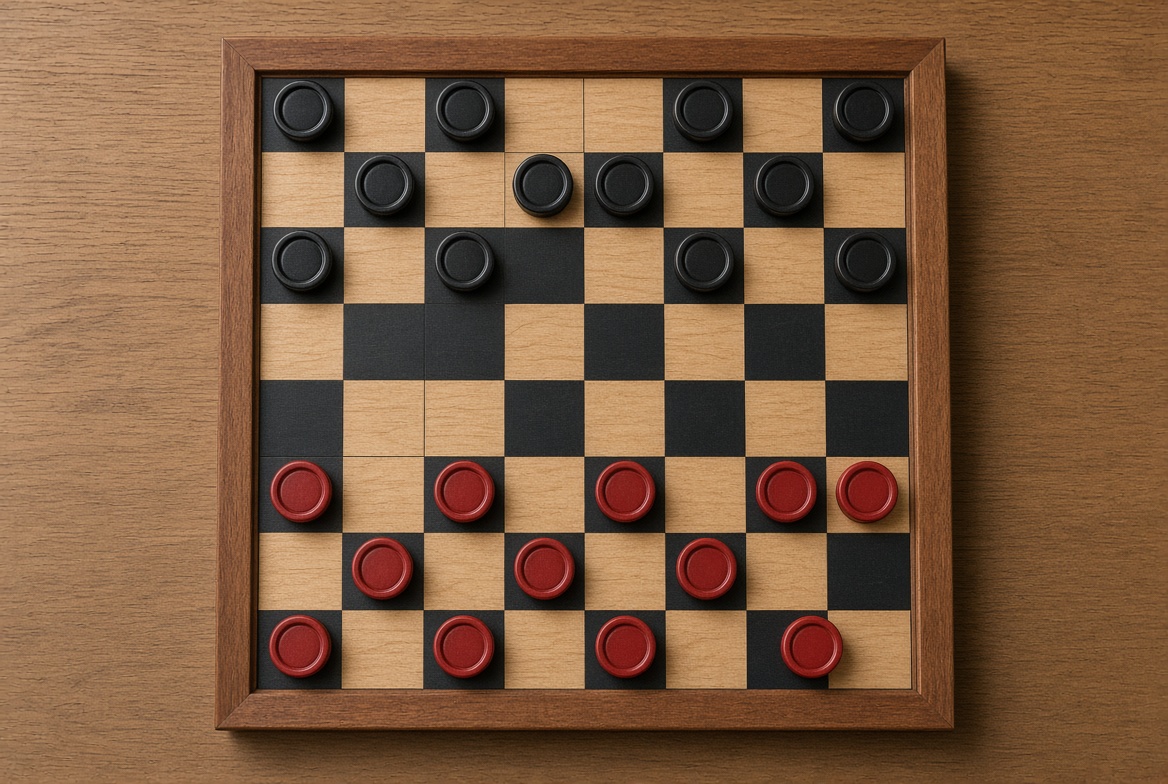
Turn the board so each player has a dark square in their bottom-left corner and a light square in their bottom-right. Each player then puts 12 pieces on the dark squares of the three rows closest to them. That’s four pieces per row. The two middle rows stay empty, and no piece ever goes on a light square. In standard American rules, the darker pieces (black) move first.
That’s the whole setup. Here’s how it looks with the rows labeled. You play the red pieces from the bottom, and your opponent plays black from the top.
| Row | a | b | c | d | e | f | g | h |
|---|---|---|---|---|---|---|---|---|
| 8 | B | B | B | B | ||||
| 7 | B | B | B | B | ||||
| 6 | B | B | B | B | ||||
| 5 | · | · | · | · | ||||
| 4 | · | · | · | · | ||||
| 3 | R | R | R | R | ||||
| 2 | R | R | R | R | ||||
| 1 | R | R | R | R |
Key: B = black piece, R = red piece, · = empty dark square, blank = light square (never used). Square a1, your bottom-left, is dark. Square h8, your opponent’s bottom-left, is also dark.
Requirements: what you need to set up checkers
- An 8×8 board. It has 64 squares that alternate in color, 32 dark and 32 light. The game only uses the 32 dark squares.
- 24 pieces. That’s 12 of one color, usually black, and 12 of another, usually red or white. If a set is short a piece, you can use a coin or a bottle cap as a stand-in.
- Two players sitting across from each other.
- A flat surface and about a minute.
One point many guides skip: 10×10 boards are for a different game. International draughts, the version played across much of Europe, uses a 100-square board and 20 pieces per side, filled into four rows. If your set has 40 pieces and a bigger grid, that’s what you have. Everything in this guide covers the 8×8 American and English game, also called checkers or English draughts.
Step-by-step: how to set up a checkers board
Step 1: Put the board between the players
Lay it flat, with one edge facing each player. Don’t set it at an angle or toward a corner.
Step 2: Check the orientation (the step most people get wrong)
Look at the corner square nearest your left hand. It must be dark. Another way to check is that the corner nearest your right hand must be light. If it’s the other way around, turn the board 90 degrees. Because the board is symmetrical, a correct setup also gives your opponent a dark square on their left.
People who play a lot use a second check: the double corner, which is the two dark squares touching diagonally in a corner, should be at your right hand.
Step 3: Place your 12 pieces
Fill the dark squares of the three rows nearest you, starting at your edge. Each row has exactly four dark squares, so you get 4 + 4 + 4 = 12. Your opponent does the same on their side.
Step 4: Check the setup
- The two middle rows (4 and 5) are completely empty.
- Every piece is on a dark square.
- Each row holds four pieces, and each side has 12.
- Pieces in neighboring rows are offset from each other, like a staggered brick pattern, not stacked in straight columns.
Step 5: Decide who moves first
Under World Checkers/Draughts Federation rules and standard US play, black (the darker pieces) moves first. In casual home games, people often flip a coin or let the youngest player go first. That’s fine, as long as you agree before anyone moves. In a series of games, players usually switch colors each game.
Step 6: For kids and beginners, use one simple check
When we teach this to new players, one line sticks: “Dark corner on the left, four per row, three rows.” Have kids count the four pieces in each row out loud. It catches nearly every setup mistake before the game starts.
Costs and timing
| Option | Typical price | Good for |
|---|---|---|
| Cardboard board with plastic pieces | $5–$12 | Kids, travel, backup sets |
| Folding wood board or 3-in-1 game set | $15–$50 | Home play that lasts for years |
| Roll-up vinyl board with tournament pieces | $15–$30 | Clubs and regular players |
| Giant outdoor set (mat or tiles with large pieces) | $40–$150+ | Patios, events, schools |
Timing: Setting up takes about a minute. It takes closer to 30 seconds once you’ve done it a few times. Teaching a child the setup and basic moves usually takes 10–15 minutes.
A Florida note: Humidity warps cheap wood boards. If you store a set in a garage, on a lanai or in a beach house, a vinyl roll-up board will last longer. Outdoor vinyl mats also fade fast in direct Florida sun, so bring them inside after use. Many Florida public library systems keep board games for in-library play, and a lot of county parks and senior centers have tables with built-in checkerboards. Some even have giant ground-level boards. Before buying a set to try the game, check your local parks department or library calendar.
Planning a game day because the forecast looks bad? Our explainer on why it’s raining so much this year covers why so many afternoons have moved indoors.
Common mistakes when setting up a checkerboard
- The board is turned 90 degrees. This is the most common error. A light square ends up in your bottom-left, and the double corner moves to the wrong side. That changes the opening positions experienced players rely on. Fix it with the dark-corner-on-the-left check.
- Pieces are on light squares. In checkers, pieces only move diagonally, so they stay on one color the whole game. Start on light squares and everything is off.
- The piece count is wrong. Some people fill four rows, which is a habit from 10×10 draughts or a mix-up with chess. Others use only two rows. It’s 12 pieces and three rows each.
- Checkers and chess setups get mixed up. A chessboard is the same 8×8 grid, but chess uses all 64 squares, 16 pieces per side, and the reverse orientation check: a light square goes in each player’s bottom-right. Strictly, that’s the same physical layout, since dark on the left means light on the right. Where people go wrong is the piece placement.
- Kings start on the board. No pieces start as kings. A piece only becomes a king, crowned with a second piece stacked on top, when it reaches the far row.
Not what you meant? Chess setup, checkerboard assay and checkerboard patterns
How to set up a chess board
Turn the board the same way, with a light square at each player’s bottom-right (“light on right”). Put pawns across the second row. On the back row, from the corners inward, place rooks, knights and bishops. The queen goes on the square that matches her color, so the white queen is on a light square and the black queen on a dark one. The king goes on the last open square.
How to set up a checkerboard assay
This is a lab method, not a game. In microbiology and pharmacology, a checkerboard assay tests two drugs together. Researchers dilute one drug across the columns of a microplate and the other down the rows. Then they calculate a fractional inhibitory concentration (FIC) index to see whether the combination is synergistic. A FIC index of 0.5 or lower is the usual cutoff for synergy. If that’s what you’re after, follow your lab’s protocol or the CLSI guidance, not a games guide.
How to make a checkerboard pattern
For crafts, tile or design work, start with a grid of equal squares and fill every other square, offsetting each row by one. On an 8×8 grid that gives 32 of each color. For floors and walls, lay out your center lines first so the pattern stays symmetrical at the edges.
Like this guide? We write a lot of quick, step-by-step explainers. Try our guides on how to wash a lettuce and how long to boil a chicken breast, or browse more in our News & Lifestyle section.
FAQs
How do you set up a checkers board?
Put the board so each player has a dark square in their bottom-left corner. Each player then places 12 pieces on the dark squares of the three rows closest to them, four per row. The two middle rows stay empty, and no pieces go on light squares.
Which color goes on the bottom right in checkers?
A light square goes in each player’s bottom-right corner, which puts a dark square in the bottom-left. The double corner, two dark squares touching diagonally, should be on your right.
How many pieces does each player have in checkers?
In standard 8×8 American checkers, each player has 12 pieces, for 24 in total. International draughts uses a 10×10 board with 20 pieces per player.
Do checkers go on black or red squares?
They go on the dark squares. On a typical red-and-black board, those are the black squares, and on tournament boards they’re usually green. All pieces start on and stay on the same color for the whole game.
Who moves first in checkers?
Under standard US and World Checkers/Draughts Federation rules, black (the darker pieces) moves first. In casual games, players often flip a coin instead. Just agree on it before you start.
How many squares are on a checkers board?
A standard checkers board has 64 squares in an 8×8 grid, 32 dark and 32 light. Only the 32 dark squares are used in play.