Most “best marathon” lists repeat the same three big-city races and stop there. This one asks a different question: which U.S. marathons are the most memorable to run? Some cross a coastal highway, some start under fireworks, and some finish after 11 p.m. with the sun still up. Below you’ll find how we scored them, a comparison table with approximate entry fees, and how to pick the right race for your goal.
How We Chose the Coolest Marathons in the U.S.
“Coolest” is not the same as “fastest” or “most prestigious.” A race can be a great Boston qualifier and still be a forgettable day. We scored each race from 1 to 5 on five criteria:
- Theme or setting: Is there something about this race you can’t get anywhere else?
- Scenery: What you actually see from the course, not just the backdrop in the marketing photos.
- Atmosphere: Crowd support, volunteers and the overall mood of race weekend.
- Accessibility: How hard it is to get a bib, plus cutoff times and whether first-timers can manage the course.
- Value and logistics: The entry fee, travel costs and how hard race weekend is to manage.
A perfect score is 25. Entry fees are approximate ranges from recent registration cycles. Most races raise prices every year, and many charge more as race day gets closer, so use our numbers as a budget guide and confirm on the official race site before you register.
At-a-Glance: Coolest U.S. Marathons Compared
| Race | Location | Typical month | Approx. entry fee | Difficulty | How you get in | Best for | Score |
|---|---|---|---|---|---|---|---|
| Big Sur International | Big Sur to Carmel, CA | Late April | $200–$250 | Hard | Drawing/lottery, charity | Scenery lovers | 23 |
| Honolulu Marathon | Honolulu, HI | December | $150–$300 (rises over time) | Moderate (heat) | First-come | Walkers, slower runners | 22 |
| Mayor’s Midnight Sun | Anchorage, AK | June (near solstice) | $100–$160 | Moderate | First-come | Adventure travelers | 21 |
| Marine Corps Marathon | Arlington, VA / Washington, D.C. | Late October | $150–$190 | Moderate | Registration window/lottery, charity, military | First-timers | 21 |
| New York City Marathon | All five boroughs, NY | Early November | $255–$315 | Moderate–hard (bridges) | Lottery, time qualifier, charity, 9+1 | Big-crowd energy | 21 |
| Boston Marathon | Hopkinton to Boston, MA | April (Patriots’ Day) | $230–$260 | Moderate–hard | Qualifying time, charity | Qualifiers, bucket-listers | 20 |
| Grandma’s Marathon | Two Harbors to Duluth, MN | Mid-June | $135–$155 | Easy–moderate | First-come | Value, PR attempts | 20 |
| Chicago Marathon | Chicago, IL | October | $250–$275 | Easy (flat) | Lottery, time qualifier, charity | PRs, first-timers | 20 |
| Crazy Horse Marathon | Black Hills, SD | Early October | $100–$150 | Moderate (altitude, gravel) | First-come | Quirky, small-field fans | 19 |
| California International (CIM) | Folsom to Sacramento, CA | Early December | $150–$200 | Easy–moderate | First-come | Boston qualifying | 19 |
Our Picks: The Coolest Marathons Worth Traveling For
Big Sur International Marathon: The Most Scenic Marathon in the U.S.
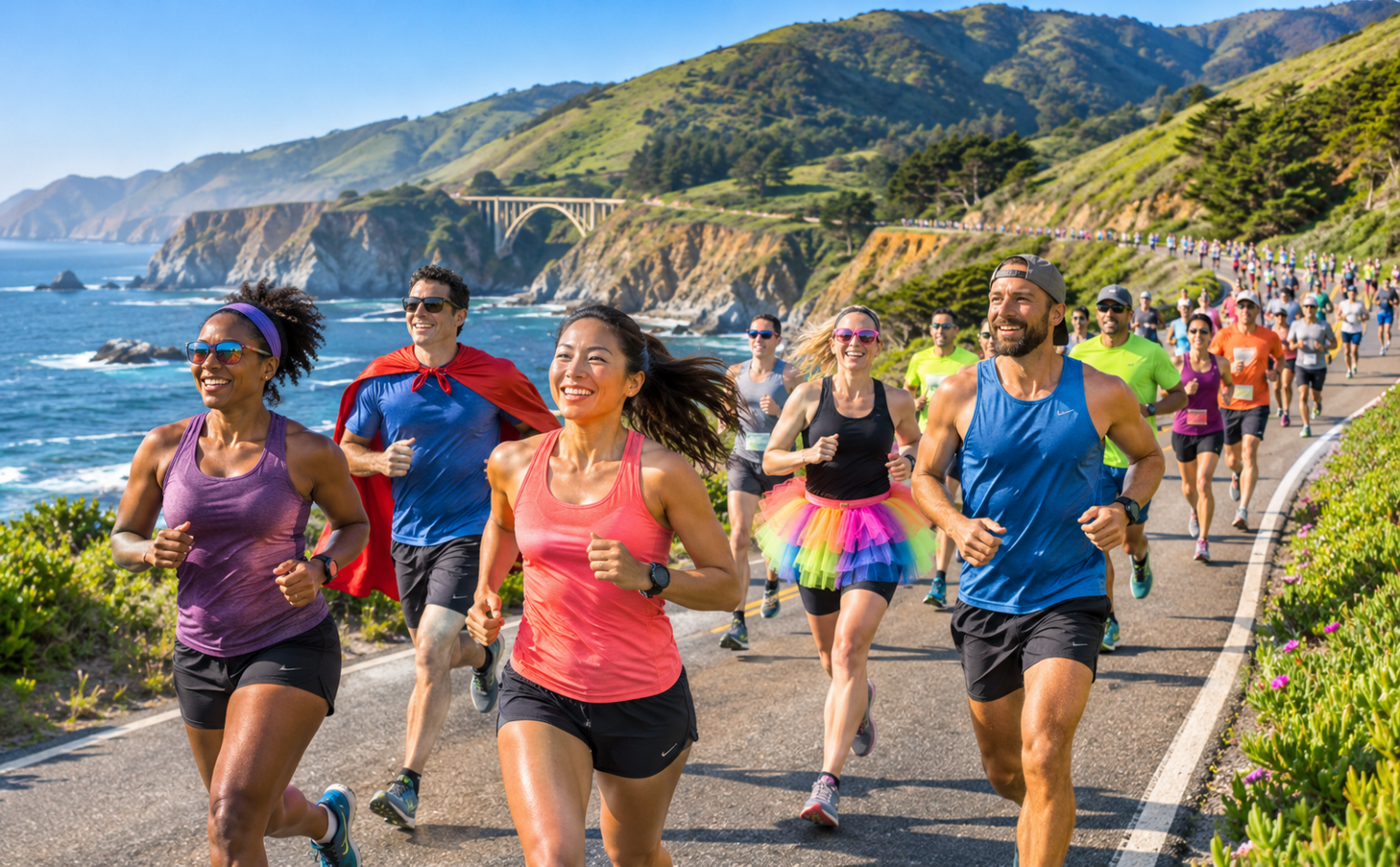
This point-to-point race runs north on Highway 1, with the Pacific beside you most of the way. The famous moments are the two-mile climb up Hurricane Point and the pianist playing at Bixby Bridge near the halfway mark. The field is small and spots go fast, so enter the drawing as soon as it opens. Plan to run a few minutes per mile slower than usual. The hills and headwinds will slow you down, so this is a race for the experience, not a PR.
Honolulu Marathon: No Time Limit, Fireworks at the Start
Honolulu starts before dawn with fireworks, passes Diamond Head and has no official time limit, so it’s one of the most welcoming marathons in the country. Lots of walkers and first-timers run it. The trade-off is warm, humid weather after sunrise. Registration is first-come, and the price goes up in tiers, so signing up early saves real money.
Anchorage Mayor’s Midnight Sun Marathon: Running Near the Solstice
Anchorage gets roughly 19 hours of daylight in late June, and this race is held as close to the solstice as possible. Much of the course runs on trails, including stretches of the Tony Knowles Coastal Trail, with views of the Chugach Mountains. It’s a great reason to build an Alaska trip around a race. Flights and lodging in June cost more than the entry fee, so book early.
Marine Corps Marathon: The People’s Marathon
MCM pays no prize money and is run by Marines, which gives it a mood unlike any other big race. Marines hand out water and medals, and the course passes the National Mall and major monuments. It’s a strong first marathon, but know the “Beat the Bridge” rule: you have to reach the 14th Street Bridge around mile 20 before a set cutoff. That works out to about a 14-minute-per-mile pace.
New York City, Boston and Chicago: The Flagship Experiences
They’re famous for good reason. New York crosses five boroughs and five bridges, with huge crowds in Brooklyn and on First Avenue. Boston is the oldest annual marathon in the world, and most runners need a qualifying time to get in. Its Newton hills, finishing with Heartbreak Hill, break a lot of people’s pacing plans. Chicago is flat and fast, and spectators line nearly the whole course. All three are World Marathon Majors, so they cost the most and are the hardest to get into.
Grandma’s Marathon and CIM: Scenic, Fast and Good Value
Grandma’s follows the Lake Superior shoreline into Duluth. The lake often keeps temperatures cool, though warm years do happen in June. The fee runs about $100 to $150 less than the Majors. CIM drops about 340 feet from Folsom to Sacramento on a rolling course and is known as one of the best races in the country for Boston qualifying.
Crazy Horse Marathon: The Quirky Regional Pick
This race starts near the Crazy Horse Memorial and follows the George S. Mickelson Trail through the Black Hills. The course is mostly packed gravel at an elevation of roughly 5,000 to 6,000 feet. The field is small and the race has a real local feel, the kind of event that makes “coolest races in the U.S.” lists. If you live near sea level, plan for the altitude to slow you down.
Great Marathons to Run, by Runner Type
- First-timers: Marine Corps, Chicago or Honolulu. You get big crowds, lots of course support and manageable cutoffs.
- PR and Boston qualifying: CIM, Chicago or Grandma’s. These courses are flat or net downhill and usually run in cool weather.
- Scenery: Big Sur, Anchorage or Crazy Horse.
- Walkers and slower runners: Honolulu, because it has no time limit. Always check the cutoffs before you sign up anywhere else.
- Budget travelers: Grandma’s, Crazy Horse or CIM. Entry fees are lower, and hotel prices don’t spike the way they do in NYC.
About “easiest” marathons: no 26.2 is easy. A course feels easier when it’s flat or gently downhill, the weather is cool, the cutoffs are generous and spectators show up. Chicago and CIM hit most of those marks. Big Sur and Crazy Horse don’t, and that’s part of their appeal.
Costs, Registration and Race-Day Details
How You Actually Get a Bib
- Lottery or drawing: NYC, Chicago and Big Sur. Entry is a random draw, and the odds are often low.
- Qualifying time: Boston requires one. NYC and Chicago offer guaranteed entry for fast times.
- Charity: Most big races offer charity spots. You usually commit to raising anywhere from about $1,500 to more than $5,000.
- First-come: Honolulu, Grandma’s, CIM, Anchorage and Crazy Horse. You just register before the race fills or the price goes up.
Major-race lotteries usually open 7 to 10 months before race day. Put the opening dates on your calendar.
The Real Trip Budget
The entry fee is often the smallest part of the cost. For a destination Major, plan on $800 to $2,000 or more once you add flights, two or three hotel nights at race-weekend rates, and meals. Most races also require you to pick up your packet in person a day or two before the race, which often means one more hotel night.
Planning Tips (Plus a Florida Note)
- Give yourself 16 to 20 weeks of training if you already run regularly. Beginners should add a base-building phase before that.
- Train for your race’s conditions. Do hill repeats for Big Sur and Boston. Arrive a few days early, or adjust your pace, for Crazy Horse’s altitude. Get used to heat if you’re running Honolulu.
- Book lodging as soon as you’re registered. Hotels near the start and finish sell out first.
- Know your weather. Check the forecast terms the week of the race. Our guide to what “isolated T-storms” means covers one of the most common ones you’ll see.
- Don’t overdo carb-loading. Add carbs in the last two or three days, but go easy on the heavy toppings. Our breakdown of whether mashed potatoes are fattening explains why.
Florida note: If you train in Florida, you already have a heat and humidity advantage for Honolulu. Run at dawn, practice your hydration, and remember that cooler races will feel faster than your training runs. Florida’s winter season is also a good time for a first marathon closer to home. The Space Coast Marathon in Cocoa (usually around Thanksgiving weekend), the Miami Marathon (usually late January or early February) and the Walt Disney World Marathon (usually January) are all popular. Confirm the current dates on each official site. If you’re already traveling for a race, see our top 10 aquariums in the U.S. for a rest-day plan that keeps you off your feet. For more guides like this one, visit our News & Lifestyle section.
FAQs
What is the coolest marathon in the U.S.?
On our scoring, Big Sur International comes out on top. It runs along Highway 1 on the Pacific coast and has a pianist at Bixby Bridge. Honolulu, with fireworks at the start and no time limit, and Anchorage’s Mayor’s Midnight Sun, held near the summer solstice, are close behind.
What are some great marathons to run for the first time?
The Marine Corps Marathon, the Chicago Marathon and the Honolulu Marathon are all strong first-timer choices. MCM and Chicago have big crowds and lots of course support. Chicago is flat, and Honolulu has no official time limit. Check cutoff times before you register for any race.
What is the easiest marathon in the U.S.?
No marathon is truly easy. Flat or net-downhill courses in cool weather, such as Chicago, CIM and Grandma’s, are usually the most forgiving. Generous cutoffs also help, and Honolulu has no time limit at all.
What are the 6 World Marathon Majors?
The original six are Tokyo, Boston, London, Berlin, Chicago and New York City. Sydney was added as the seventh Major in 2025. Three of the Majors are in the U.S.: Boston, Chicago and New York.
How much does it cost to run a marathon in the U.S.?
Entry fees usually run from about $100 for small regional races to $250–$315 for the Majors. Destination races add travel costs. Plan on roughly $800 to $2,000 or more once you include flights, race-weekend hotel rates and meals.
Do you need to qualify to run a marathon?
Most marathons don’t require a qualifying time. Boston is the main U.S. exception, though it also offers charity entries. New York and Chicago use lotteries but offer guaranteed entry for fast qualifying times or through charity.