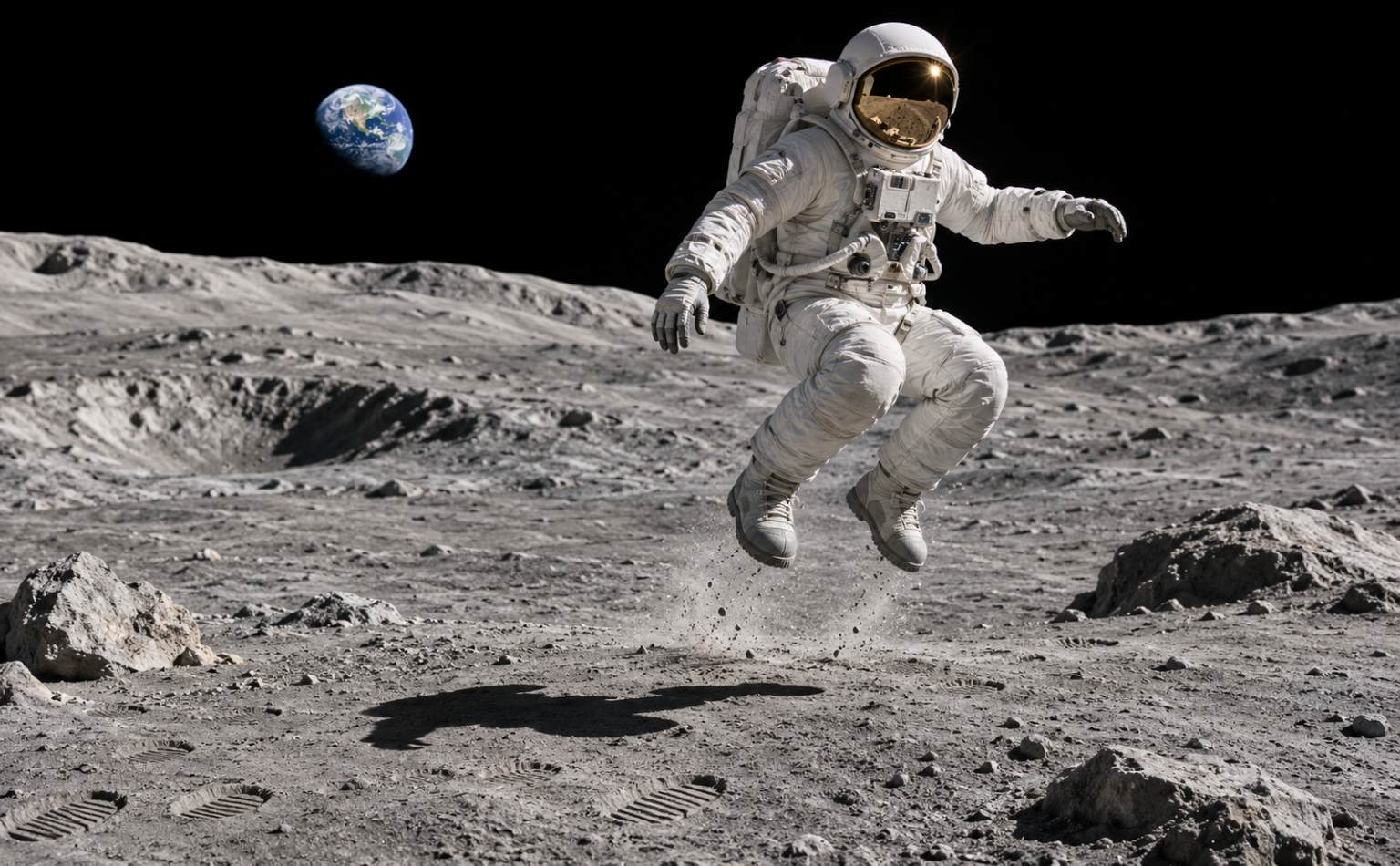
Yes, the Moon has gravity. At the surface it pulls at about 1.62 meters per second squared. Earth pulls at about 9.8 m/s², so the Moon’s gravity is roughly one-sixth of ours. That is low gravity, not zero gravity. A person who weighs 180 pounds on Earth would weigh about 30 pounds on the Moon, and if they let go of a rock it would still fall to the ground, just more slowly.
The rest of this guide puts that number to work. It covers what you’d weigh, why the Apollo footage looks the way it does, why the Moon has less gravity than Earth, and where the common “no gravity” idea comes from.
Quick answer: Is there gravity on the Moon, yes or no?
- Yes. Surface gravity is 1.62 m/s², about 16.5% of Earth’s, according to NASA’s lunar fact sheet.
- Not zero. Every object with mass has gravity, and the Moon has about 73 quintillion metric tons of it.
- Rule of thumb: divide your Earth weight by six to get your Moon weight.
What it means: low gravity is not no gravity
Gravity is the attraction between any two things that have mass. The more mass an object has, the harder it pulls. The farther away you are from it, the weaker the pull gets. A planet, a moon, a bowling ball and you all have gravity. The difference is only in strength.
That’s why the phrase “zero gravity on the Moon” is wrong. The Moon is massive enough to hold astronauts on its surface, keep dust from drifting off into space, and pull on Earth’s oceans from 239,000 miles away.
Your weight changes, but your mass doesn’t
This distinction comes up a lot. Mass is how much matter you’re made of, and it stays the same everywhere. Weight is how hard gravity pulls on that mass. On the Moon you’d weigh about one-sixth as much, but you’d be just as hard to push sideways or to stop once you’re moving. Apollo astronauts found this out quickly: they could lift heavy gear easily, but changing direction quickly took real effort.
Key facts: How is the Moon’s gravity different from Earth’s?
| Measure | Moon | Earth | Moon as share of Earth |
|---|---|---|---|
| Surface gravity | 1.62 m/s² | 9.81 m/s² | ~16.5% (about 1/6) |
| Mass | 7.35 × 10²² kg | 5.97 × 1024 kg | ~1.2% (about 1/81) |
| Mean radius | 1,737 km (1,079 mi) | 6,371 km (3,959 mi) | ~27% |
| Escape velocity | 2.38 km/s | 11.2 km/s | ~21% |
| Average density | 3.34 g/cm³ | 5.51 g/cm³ | ~61% |
Why is there less gravity on the Moon than on Earth?
Surface gravity depends on two things: how much mass a body has and how far its surface is from its center. The Moon has only about 1.2% of Earth’s mass. Being smaller does help, because you’re standing closer to the center, and that raises the pull about 13 times. But having 81 times less mass outweighs that. The net result is about one-sixth.
The Moon is also less dense than Earth. It has no large iron core like ours, so even for its size, it packs less mass.
How is there gravity on the Moon if it doesn’t spin?
There are two misconceptions in this question. First, the Moon does spin. It rotates once every 27.3 days, the same time it takes to orbit Earth, which is why we always see the same face. Second, spin doesn’t create gravity. Mass does. If anything, rotation slightly reduces how much gravity you feel at the equator, because you’re being flung outward a little. A planet that didn’t spin at all would still have full gravity.
The Moon’s gravity reaches Earth
The Moon pulls harder on the side of Earth facing it than on the far side. That difference stretches the oceans into two bulges, and Earth rotates through those bulges. That’s the main driver of ocean tides. The Sun adds a smaller effect, which is why tides peak around new and full moons.
Examples: What the Moon’s gravity looks like in practice
How much would you weigh on the Moon?
| Weight on Earth | Weight on the Moon |
|---|---|
| 50 lb (a typical 6-year-old) | ~8 lb |
| 100 lb | ~16.5 lb |
| 150 lb | ~25 lb |
| 200 lb | ~33 lb |
| 250 lb | ~41 lb |
To calculate your own, multiply your Earth weight by 0.165. Keep in mind that an Apollo astronaut wasn’t walking around at 30 pounds. The spacesuit and life-support backpack weighed roughly 180–200 pounds on Earth, so a suited astronaut weighed something like 55–65 pounds on the Moon.
Why did Apollo astronauts bounce if the Moon has gravity?
They bounced because it has gravity, just not much. Each step pushed them up, and gravity brought them back down about six times more slowly than on Earth. Walking normally felt awkward, so crews settled into a “kangaroo hop” or a loping skip. They also fell over fairly often. The falls were slow and soft, but getting back up in a stiff, pressurized suit was hard work.
Other details in the footage make sense once you account for low gravity and no air:
- Dust kicked up by boots and the lunar rover flew in clean arcs and dropped straight back down. There was no air to make it billow or hang.
- The flag had a horizontal rod sewn into the top to hold it out. It kept rippling after astronauts twisted the pole because there was no air to slow the motion down.
- The hammer and feather. On Apollo 15 in 1971, David Scott dropped both at once. They hit the ground together, because gravity accelerates everything equally when no air resistance is in the way.
How high could you jump?
In theory, about six times higher. If you can jump 18 inches on Earth, you could jump about 9 feet on the Moon, and you’d be in the air for several seconds. In practice, the bulky suit and the risk of landing badly kept Apollo crews closer to the ground.
Why low gravity matters for Moon missions
The Moon’s gravity is weaker, but it still shapes every mission. With no air, parachutes don’t work, so landers have to burn rocket fuel the whole way down. On the other hand, leaving the Moon takes much less energy than leaving Earth. Escape velocity is 2.38 km/s against Earth’s 11.2 km/s. That’s why the Apollo lunar module’s small ascent stage could lift off the surface, while launching from Earth took the 363-foot Saturn V. Planners for NASA’s Artemis program also count on low gravity in another way: in the future, lunar water ice could be turned into rocket propellant, and launching it from the Moon would be cheap compared with hauling it up from Earth.
Common questions about the Moon’s gravity
Why do astronauts float in orbit but walk on the Moon?
Astronauts on the International Space Station aren’t floating because gravity is missing. At the station’s altitude, Earth’s gravity is still about 90% as strong as on the ground. They float because the station and everyone inside it are in constant free fall around Earth. On the Moon’s surface, astronauts are standing on the ground, so they feel the Moon’s weaker pull as weight.
Why doesn’t the Moon fall into Earth?
It is falling, all the time. But it’s also moving sideways at about 1 km per second, so as it falls toward Earth, it keeps missing. That balance is what an orbit is. The Moon is actually drifting away from Earth by about 3.8 cm (1.5 inches) a year, which scientists measure by bouncing lasers off reflectors that Apollo crews left on the surface.
Why is there gravity on Earth but not the Moon?
Both have gravity. People get the opposite impression from footage of floating astronauts, which usually shows orbit, not the lunar surface. The Moon’s gravity is weaker, not absent.
Florida relevance: Where Moon missions begin
Every crewed Apollo Moon mission launched from Kennedy Space Center on Florida’s Space Coast. That includes Apollo 11, which lifted off from Launch Complex 39A on July 16, 1969. The Artemis program flies from the same area: Artemis I launched from Pad 39B in November 2022. Commercial landers have also launched from Florida, including Intuitive Machines’ IM-1 in 2024 and Firefly’s Blue Ghost in 2025. Check NASA’s launch schedule for current Artemis dates, because they have shifted several times.
If you’re planning to watch a launch from the coast, plan around the weather. Summer afternoon storms scrub launches regularly; our guide to isolated t-storms and what the forecast really means helps you read the odds.
Floridians also live with the Moon’s gravity every month. The Atlantic coast generally gets two high tides a day, while parts of the Panhandle, such as Pensacola, often get just one. The fall “king tides” that flood low-lying streets in Miami-Dade and the Keys come at new and full moons, when the Moon is near its closest point to Earth. If you’re interested in how tides shape coastal sea life, several of the top aquariums in the U.S. have intertidal exhibits worth a visit.
For more science and space explainers, browse our Technology section.
Frequently Asked Questions
Is there zero gravity on the Moon?
No. The Moon’s surface gravity is about 1.62 m/s², roughly one-sixth of Earth’s. That’s low gravity, not zero. Objects still fall, and astronauts stay on the ground.
How much gravity does the Moon have compared to Earth?
About 16.5%, or roughly 1/6. The Moon pulls at 1.62 m/s² compared with Earth’s 9.81 m/s², so a 150-pound person would weigh about 25 pounds on the Moon.
Why is there less gravity on the Moon than on Earth?
The Moon has only about 1.2% of Earth’s mass. Its smaller radius strengthens surface gravity somewhat, but not nearly enough to make up for having about 81 times less mass. The net result is about one-sixth of Earth’s gravity.
Why do astronauts bounce on the Moon if it has gravity?
Because the gravity is weak. Each step pushes them up, and the Moon’s low gravity brings them down about six times more slowly than Earth’s would. That’s why hopping was easier than walking normally in a bulky suit.
Is there gravity in deep space?
Yes. Gravity never fully reaches zero. It weakens with distance from any mass, following the inverse-square law, so in deep space it is extremely weak but still present. Astronauts float because they are in free fall, not because gravity is absent.
How is there gravity on the Moon if it doesn’t spin?
Gravity comes from mass, not rotation. The Moon does in fact spin, once every 27.3 days, but even a body that didn’t rotate at all would have gravity.