Status note: This guide reflects the most recent widely reported counts, from Axios, Engadget and Time Out during The Odyssey‘s summer 2026 release. Film-capable screens open, close and get upgraded, so check the venue’s own booking page before you travel. We explain how below.
How many 70mm film theaters are in the US
The short answer is very few. During the July 2026 release of Christopher Nolan’s The Odyssey, Axios reported that only 25 US theaters could show the film in IMAX 70mm. Engadget’s list came to about 30, and other outlets put the number at 26.
The numbers differ because the outlets counted different things:
- IMAX 15/70 only. These screens run the giant 15-perforation IMAX film format. It is the strictest definition and gives the lowest count.
- Any IMAX film-capable venue. Some lists include museum and science-center domes, or venues that were booked for some 70mm titles and not others.
- Any 70mm-capable house. When you add traditional 5-perf 70mm projectors, such as those at LA’s Egyptian Theatre and TCL Chinese Theatre, the count rises well above 30.
For Florida readers, one fact matters more than the national count. The AutoNation IMAX Theater at the Museum of Discovery and Science (MODS) in Fort Lauderdale is the only IMAX 70mm film screen in the state. The next nearest IMAX film screens are several states away.
What happened: why 70mm film suddenly sells out
The Odyssey was shot entirely with IMAX film cameras, and the studio treated the 70mm prints as the premium way to see it. Tickets for the IMAX 70mm shows went on sale in July 2025, a full year before release, and the prime seats at many venues sold out within hours.
WLRN reported that the Fort Lauderdale screen was sold out for weeks after opening. Some of the buyers came from other states, because the Fort Lauderdale screen was the only IMAX film option across a large part of the Southeast.
What is 70mm cinema, and what is special about 70mm film?
70mm is the width of the film strip. A wider strip gives a larger image area on each frame, which means more detail, finer grain and a brighter, steadier picture on a big screen. There are two formats you will see advertised:
- Standard 70mm (5/70). The film runs vertically with 5 perforations per frame. This is the roadshow format used for Lawrence of Arabia, 2001 and modern runs such as The Hateful Eight.
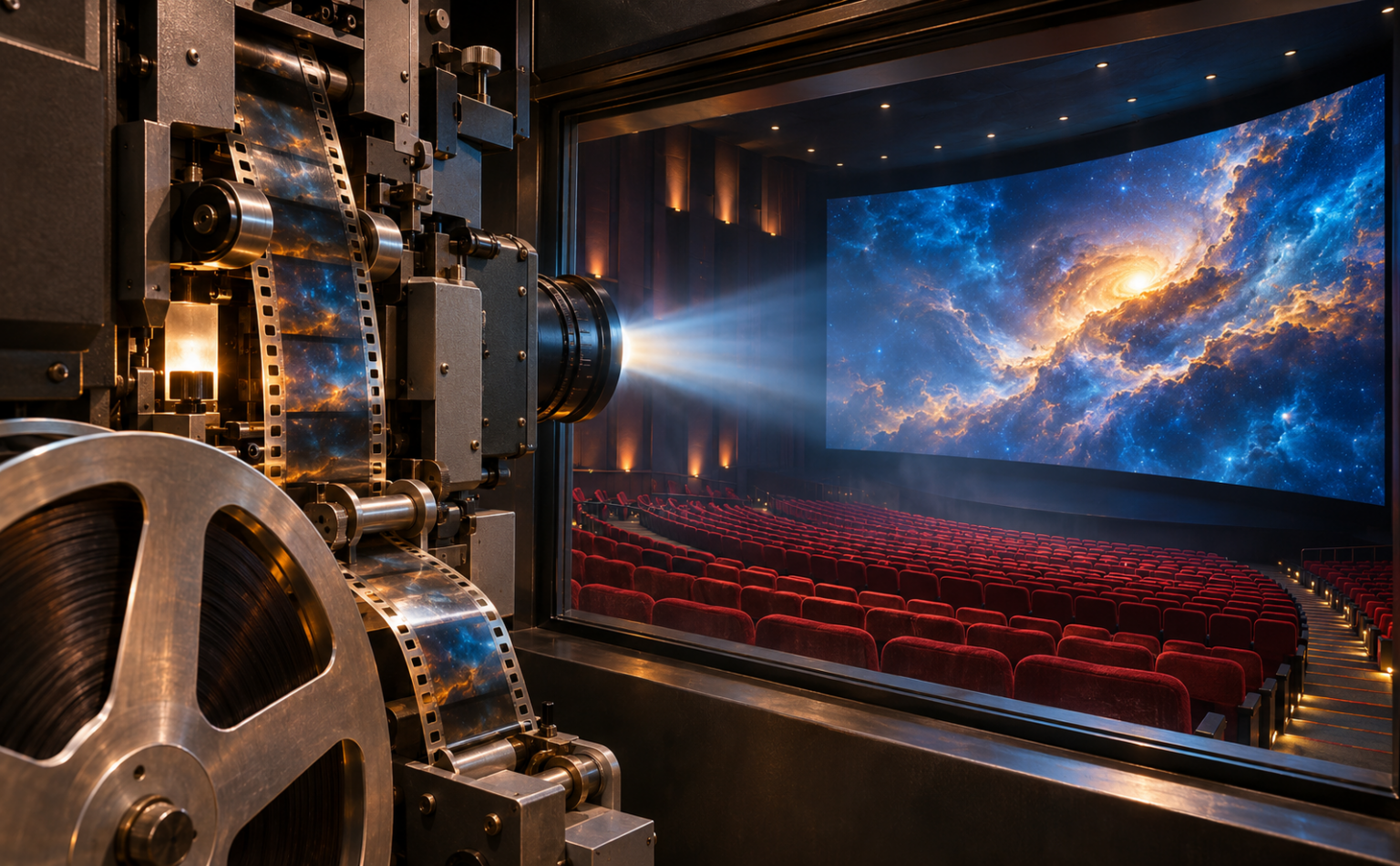
- IMAX 70mm (15/70). The film runs horizontally with 15 perforations per frame. The frame is about three times the size of 5/70 and roughly ten times the size of 35mm.
70mm film vs 35mm vs digital: comparison
| Format | Approx. frame size | Typical aspect ratio | Typical screen | How it’s labeled |
|---|---|---|---|---|
| 35mm film | ~21 × 16 mm | 1.85:1 or 2.39:1 | Standard multiplex | “35mm” (rare today) |
| 5/70 film | ~48.5 × 22 mm | 2.20:1 | Large flat screen | “70mm” |
| IMAX 15/70 film | ~70 × 48.5 mm | 1.43:1 | Very tall, often 5+ stories | “IMAX 70mm” or “IMAX 70mm Film” |
| IMAX with Laser (digital) | N/A (4K digital) | Up to 1.43:1 at select sites | Varies widely | “IMAX with Laser” |
| Standard digital IMAX | N/A (2K digital) | 1.90:1 | Often a converted multiplex screen | “IMAX” |
So is 70mm better than digital? On a giant screen, IMAX 15/70 still resolves more detail than any digital projector in commercial use. Its weaknesses are real, though. Prints pick up scratches and dust as the run goes on, the projectors are heavy and costly to run, and a single print can only play in one auditorium.
Timeline: how 70mm declined and came back
- 1950s–1990s: 70mm was the premium roadshow format. Over time, cheaper 35mm with digital sound replaced it.
- 2012–2015: Digital projection replaced film in most US theaters. Many 70mm projectors were scrapped or stored. In 2015, The Hateful Eight ran a 70mm roadshow in about 100 theaters, many with temporarily installed projectors.
- 2017: Dunkirk had one of the widest 70mm releases in decades, in both IMAX 15/70 and 5/70.
- 2023: Oppenheimer‘s IMAX 70mm shows sold out for weeks and drove a revival of interest in film projection.
- 2024–2025: Repertory runs (including Interstellar‘s IMAX 70mm re-release) and new film-format releases such as Sinners and One Battle After Another kept projectionists busy.
- July 2026: The Odyssey opened in IMAX 70mm on roughly 25–30 US screens, a year after tickets first went on sale.
Next up, Dune: Part Three is scheduled for December 2026 and was filmed with IMAX cameras. Don’t assume it will get 15/70 prints until the venue’s booking page lists that format.
Who is affected: 70 mm film theater locations
The people hit hardest are moviegoers outside major metro areas. Most true IMAX 70mm screens are concentrated in a few states. California has the most, followed by states such as Colorado, Michigan, New York, Tennessee and Texas, which each have more than one. Large regions, including most of the Southeast, have one screen or none.
Traditional 70mm theaters (5/70)
Outside IMAX, a smaller group of theaters keeps 5-perf 70mm projectors and runs film series. Examples include the Egyptian Theatre and TCL Chinese Theatre in Los Angeles, plus repertory houses in New York and Chicago. The volunteer-run Sprocket School wiki and in70mm.com keep state-by-state lists. They are dense, but they are the best place to search for “70mm film theaters near me” when no blockbuster is playing.
How to tell real IMAX 70mm from “LieMAX”
- Read the format label at checkout. Real film shows say “IMAX 70mm” or “70mm Film.” Plain “IMAX” or “IMAX with Laser” means digital.
- Check the screen shape. True IMAX film screens are nearly square (1.43:1) and very tall. A wide, short screen in a multiplex is almost always digital.
- Call the venue. Ask, “Is this showing projected from a 15/70 film print?” Staff at film venues will know the answer immediately.
Official response: why there aren’t more 70mm screens
IMAX has said publicly that it is investing in its film projection fleet, including refurbishing projectors and adding lenses. Even so, expansion is slow, for three reasons:
- Prints are expensive and physically huge. An IMAX 15/70 print of a long feature can run to roughly 11 miles of film and weigh around 600 pounds.
- Projectors are scarce. Most IMAX film projectors in use today were built decades ago. Parts and trained projectionists are limited.
- Booth space. The projectors and platters need booth space most multiplexes no longer have.
During the summer run, MODS responded to demand by adding showtimes, including late-night and early-morning shows. That is the usual pattern: when a film venue sells out, it extends hours rather than adding screens.
South Florida service box: seeing 70mm near you
Venue: AutoNation IMAX Theater, Museum of Discovery and Science, 401 SW 2nd Street, Fort Lauderdale. It is Florida’s only IMAX 70mm film screen, with a five-story-tall screen.
Getting there: The museum is in downtown Fort Lauderdale’s arts district, near Las Olas Boulevard. There is paid garage parking nearby, and the city garage beside the museum fills on weekend evenings. Brightline’s Fort Lauderdale station is a short walk or rideshare away. Tri-Rail riders need a connecting bus or rideshare from the nearest station. Check current parking rates and train schedules before you go.
Tickets: Buy only on the MODS website or at the box office. Prices for 70mm feature films are higher than for documentaries, and museum members often get discounts or early access. Confirm current prices on the booking page, because they change by title.
Verify the format: Make sure the showtime says “70mm.” During some runs, MODS has also played digital showings.
Risk: When shows sell out, resale listings appear on social media and on marketplaces. They are often marked up, and some are fake. Venue-only sales are the safest option.
If it’s sold out: Look for IMAX with Laser or Dolby Cinema in Miami-Dade, Palm Beach, Tampa or Orlando. These look excellent, but they are digital, not film. The nearest IMAX 15/70 alternatives outside Florida require a multi-state trip, so confirm the format with the venue before you book travel.
What happens next
Once a blockbuster’s run ends, 70mm doesn’t disappear. Film venues usually move to repertory screenings, such as Nolan titles, 2001 and Lawrence of Arabia, and to festival programming. To keep track of new screenings:
- Check IMAX’s official location pages and filter for 70mm film.
- Sign up for the MODS newsletter, plus the newsletters of any film-capable theaters you’d travel to.
- Watch the Sprocket School wiki and in70mm.com for 5/70 repertory runs.
For more, see our Entertainment section. If you’re planning a bigger entertainment trip, read what it costs to rent out Disneyland and our guide to the biggest car shows in the US. Florida families can check Thanksgiving 2026 dates and closures. Holiday weekends are popular for big-screen outings, and they sell out fast.
FAQs
How many 70mm movie theaters are there in the US?
During The Odyssey’s July 2026 release, outlets counted roughly 25 to 30 US screens that could project IMAX 70mm film. Counts differ because some lists include only IMAX 15/70 screens, while others include museum domes or traditional 5-perf 70mm houses. Including 5/70 venues pushes the total higher.
Is there a 70mm theater in Florida?
Yes. The AutoNation IMAX Theater at the Museum of Discovery and Science, 401 SW 2nd Street in Fort Lauderdale, is Florida’s only IMAX 70mm film screen. Other Florida IMAX screens use digital laser projection, so check for the “70mm” label on the booking page before you buy.
Is 70mm film better than digital?
On very large screens, IMAX 15/70 film resolves more detail than standard digital projection and has a distinctive organic look. Digital laser projection is brighter, more consistent and never scratches. Film looks best early in a run, before prints wear. Which you prefer comes down to the image quality you value and the screen size.
What is the difference between 70mm and IMAX 70mm?
Standard 70mm (5/70) runs film vertically with five perforations per frame and produces a wide 2.20:1 image. IMAX 70mm (15/70) runs film horizontally with 15 perforations per frame, giving a frame about three times larger and a taller 1.43:1 image made for giant screens.
How can I tell if my IMAX is real 70mm or digital?
Check the format label when you buy tickets. “IMAX 70mm” or “70mm Film” means a film print, while “IMAX” or “IMAX with Laser” means digital. True film screens are usually very tall and nearly square. If in doubt, call the theater and ask whether the show is projected from a 15/70 print.
What is the screen size of a 70mm cinema?
It varies. Traditional 5/70 houses often have large flat screens around 50 to 70 feet wide. IMAX 15/70 screens are typically several stories tall, and some, like Fort Lauderdale’s five-story screen, reach roughly 60 feet high. Digital IMAX screens in multiplexes are often much smaller.