Electric vehicles are no longer a niche experiment. They now shape the direction of the entire automotive industry, yet the brands that define the space are still mostly newcomers. Tesla reshaped public perception of EVs in a way early models like the Nissan Leaf never quite managed, and that moment reset expectations. Traditional automakers, no matter how capable, are often seen as playing catch-up. Volvo understood this shift early, which is why it carved out Polestar as a separate electric-only brand designed to capture the energy and credibility of a startup rather than a legacy manufacturer.
The 2026 Polestar 4 represents a key moment for that strategy. It is the first Polestar that feels visually and conceptually disconnected from Volvo. While that alone earns it attention, standing out in a crowded premium EV market now requires more than bold design choices. With competitors offering strong performance, long range, and refined technology, Polestar needs the 4 to be exceptional rather than just different.
A brand still defining itself
Polestar’s journey has been anything but straightforward. The name originally belonged to a racing outfit that specialized in performance upgrades for Volvo vehicles. After Volvo acquired the company, it briefly served as an in-house performance arm similar to BMW M or Mercedes AMG. When electric vehicles began reshaping the industry, the Polestar name was repurposed yet again, this time as a standalone EV brand backed by Volvo and its parent company Geely.
Early models reflected that transitional phase. The Polestar 1 and the fully electric Polestar 2 were closely tied to Volvo designs, borrowing heavily from existing concepts. Even the Polestar 3, while more distinctive, shares major architecture with the Volvo EX90. That history made it difficult for Polestar to fully separate its identity in markets like the United States.
The Polestar 4 makes the strongest attempt yet to break free. It looks nothing like a Volvo and is built on Geely’s Sustainable Experience Architecture rather than Volvo’s SPA platform. Many of its components originate in China, while final assembly takes place in South Korea. This global production approach was initially intended to sidestep US trade limitations, although recent tariff changes have complicated that strategy.
A vehicle that resists easy labels
Polestar markets the 4 as an SUV coupe, but the description only partially fits. Its low roofline and wide stance give it the presence of a sporty hatchback rather than a traditional SUV. Measuring just over 190 inches long and more than 84 inches wide, it rivals vehicles like the Porsche Macan Electric in footprint, while sitting noticeably lower to the ground.
The most unconventional design choice is the complete absence of a rear window. Polestar argues that removing the glass improves rear-seat headroom and allows for better visibility through a digital rearview mirror system. Cameras provide a clear, unobstructed view that is not affected by passengers or roof pillars. Inside, rear-seat occupants benefit from generous legroom and optional reclining seats, creating a space that feels closer to a luxury sedan than an SUV.
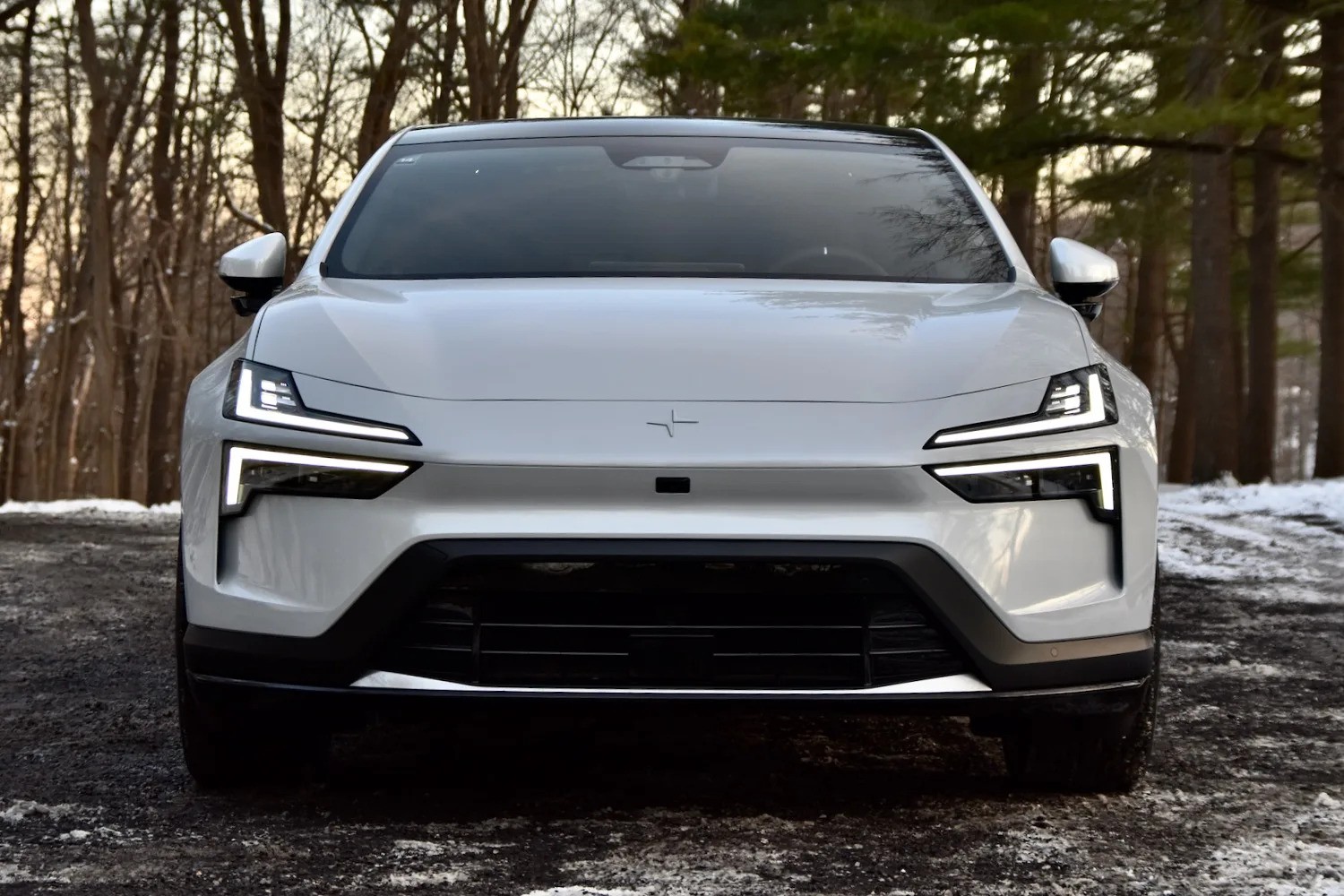
From the outside, however, the missing rear window makes less of a statement than expected. The blank panel where glass would normally sit feels understated rather than dramatic. The front of the vehicle carries more personality, with sharp lighting elements and a sculpted nose that gives the car a futuristic expression. Black plastic trim along the lower body attempts to visually slim the vehicle’s proportions.
Minimalism with trade-offs
Inside the cabin, Polestar leans fully into Scandinavian-inspired minimalism. The design is elegant and visually calming, but practicality sometimes takes a back seat. Materials are thoughtfully chosen, with options that include recycled PET-based upholstery and synthetic alternatives designed to reduce environmental impact. The overall atmosphere feels premium and carefully curated.
That clean aesthetic is achieved by removing most physical controls. There is no traditional start button, as the vehicle activates automatically when you enter. Aside from a large volume dial and a few seat controls, nearly all adjustments are handled through a large central touchscreen. Steering wheel settings, mirror alignment, and air vent positioning all live within the digital interface.
The infotainment system runs on an Android-based platform with built-in Google Maps, Google Assistant, and access to the Google Play Store. Wireless Apple CarPlay is also included, offering compatibility for iPhone users. While the software itself is responsive and familiar to anyone who has used modern Android Auto systems, it is tasked with managing an overwhelming number of functions. Navigating menus while driving can feel distracting, and the lack of tactile feedback highlights the limitations of a screen-first approach.
Touchscreens once symbolized innovation in cars, but they are no longer novel. In many situations, physical buttons remain easier and safer to use. Polestar’s decision to double down on digital controls feels less like bold innovation and more like an attempt to mirror competitors such as Tesla, Rivian, and Lucid without addressing their usability criticisms.
Strong performance paired with modest efficiency
The Polestar 4 is available in both single-motor rear-wheel drive and dual-motor all-wheel drive configurations. Both versions use a 100 kWh battery pack. The single-motor model produces 272 horsepower and accelerates from zero to 60 mph in just under seven seconds. The dual-motor variant delivers a substantial jump in output, producing 544 horsepower and reaching 60 mph in an estimated 3.7 seconds.
On the road, the dual-motor version feels smooth and confidently quick rather than aggressively fast. Acceleration builds in a controlled way that makes it easy to underestimate speed. Handling is similarly composed, with a suspension that keeps the vehicle flat through corners without sacrificing ride comfort. Steering is responsive but lacks meaningful feedback, especially at highway speeds where small inputs can cause noticeable lane movement.
Efficiency is where the Polestar 4 struggles to justify its performance focus. Estimated range sits at around 310 miles for the single-motor version and approximately 280 miles for the dual-motor model. Those figures are underwhelming given the size of the battery. Real-world driving in colder conditions produced even lower efficiency, making range anxiety a legitimate concern for long trips.
Charging speeds are adequate but unremarkable. The Polestar 4 supports DC fast charging up to 200 kW, allowing a 10 to 80 percent charge in roughly 30 minutes under ideal conditions. That lags behind newer 800-volt EVs that can complete the same task significantly faster. At home, an 11 kW Level 2 charger requires roughly 11 hours for a full recharge. Vehicles currently ship with CCS ports, though Polestar is rolling out Tesla Supercharger access through adapters, similar to other manufacturers adopting the NACS standard.
Value that does most of the heavy lifting
Pricing is arguably the Polestar 4’s strongest argument. The single-motor model starts just under $58,000, while the dual-motor version begins around $64,000. Even with optional packages like the Pilot and Plus packs, which add driver assistance features and interior upgrades, the vehicle remains competitive within the premium EV segment.
A well-equipped dual-motor model can approach the low $70,000 range, placing it alongside alternatives like the Cadillac Lyriq V and Porsche Macan Electric. In that context, the Polestar 4 delivers solid performance and upscale design for the money.
What it does not deliver is a clear technological or experiential advantage. The styling is distinctive, but not transformative. The interior feels luxurious, but sacrifices ease of use. Performance is strong, but efficiency and charging speeds lag behind expectations. The Polestar 4 shows ambition and creativity, yet it feels like a vehicle that stops just short of redefining what the brand could be.