Each March, National Nutrition Month tends to bring a familiar rhythm of advice. Eat more of this, cut back on that, start fresh. The tone often leans corrective, as if better health begins with a reset.
There is another way to look at it, one that feels less abrupt and more enduring.
Across Spain, the idea of healthy eating has never been confined to a single month or framed as a temporary shift. It is embedded in daily life, shaped by habits that repeat quietly over time. Meals are built around simple ingredients, prepared with care, and shared without urgency. The approach does not present itself as a system, yet it continues to draw attention from researchers trying to understand why Spain consistently ranks among the world’s healthiest countries.
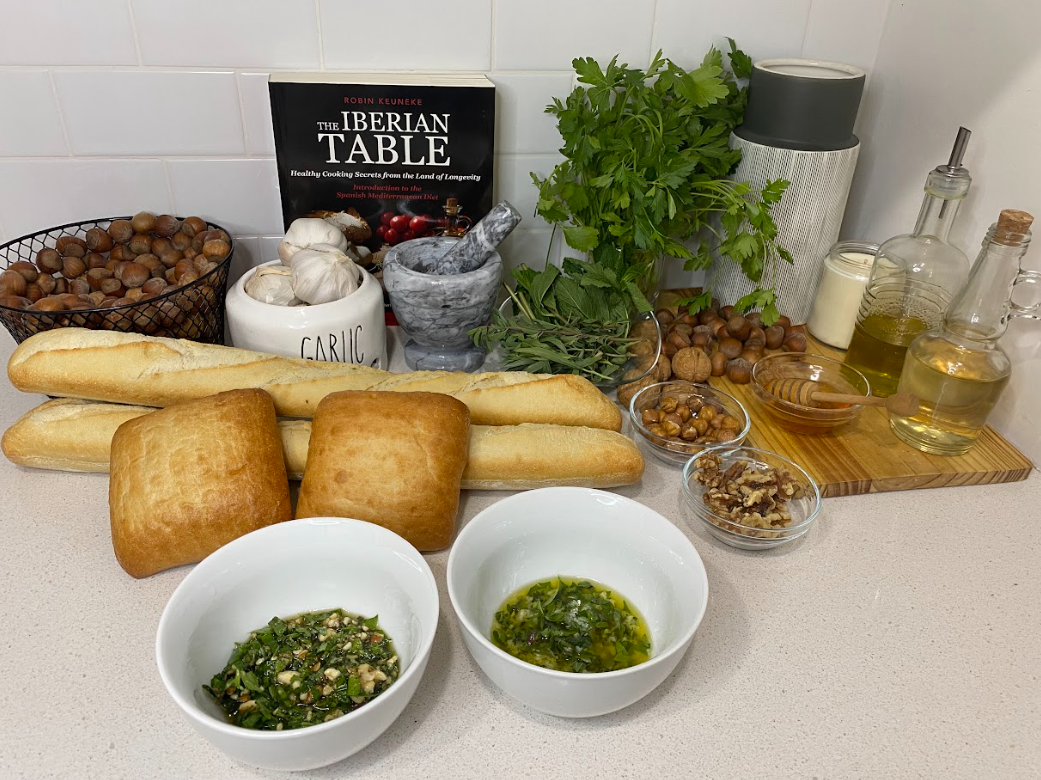
That cultural framework sits at the center of The Iberian Table, a book by author and artist Robin Keuneke. Rather than offering a rigid set of rules, the book explores how Spain’s Mediterranean traditions translate into everyday practice. It moves between recipes, history, and lived experience, tracing a way of eating that prioritizes continuity over correction.
The renewed interest in Spain’s longevity is not abstract. It has been shaped in part by the life of María Branyas Morera, who lived to 117. Researchers studying her pointed to a combination of genetics and environment, but her daily habits reflect something more accessible. Meals grounded in yogurt, fresh produce, olive oil, and time spent eating with others.
There is nothing extreme about that list. That may be the point.
In The Iberian Table, Keuneke returns to these same elements, not as trends but as foundations. Olive oil is used generously, not sparingly. Legumes appear often, providing both substance and balance. Fermented foods like yogurt support digestion in ways that are now widely discussed in scientific terms, though they have long been part of traditional diets.
The recipes themselves are approachable. Many rely on techniques that require more attention than complexity. A pot of lentils simmering slowly, vegetables dressed simply, bread meant to accompany rather than dominate. The focus is less on reinvention and more on refinement.
What stands out is not only what is cooked, but how.
Meals are not designed to be rushed. Lunch can extend, dinner often becomes a social anchor, and the act of cooking is treated as something worth engaging in fully. This pacing shapes how food is experienced, turning eating into something closer to a shared ritual than a transaction.
That distinction matters in a culture where convenience often takes precedence. In the United States, meals are frequently compressed into tight schedules, eaten between commitments, or replaced altogether by something faster. Health, in that context, becomes tied to efficiency, with choices framed around time as much as nutrition.
The Spanish model offers a quiet contrast. It suggests that health is not only a function of what is consumed, but of the conditions surrounding it. Time, attention, and connection become part of the equation.
Keuneke’s work reflects that perspective without overstating it. The book does not position itself as a solution, nor does it frame Spanish traditions as something to replicate exactly. Instead, it presents a set of patterns that can be adapted. Cook more often, rely on whole ingredients, allow meals to unfold, and make space for others at the table.
There is also an emotional dimension that runs through the work. Food is tied to memory, to place, to relationships. Meals carry meaning beyond their nutritional value, which may explain why they are sustained over time. Habits built on enjoyment tend to last longer than those built on restriction.
As National Nutrition Month brings renewed focus to diet, the appeal of this approach becomes clearer. It does not ask for a reset. It asks for attention.
A meal prepared at home, a table shared with others, ingredients chosen with care. These are not dramatic changes, yet they shape health in ways that accumulate quietly.
In Spain, that accumulation has been unfolding for generations. The results are visible not only in data, but in the rhythm of daily life.
For those looking to make changes this March, the lesson may be less about starting over and more about slowing down. Health, in this context, is not something to chase. It is something to build, one meal at a time.