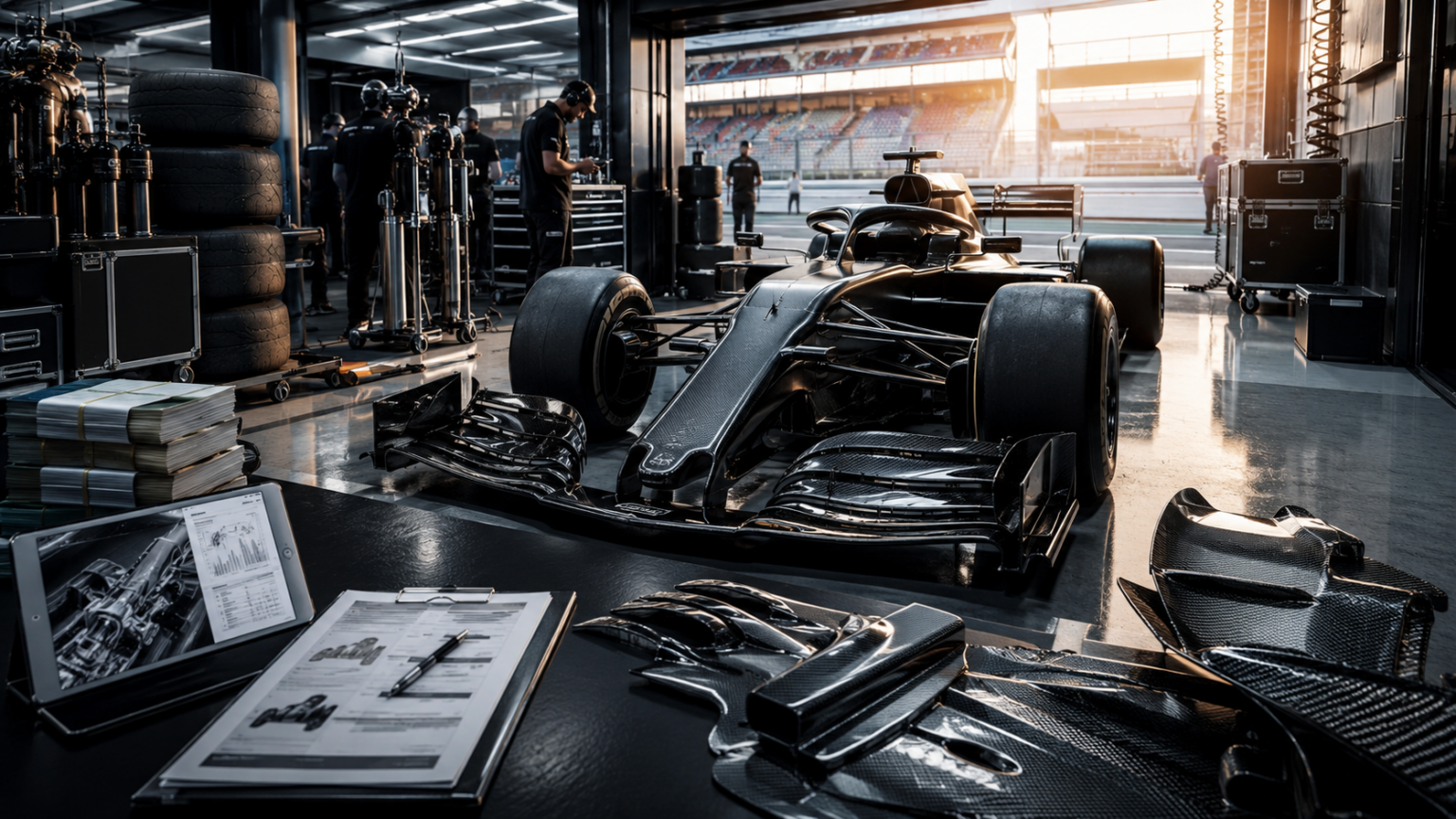
A single 2026-spec Formula 1 car costs roughly $15 million to $22 million to build, with about $16 million being a fair average for a front-running team. That number is the cost to design and manufacture one complete race car — chassis, hybrid power unit, aerodynamics, electronics, the works. It is not the price you’d pay to buy one, and it is not the same as a team’s season budget.
That distinction trips up almost everyone, so we’ll clear it up first, then walk through the build piece by piece, convert the numbers into the currencies people actually search for, and explain whether a regular person can own one. Consider this your practitioner’s guide rather than a spec sheet.
How Much Does an F1 Car Cost?
The short version, up front:
- Build one car (2026 spec): ~$15M–$22M, averaging around $16M.
- Biggest single line item: the hybrid power unit, at $7M–$12M.
- Run a full team for a season: capped at $215 million for 2026 under the FIA cost cap (up from $135M when the cap launched in 2021).
- Buy a retired race car: anywhere from ~$119,000 for a static “show car” to $18M+ for a championship-winning chassis at auction.
So the average cost of an F1 car depends entirely on which question you’re asking. Building one, running a team, and buying one are three very different price tags — and conflating them is the single most common mistake we see.
What Actually Goes Into an F1 Car’s Price
An F1 car is roughly 14,000–20,000 individual components, but the cost concentrates in a handful of systems. Here’s where the money goes on a single grand prix car.
Power unit — $7M to $12M
The 1.6-litre turbo-hybrid V6 plus its energy recovery systems (ERS) is the most expensive part of the car by a wide margin. Only four manufacturers build them — Ferrari, Mercedes, Honda/Red Bull Powertrains, and Audi for 2026 — and customer teams effectively lease them for around $10M–$15M per season, covering multiple units.
Chassis/monocoque — $650K to $1.5M+
The carbon-fibre survival cell is molded, baked in an autoclave, and crash-tested to FIA standards before it ever turns a wheel. It’s the structural heart of the car and the reason drivers walk away from 40G impacts.
Aerodynamics package — $2M+ across the season
Front and rear wings run roughly $150K–$300K each, and teams build many iterations. Add the floor, diffuser, bargeboards and endplates, and aero becomes a rolling development cost rather than a one-time buy.
Gearbox, suspension, brakes — $600K to $1M
The eight-speed carbon-cased gearbox alone runs several hundred thousand dollars. Carbon-carbon brake discs cost more than a family car and last a single weekend.
Electronics and steering wheel — $50K to $100K
The steering wheel is a bespoke command center — dozens of buttons, a display, clutch paddles — and typically costs $50,000 or more on its own.
How an F1 Car Is Built and Priced
The “how much does a F1 car cost to make” question makes more sense as a process. Here’s the build sequence, and where cost accrues at each stage.
- Design and simulation. Engineers run thousands of CFD iterations and wind-tunnel hours — both strictly rationed by regulation, so this phase is as much about spending your allocation wisely as spending money.
- Chassis manufacturing and crash testing. The monocoque is laid up, cured, and subjected to mandatory FIA impact and load tests. Fail one, and you rebuild — expensively.
- Power unit integration. The engine (often supplied by a separate manufacturer) is packaged with cooling, the fuel system, and ERS. Integration is where a good chassis wins or loses a tenth.
- Aero fabrication and iteration. Wings, floors, and bodywork are fabricated, tested, and re-fabricated. This never really stops — teams bring upgrades to most races.
- Final assembly and testing. Everything comes together, then heads to pre-season testing, where reliability problems get very costly, very fast.
- In-season upgrades. This is the hidden multiplier. The “$16M car” quietly becomes far more expensive as new parts flow in all year — which is exactly why the season cost cap exists.
Build vs. Season vs. Buying One
Here’s the clean comparison most guides skip. Three different questions, three different answers.
| What you’re paying for | Approximate cost (USD) |
|---|---|
| Build one F1 car (2026 spec) | $15M–$22M |
| Run a full team for a season (FIA cost cap) | $215M |
| Power unit alone | $7M–$12M |
| Buy a static “show car” (non-running) | ~$119,000 |
| Buy a retired race-used car at auction | $1M–$18M+ |
How much does a F1 car cost in rupees, pounds and rand
Plenty of people search the average cost of an F1 car in their own currency. Using a ~$16M average build cost and mid-2026 rates, that’s roughly:
| Currency | Approx. average build cost |
|---|---|
| US Dollars (USD) | $16 million |
| British Pounds (GBP) | £12.5 million |
| Indian Rupees (INR) | ₹133 crore (₹1.33 billion) |
| South African Rand (ZAR) | R290 million |
Rates move daily, so treat these as ballpark conversions, not quotes.
How much is a Formula One car worth at auction?
Collector value is a different market entirely. A 2013 Lewis Hamilton Mercedes W04 sold for $18.8 million in 2023 — a record for a modern F1 car. Championship-pedigree chassis command the premium; a generic retired car with no title history sells for far less. And a “show car” — a display shell with no engine — goes for around $119,000 and cannot be driven.
Grand Prix car cost vs. NASCAR and IndyCar
For context on why F1 sits in its own tier: a NASCAR Cup car costs roughly $200,000–$500,000, and an IndyCar around $1M–$3M fully built. So how much a Grand Prix car costs isn’t close — an F1 car’s power unit alone costs several times a complete NASCAR machine. It’s a useful reference point if you’re deciding where to spend a big-ticket budget on an experience versus following the racing.
Common Mistakes People Make Estimating F1 Car Costs
- Confusing the $215M cost cap with the price of one car. The cap covers a whole team’s season — two cars, development, most staff. One car is a fraction of it.
- Assuming a show car is race-ready. That $119K “F1 car” for sale is usually a hollow display body. It won’t start, let alone race.
- Thinking every team builds its own engine. Most customer teams lease power units from a manufacturer. Only a handful build in-house.
- Ignoring in-season upgrades. The build cost is a starting line, not a finish line. Development parts add millions across a season.
- Believing you can buy a current-season car. You can’t. Teams don’t sell active machinery, and the IP is protected.
A Florida note: getting close to the cars
You can’t buy one, but you can stand next to them. The Miami Grand Prix at Hard Rock Stadium each May is the closest most Floridians get to a current F1 car, and several simulator venues around Miami and Orlando let you “drive” one for the price of dinner. If you’re planning a race-weekend trip, our guide to stretching a big budget in Florida pairs well with a Miami GP itinerary.
The Bottom Line
If someone asks how much a F1 car costs and you want the honest one-line answer: about $16 million to build one, up to $215 million to run the team around it, and effectively priceless if it won a championship. The number you quote just depends on which of those three you actually mean. For more real-world price breakdowns, browse our Automotive coverage.
FAQs
What is the average cost of an F1 car?
The average cost of an F1 car to build in 2026 is around $16 million, within a range of roughly $15M–$22M. That figure covers one complete car — chassis, hybrid power unit, aero, and electronics — but not the team’s full season budget.
How much does a Grand Prix car cost compared to NASCAR or IndyCar?
A Grand Prix (F1) car costs $15M–$22M to build. By comparison, a NASCAR Cup car runs $200,000–$500,000 and an IndyCar about $1M–$3M. An F1 power unit alone costs several times a complete NASCAR car.
How much is a Formula One car worth at auction?
Championship-winning cars command the most — a Lewis Hamilton Mercedes W04 sold for $18.8 million in 2023. Generic retired cars sell for $1M and up, while a non-running static show car goes for around $119,000.
How much does an F1 engine (power unit) cost?
The hybrid V6 turbo power unit is the single most expensive part, at roughly $7M–$12M. Customer teams typically lease power units for around $10M–$15M per season, covering multiple units allowed under the rules.
Can a regular person buy an F1 car?
Not a current-season one — teams don’t sell active machinery. You can buy retired race cars at auction (prices from about $1M to $18M+) or a non-running show car for roughly $119,000, but a show car cannot be driven.
Why are F1 cars so expensive?
Each car has 14,000–20,000 bespoke components, a $7M–$12M hybrid power unit, crash-tested carbon-fibre construction, and constant in-season aerodynamic development. Almost nothing is off-the-shelf, and the engineering is at the outer edge of what’s technically possible.