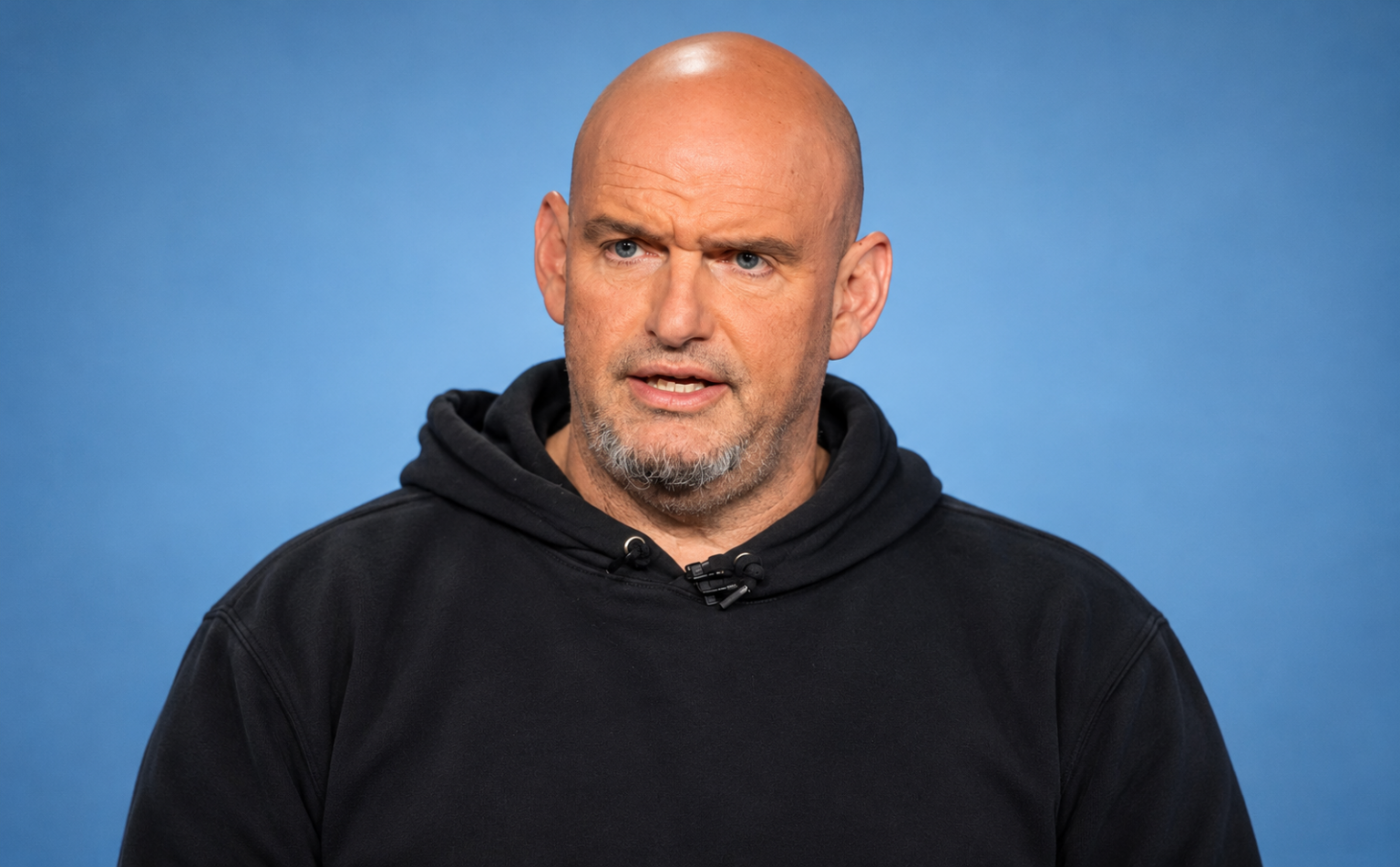
Short answer: John Fetterman is still a Democrat. He was elected to the U.S. Senate from Pennsylvania as a Democrat in 2022 and still caucuses with Senate Democrats. What has changed is that he has now publicly said where his breaking point is.
In a recent Fox News interview, Kayleigh McEnany asked Fetterman whether anything would make him leave the Democratic Party. He answered “Yeah, absolutely” and named one scenario: Sen. Chris Van Hollen of Maryland being elected leader of Senate Democrats. Newsweek, the Daily Beast and Middle East Eye all reported the exchange. Fetterman’s objection is Israel. Van Hollen is one of the Senate’s most prominent critics of the Israeli government’s conduct of the Gaza war, and Fetterman is one of Israel’s most outspoken defenders in either party.
This matters because it is the first time Fetterman has tied his party label to a specific condition. Before this, his line was that he was “not going to switch.” Now it depends on who runs the caucus, and Senate Democrats will be choosing their leadership after the 2026 midterms.
What isn’t confirmed: Fetterman has not filed to change his party registration, announced that he will become an independent or begun talks to join the Republicans. Treat any headline that says otherwise with caution.
The friction points behind the tension
The Van Hollen comment is the latest flashpoint, not the first. The tension between Fetterman and the Democratic Party has built up over several issues.
- Israel and Gaza. Since October 2023, Fetterman has backed Israel’s military campaign without reservation. He has criticized fellow Democrats who called for conditions on aid or a ceasefire.
- Iran war powers. In June 2025 he was the only Senate Democrat to vote against Sen. Tim Kaine’s resolution to limit military action against Iran without congressional approval.
- Government funding. In the March 2025 funding fight and again during the fall 2025 shutdown, he voted with Republicans to advance GOP stopgap bills. He argued that shutdowns hurt the workers Democrats say they protect.
- Immigration. He co-sponsored the Laken Riley Act in January 2025. He has also declined to join the party’s harshest criticism of immigration enforcement and ICE.
- Tone toward Trump. He met with President-elect Trump at Mar-a-Lago, appears often on Fox News, and has said Democrats lose voters when they treat every Trump move as a crisis.
Fetterman’s own description has stayed the same throughout. He calls himself “an independent voice in the Democratic Party” and a “lifelong Democrat who votes overwhelmingly with my party.” On most core economic votes, including labor, the minimum wage and health care, that is still true.
Timeline of the Fetterman–Democrat rift
- Nov. 2022: Fetterman beats Mehmet Oz for Pennsylvania’s open Senate seat. He runs as a progressive-leaning populist.
- Oct. 2023 onward: He breaks sharply with the party’s left wing over Israel and Gaza.
- Jan. 2025: He co-sponsors the Laken Riley Act, the first bill Trump signs in his second term.
- March 2025: He votes for the GOP stopgap funding bill.
- June 2025: He is the lone Democrat to oppose the Iran war-powers resolution.
- Fall 2025: During the government shutdown, he repeatedly votes to advance Republican funding bills. In interviews he says he is “not going to switch” parties.
- May 8, 2026: A USA Today opinion column weighs his reelection prospects and the chance of a Democratic primary challenge.
- Sept. 14–15, 2026: NPR reports that Pennsylvania Democrats’ frustration with his performance is “boiling over.” Axios Pittsburgh explains why state Democrats aren’t punishing him.
- Nov. 2, 2026: The Washington Times reports that Fetterman “casts a big shadow” over the midterms.
- Mid-Nov. 2026: On Fox News, he says he would “absolutely” consider leaving the party if Van Hollen becomes Democratic leader.
Why isn’t Fetterman kicked out of the Democratic Party?
This is the question people search for most, and the answer comes down to mechanics, not willpower. No one has the power to do it in any way that would matter.
Parties don’t own Senate seats
Party membership in the U.S. is mostly self-declared. You become a Democrat by registering as one. The Democratic National Committee and the Pennsylvania Democratic Party cannot take away Fetterman’s seat, his vote or his title. His seat belongs to Pennsylvania voters until his term ends in January 2029.
Senate expulsion is a different and much higher bar
Under Article I, Section 5 of the Constitution, the Senate can expel a member only by a two-thirds vote. It has done so 15 times, and 14 of those cases involved senators who supported the Confederacy in 1861–62. Disagreeing with your party has never been grounds for expulsion and almost certainly never will be.
What the party can do, and why it hasn’t
Senate Democrats control their own internal benefits, mainly committee assignments and leadership roles, and could in theory take them away. State parties can decline to endorse him, withhold money or recruit a primary challenger. These steps rarely happen, for practical reasons:
- Every seat counts. A senator who votes with you most of the time is worth far more than one you push into the other caucus.
- Leadership wants him to stay. According to Axios, Chuck Schumer and Vermont Sen. Peter Welch have publicly said they want Fetterman in the caucus.
- Punishment can backfire. Pressuring a senator to leave is the quickest way to make him leave.
- He isn’t on the ballot until 2028. Voters, not party officials, get the real say in a primary.
Commentators also speculate about his motives. A Duquesne University professor quoted in coverage of the rift suggested he may be building a post-Senate media career. That is opinion, not reporting, and Fetterman has not said anything like it.
Who is affected
Senate Democrats
The red line puts pressure on the leadership race. Senators who back Van Hollen now have to weigh whether his election could cost them a member. A Fetterman exit would also force committee rosters and ratios to be renegotiated.
Pennsylvania Democrats and voters
Local party leaders are angry. NPR quoted officials including Lehigh County Democratic Chair Lori McFarland. Ahmed Moor, a Palestinian American writer, has emerged as a potential primary challenger for 2028. Many Pennsylvania voters who backed Fetterman in 2022 as a progressive say they don’t recognize his current positions. Others, especially in swing counties, like his independent streak.
Republicans
Senate Majority Leader John Thune and other Republicans have publicly said Fetterman would be welcome. Any GOP effort to recruit him gets easier if he is openly at odds with Democratic leadership.
A brief Florida note
Florida’s two senators are Republicans, so the Fetterman story doesn’t change the state’s own delegation. It does affect Senate control, which shapes the issues Florida readers follow closely, such as disaster aid, flood insurance and the confirmation of federal judges and appointees. A single seat changing sides can decide which party sets the Senate’s agenda.
Official response
- Fetterman: He describes himself as a “lifelong Democrat who votes overwhelmingly with my party” and has repeatedly said the party should not punish independent thinking.
- Senate Democratic leadership: Schumer and Welch have earlier said on record that they want him in the caucus, according to Axios. As of publication, we have not seen a formal leadership statement responding to the Van Hollen comment.
- Chris Van Hollen: We found no direct public response to Fetterman’s red line at publication time.
- Pennsylvania Democratic Party: Individual county chairs have criticized him. The state party has not taken formal disciplinary action.
For flag-related updates tied to Senate news, such as when Congress orders flags lowered, see our guide to flag etiquette and the half-staff rules.
What happens next
The next trigger is the Senate Democratic leadership vote. If Van Hollen doesn’t win, the red line may never be tested. If he does, Fetterman has three realistic options:
| Scenario | What changes | Precedent |
|---|---|---|
| Stays a Democrat | Nothing formal. The friction continues, and a 2028 primary becomes more likely. | Joe Manchin, for most of his career |
| Becomes an independent who caucuses with Democrats | His label changes, but his committee seats and votes on organizing the Senate likely stay the same. | Kyrsten Sinema and Joe Manchin, 2022–2024 |
| Joins the Republican conference | Committee ratios shift. In a closely divided Senate, control could change. | Jim Jeffords (R to I) in 2001 flipped the Senate. Arlen Specter of Pennsylvania (R to D) in 2009. |
The Specter example is the one Pennsylvania voters remember. He switched parties to avoid a primary he expected to lose, then lost the Democratic primary anyway in 2010. Changing parties doesn’t fix a problem with your own voters.
Some outlets, including Newsweek, have speculated that Fetterman could even be a future Republican presidential contender. There is no evidence he is pursuing that, and it should be read as speculation.
His seat is next up in November 2028, with the Pennsylvania primary in spring 2028. Until then, the most likely outcome is the one we’ve seen for two years: a Democrat in name and on most votes, who breaks loudly with his party on Israel, immigration and shutdown tactics.
We’ll update this page as the leadership race moves. For more on civic customs around service and public office, see our explainer on what to say on Veterans Day.
FAQs
Is John Fetterman a Republican or a Democrat?
He is a Democrat. Fetterman was elected to the Senate from Pennsylvania as a Democrat in 2022 and still caucuses with Senate Democrats. He has said he might leave if Chris Van Hollen becomes Senate Democratic leader, but he has not switched.
Why is Fetterman not kicked out of the Democrats?
Parties can’t remove a senator from office, and party membership is self-declared. The Senate can expel a member only by a two-thirds vote, which has never been used over policy disagreements. Democratic leaders also want to keep his vote, since he still sides with the caucus on most issues.
Can a political party expel a senator?
Not from the Senate. A party caucus can take away internal benefits such as committee seats or leadership roles, and a state party can refuse to endorse him or back a primary challenger. Only the full Senate, by a two-thirds vote, can expel a member.
Does Fetterman vote with Democrats?
Mostly, yes, especially on economic, labor and health care votes. His high-profile breaks have come on Israel, the 2025 Iran war-powers resolution, GOP stopgap funding bills and some immigration measures such as the Laken Riley Act.
What would happen to the Senate if Fetterman switched parties?
If he became an independent who still caucuses with Democrats, little would change in practice. If he joined Republicans, committee ratios would shift, and in a closely divided Senate control could change, as it did when Jim Jeffords left the GOP in 2001.
When is Fetterman up for reelection?
His current term ends in January 2029, so his seat is on the November 2028 ballot, with Pennsylvania’s primary in spring 2028.