Solar panels have always been about performance, not appearance. But a new breakthrough suggests that may finally change. By blending energy production with visual flexibility, researchers have created a type of solar technology that could transform how buildings generate power and how solar installations look in everyday spaces.
The development comes from scientists at the Hebrew University of Jerusalem, whose work was recently detailed in research published via EES Solar. Their team has produced semi-transparent, flexible perovskite solar cells using advanced 3D printing techniques. What makes them stand out is their ability to display adjustable colors and light transmission while still producing electricity.
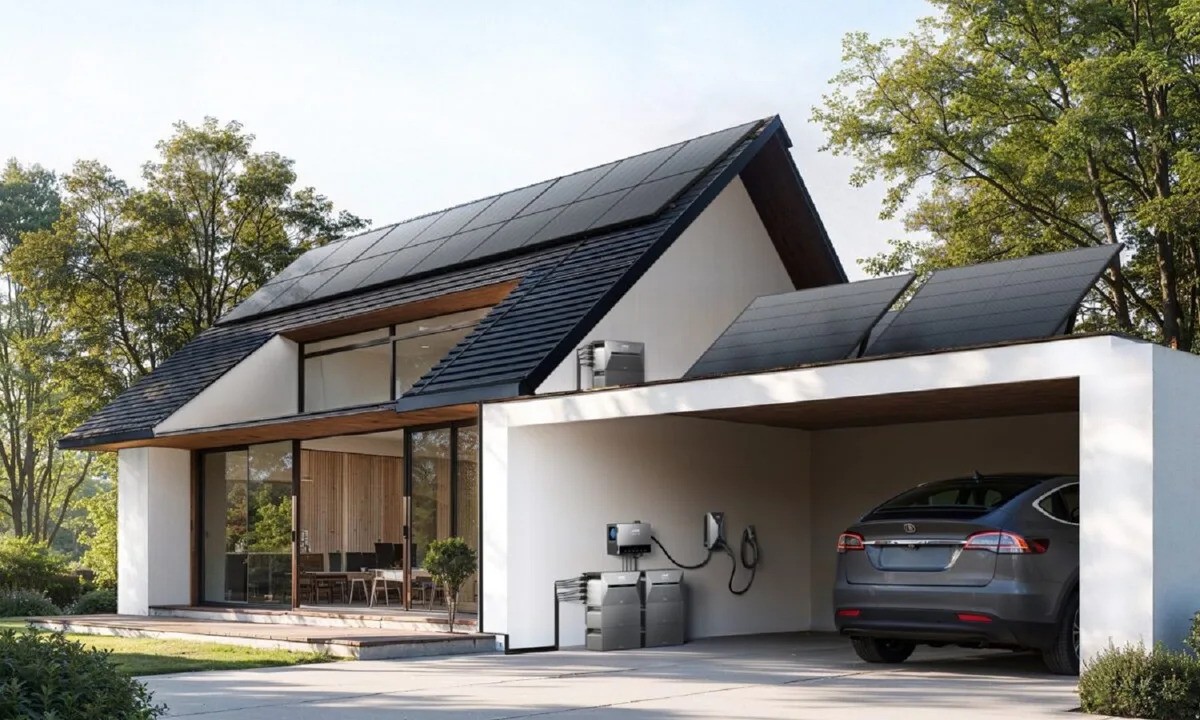
Most solar panels today come in familiar shades of blue, dark gray, or black. That uniform design works fine on rooftops that remain mostly out of sight. However, when solar panels are installed on visible parts of buildings, they often clash with architectural design. This challenge affects cities worldwide, where space limitations demand solar solutions that work on windows, facades, and walls without disrupting visual harmony.
Solar cells were never intended to serve as design elements. Their purpose has always been simple: absorb sunlight and convert it into usable energy. The researchers behind this project are rethinking that idea entirely. Their goal is to create solar materials that integrate naturally into modern buildings, enhance aesthetics, and expand where renewable energy can be generated.
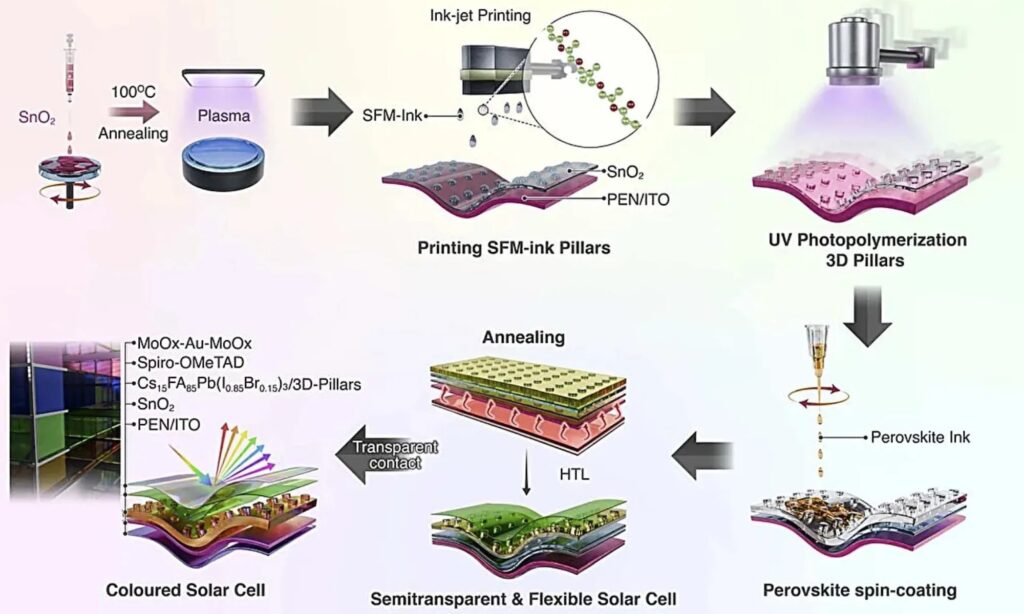
At the core of this innovation are perovskite solar cells, a class of materials already known for efficient light absorption and strong energy conversion potential. Instead of using flat layers like traditional panels, the researchers 3D printed the perovskite into microscopic vertical pillars. The structure resembles a dense forest of tiny columns, each designed to capture light from multiple angles.
By modifying the height, spacing, and density of these micro-pillars, the team can control how much light passes through the material. This allows the solar cells to remain partially transparent, making them suitable for windows and glass surfaces. At the same time, the unique arrangement reflects and absorbs specific wavelengths of light, giving the material visible color without relying on dyes or coatings.
The design offers another major advantage: flexibility. Because the solar layer is no longer a rigid sheet, it can bend and flex without cracking. That opens the door to applications on curved walls, architectural facades, and surfaces where traditional panels would fail. The material can even be printed directly onto glass or other non-flat structures while continuing to generate electricity.
This level of customization means solar installations could be tailored to match a building’s design language, color palette, or even decorative themes. Homes, offices, hotels, and commercial buildings could adopt solar technology without compromising their appearance. Glass-heavy architecture, in particular, could benefit from windows that quietly produce energy throughout the day.
The concept also raises interesting possibilities beyond buildings. For example, the same technology could potentially be applied to vehicle windows, generating enough power to support small onboard electronics or charge portable devices. It could also reduce the need for large, visually dominant rooftop panels, as energy generation shifts into surfaces already built into structures.
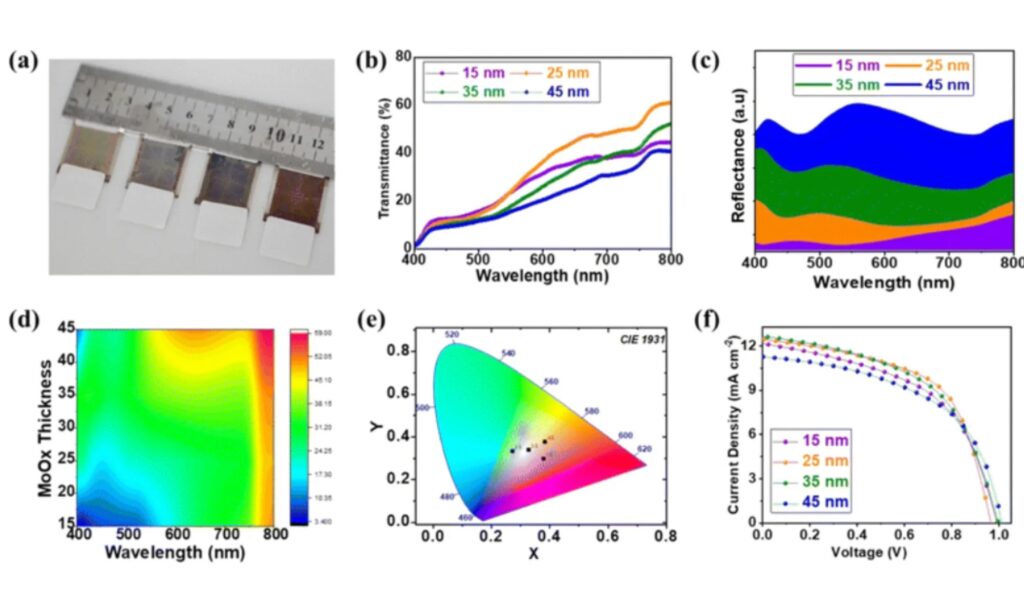
In practical terms, this material behaves both as a light-absorbing energy source and as an architectural feature. Laboratory testing shows the flexible solar cells can reach power conversion efficiencies of up to 9.2 percent while maintaining an average visible transparency of around 35 percent. The vertically structured perovskite has also demonstrated stable performance during prolonged use and repeated bending, suggesting it can withstand real-world conditions.
While these results are promising, there is still work ahead. Traditional solar panels currently deliver higher efficiency, which remains a key factor for widespread adoption. The research team is focusing on improving durability and long-term performance to ensure the technology can handle years of exposure in outdoor environments.
Once those challenges are addressed, this approach could move beyond laboratory experiments and into urban landscapes. Buildings may one day generate clean energy through colorful windows and facades that blend seamlessly into their surroundings, reshaping how renewable power fits into everyday life.