As NASA moves closer to its long-awaited return to the Moon, a major piece of the puzzle is finally taking shape. Axiom Space has released fresh footage highlighting its next-generation lunar spacesuit, giving the public a closer look at how astronauts will move, work, and explore on the Moon during upcoming missions.
The timing is deliberate. NASA is preparing for the Artemis II mission, which will send four astronauts on a crewed journey around the Moon, setting the stage for what comes next. That next step is Artemis III, a mission planned no earlier than 2027, which aims to place humans on the lunar surface for the first time since the Apollo era ended in 1972.
Axiom Space has been selected by NASA to design and build the new spacesuit that astronauts will wear during those historic surface walks. Known as the AxEMU, the suit represents a clear shift away from the restrictive designs of earlier lunar gear. In a newly shared video, the company demonstrates just how far mobility has come, including movements that would have been nearly impossible in older suits.
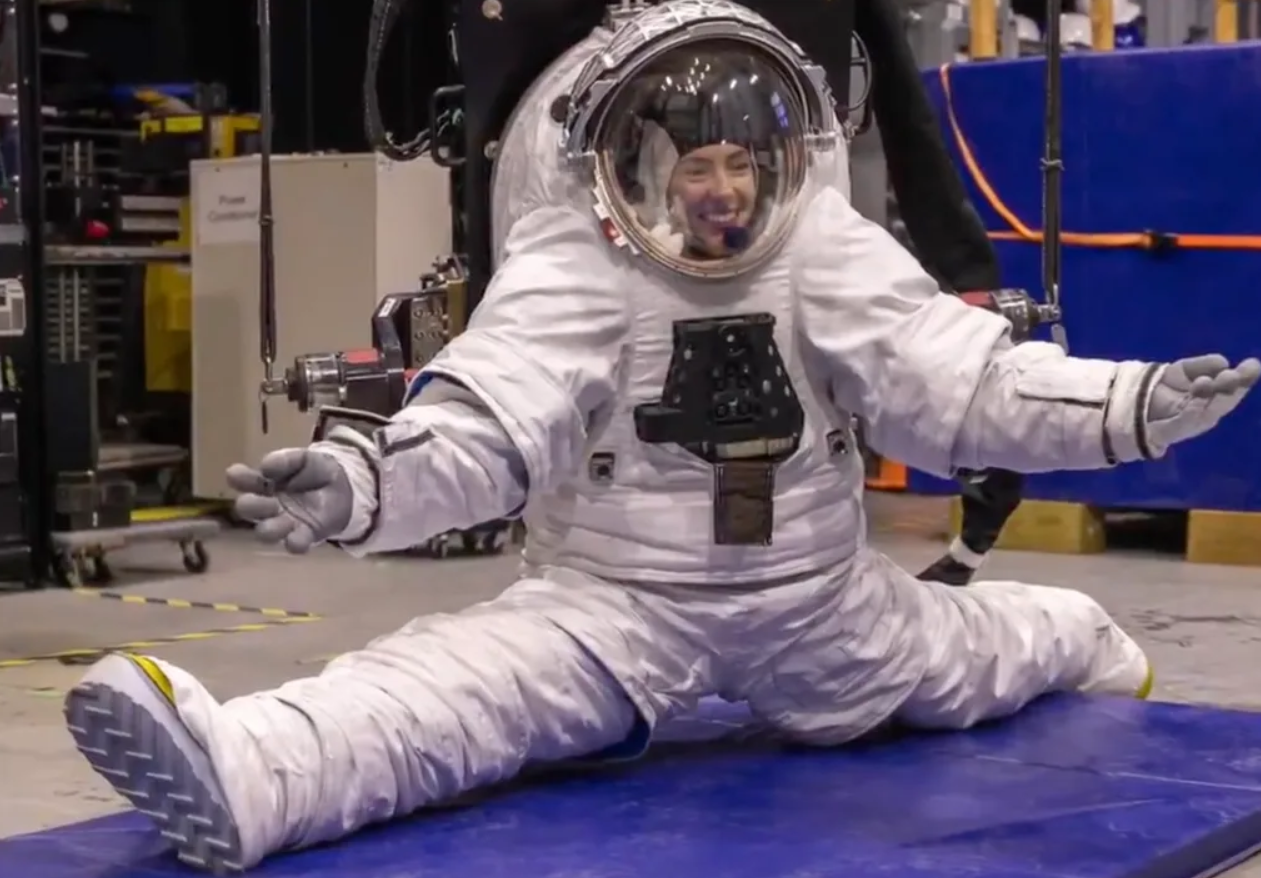
According to Axiom Space, improved freedom of motion sits at the core of the AxEMU design. Enhanced joint flexibility allows astronauts to bend, squat, kneel, and reach with far greater ease, making it easier to collect samples and navigate uneven terrain. To underline that progress, the company even shared an image showing the wearer performing a full split, a visual reminder of how much range the suit provides compared to the stiff Apollo-era alternatives.
Weight reduction is another meaningful improvement. The AxEMU weighs around 20 pounds less on Earth than the spacesuits used during the Apollo missions. While that difference may sound modest, it becomes more noticeable under the Moon’s weaker gravity, helping astronauts move more efficiently during long surface excursions.
Endurance has also been extended. The new suit supports up to eight hours of lunar surface activity, surpassing the four-to-seven-hour operational window of older designs. This increase is made possible by a redesigned life support backpack, which includes upgraded cooling, air circulation, and systems for delivering food and water. Longer time outside the lander means more science, exploration, and flexibility during each mission.
The AxEMU is being built to operate in one of the harshest environments astronauts have ever faced. Missions are expected to target the Moon’s south pole, where temperatures swing dramatically and sunlight behaves differently than at equatorial sites. Axiom Space says the suit is engineered to handle these extremes while also protecting astronauts from abrasive lunar regolith, the fine dust that coats the surface and can damage equipment over time.
On its official site, Axiom Space describes the spacesuit program as a key step in strengthening long-term exploration efforts, not just on the Moon but across the wider solar system. The company positions the AxEMU as a modern evolution of proven designs, blending lessons from Apollo with new materials, technology, and engineering approaches.
While Axiom Space focuses on spacesuits, NASA is also relying on SpaceX to deliver astronauts to the lunar surface using the Starship spacecraft. Progress on that vehicle remains closely watched, as delays or technical challenges could affect Artemis III’s schedule. The coming year is expected to be especially important for Starship testing, with each milestone playing a role in determining when humans can once again walk on the Moon.
Together, the new spacesuit and upcoming missions highlight how much lunar exploration has evolved. Compared to the early days of Apollo, today’s technology is designed to support longer stays, more ambitious science goals, and safer operations in one of the most demanding environments humans have ever explored.