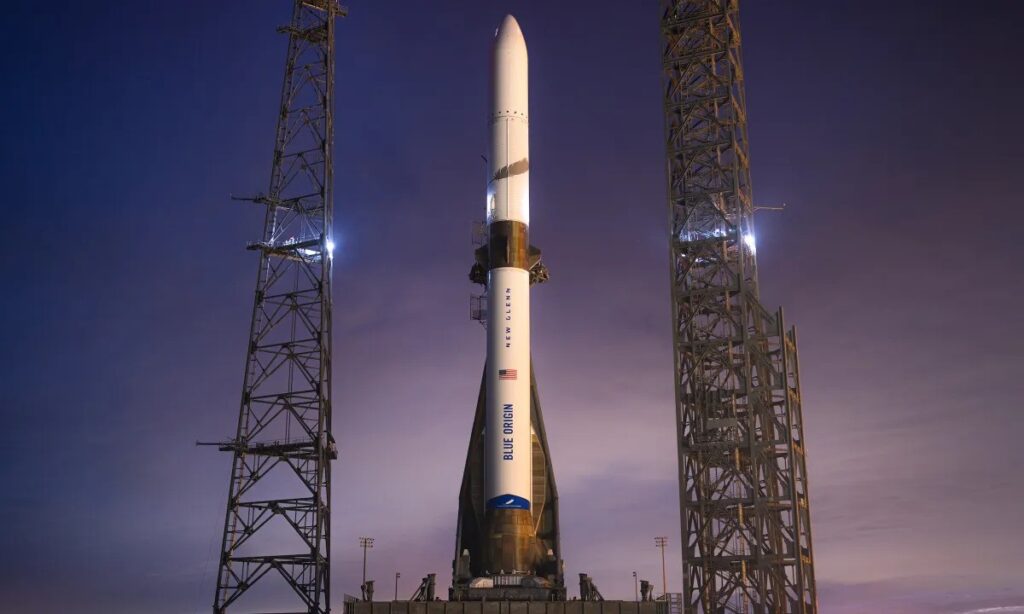
Blue Origin was set to ignite fresh momentum in deep-space exploration with the launch of NASA’s ESCAPADE mission, but an unexpected force stepped in at the last moment. This time, the delay didn’t come from storms along Florida’s coastline or strong surface winds at Cape Canaveral. The real threat was unfolding 93 million miles away.
The private spaceflight company had already regrouped from a scrubbed attempt earlier in the week due to Earth weather. By Wednesday, the New Glenn rocket was ready and the mission team had every indication that the long-awaited Mars spacecraft would finally begin its journey. Instead, Blue Origin hit pause after monitoring a surge in solar activity that raised concerns for ESCAPADE’s safety.
In a post shared on X, the company explained that the rocket was fully prepared for liftoff, but the mission would stand down because of “highly elevated solar activity and its potential effects on the ESCAPADE spacecraft.” Solar behavior can shift quickly, so the teams are now waiting for calmer conditions, which may take several days.
The warning signs came from intensified activity on the sun involving two powerful coronal mass ejections. CMEs are colossal bursts of magnetized plasma that shoot from the sun’s outer atmosphere into space. According to the National Oceanic and Atmospheric Administration, these eruptions can launch billions of tons of solar material at incredible speed, sometimes directly toward Earth. Major space-weather events can interfere with satellites, GPS systems, and even electrical grids. Over the years, researchers at organizations like NASA’s Space Weather Prediction Center, have continued to study how these storms affect modern infrastructure.
The current geomagnetic storm impacting Earth is being called a “cannibal” solar storm because a faster eruption overtook an earlier one, creating a merged, more intense wave of charged particles. The result has been visible around the world. Dazzling auroras swept unusually far south, with sightings reported as far as Alabama. The NOAA issued a G4 storm watch, placing the event among the stronger categories of geomagnetic activity.
The long-term effects on satellites and power systems are still being assessed, but recent history shows the risks are real. In 2022, SpaceX lost roughly 40 newly launched Starlink satellites after a geomagnetic storm increased atmospheric drag, pulling them out of orbit faster than expected. More on that incident can be found here.
This atmospheric expansion is a side effect of solar storms. As the upper layers of Earth’s atmosphere heat and swell, low-Earth orbit satellites face more resistance, which can lead to orbit decay. With ESCAPADE designed to perform sensitive scientific measurements, it makes sense that mission planners would err on the side of caution.
ESCAPADE is NASA’s first Mars mission in five years, and it aims to study the planet’s magnetosphere with two identical spacecraft to better understand how solar wind interacts with its atmosphere. The data could help scientists paint a clearer picture of how Mars changed over billions of years, and how habitable environments evolve on rocky planets.
For now, the mission waits on the sun. Blue Origin and NASA will resume launch operations when solar conditions stabilize and the risks to hardware diminish. Given the stakes, the delay underscores how even the most advanced technology must still answer to space weather, one of the most unpredictable forces shaping our journey beyond Earth.