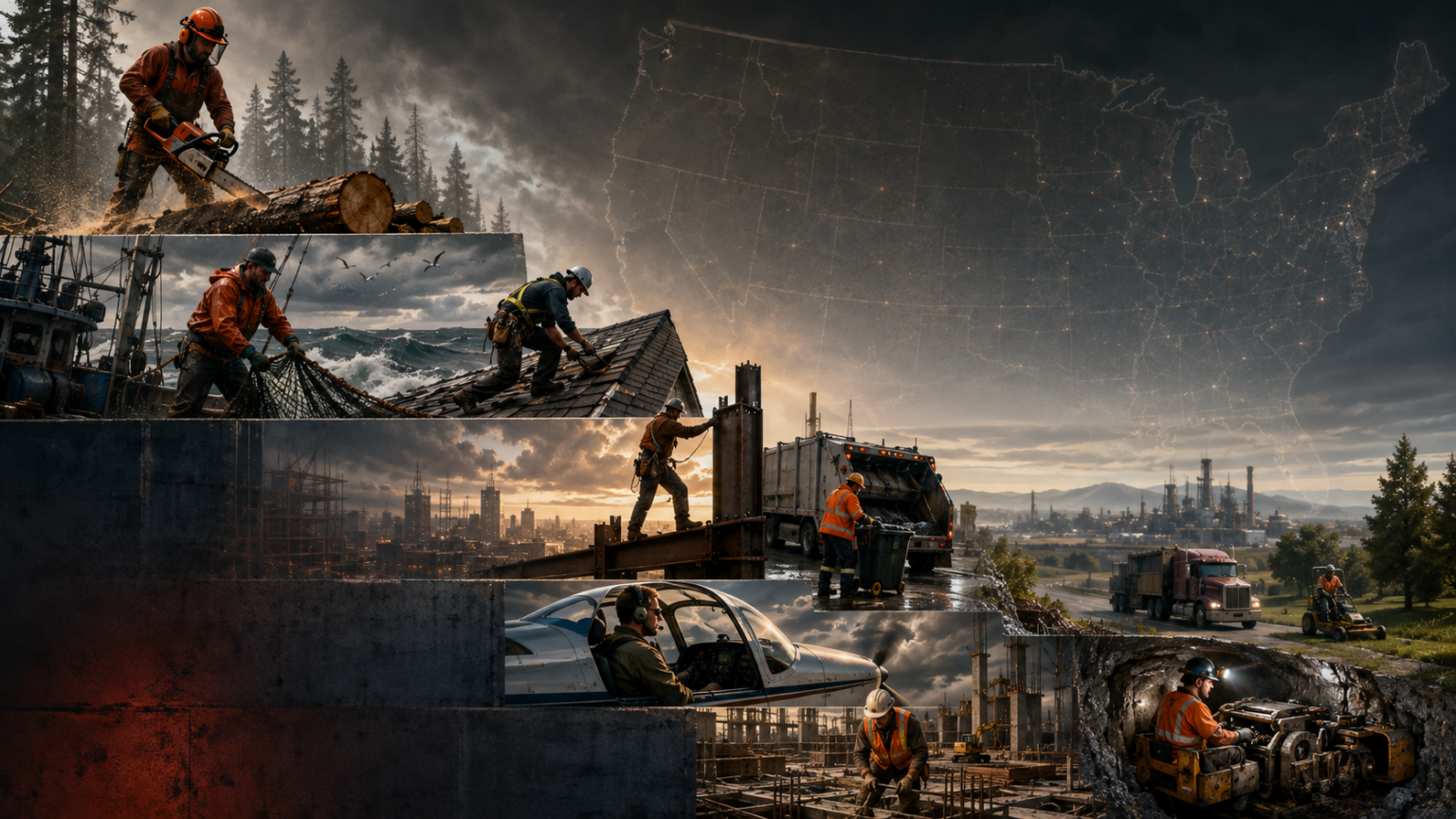
Every list of the most dangerous jobs in America pulls from the same place: the U.S. Bureau of Labor Statistics. Yet the rankings you find rarely agree, rarely show what these jobs pay, and almost never explain how the ordering was decided. Most of the pages ranking for this search are personal-injury law firms using the data to book consultations.
We took a different approach. Below is a clean, sourced breakdown ranked by fatality rate, paired with median pay and the leading cause of death for each occupation — so you can weigh risk against reward in one view.
How we selected these rankings
Our primary source is the BLS Census of Fatal Occupational Injuries (CFOI), the most authoritative count of on-the-job deaths in the country, using the most recent full year of data (released late 2025 for 2024).
The metric that matters is the fatal injury rate per 100,000 full-time-equivalent workers — not the raw number of deaths. This is the single most important distinction in the whole topic. Truck drivers rack up more total fatalities than any other job simply because there are millions of them. But their rate per 100,000 is a fraction of a logger’s. Ranking by raw deaths tells you which fields are big; ranking by rate tells you which are dangerous. We rank by rate.
For context, the overall U.S. workplace fatality rate hovers around 3.5 to 3.7 per 100,000 workers, and roughly 5,200 to 5,300 workers die on the job each year. Anything on this list runs multiples above that baseline.
What about police and the military? This is the most common follow-up question, so let’s answer it directly. CFOI covers civilian occupations. Active-duty military deaths are tracked separately by the Department of Defense and are excluded here — including combat, they would reshuffle the list entirely. Police officers are in BLS data, but their fatality rate (roughly 12–14 per 100,000, split between traffic incidents and violence) sits below every job on this top-10. It’s a genuinely hazardous job; it simply isn’t among the statistical extremes.
At-a-glance: America’s most dangerous jobs compared
Here is the top 10 by fatality rate. Median pay is from BLS Occupational Employment and Wage Statistics; figures are rounded and reflect the latest published year.
| Rank | Job | Fatality rate (per 100k) | Approx. annual deaths | Median pay | Leading cause |
|---|---|---|---|---|---|
| 1 | Logging workers | ~100+ | ~60 | $50,000 | Struck by trees/equipment |
| 2 | Fishing & hunting workers | ~75 | ~30 | $40,000 | Drowning, vessel capsizing |
| 3 | Roofers | ~50 | ~120 | $50,000 | Falls |
| 4 | Aircraft pilots & flight engineers | ~45 | ~70 | $171,000 | Crashes (small/ag aircraft) |
| 5 | Refuse & recyclable collectors | ~35 | ~40 | $47,000 | Traffic incidents |
| 6 | Structural iron & steel workers | ~30 | ~15 | $62,000 | Falls |
| 7 | Delivery & heavy truck drivers | ~28 | ~1,000+ | $54,000 | Roadway crashes |
| 8 | Farmers, ranchers & ag managers | ~24 | ~250 | $84,000 | Vehicle/machinery rollovers |
| 9 | Construction laborers | ~20 | ~350 | $46,000 | Falls, struck-by |
| 10 | Power line installers & repairers | ~19 | ~30 | $85,000 | Electrocution, falls |
The headline: logging sits at roughly 100+ deaths per 100,000 workers — about 27 to 30 times the national average and comfortably the most dangerous job in the U.S. by rate. Note the pay column too: several of the deadliest jobs pay near the national median, while pilots and linemen show that high risk sometimes — but not always — buys a premium.
The most dangerous jobs in America, ranked
1. Logging workers
Logging tops nearly every credible list, and it isn’t close. Fellers work with chainsaws and heavy machinery on uneven, remote terrain, often far from emergency care. The dominant killer is being struck by falling trees, limbs (“widowmakers”), or rolling logs. Mechanization has helped, but the fundamentals of dropping massive timber remain unforgiving.
2. Fishing and hunting workers
Commercial fishing is the classic high-per-capita danger: cold water, heavy gear, long shifts, and vessels that can capsize miles from help. Drowning and hypothermia lead the causes. Alaska’s crab and salmon fleets draw the headlines, but the Gulf of Mexico shrimp and stone-crab fleets carry the same core risks.
3. Roofers
Roofing’s danger is simple physics — height plus heat. Falls from roofs and ladders are the leading cause, compounded by heat illness in summer and slick surfaces year-round. It’s also a field with a large share of small crews and independent contractors, where safety oversight varies widely from job to job.
4. Aircraft pilots and flight engineers
The commercial airline safety record is extraordinary. The fatality rate here is driven by general aviation: crop dusters, bush pilots, air-taxi, and helicopter operations flying low, in tight spaces, and in variable weather.
5. Refuse and recyclable material collectors
Garbage collection is dangerous for a reason most people never consider: traffic. Workers spend the day stepping in and out of the roadway beside moving vehicles. Being struck by passing cars or caught in truck machinery drives the toll.
6–10, in brief
- Structural iron and steel workers — building skeletons at height; falls dominate, offset partly by strong union safety programs and $60k+ median pay.
- Delivery and heavy truck drivers — the lower rate hides the highest total death count of any job, over a thousand a year, almost all roadway crashes.
- Farmers and ranchers — tractor rollovers and machinery entanglements; an aging workforce raises the risk.
- Construction laborers — the industry’s “Fatal Four”: falls, struck-by, caught-between, and electrocutions.
- Power line workers — electrocution and falls, with demand rising as the grid expands and storms hit harder.
Pay, training, and what the risk buys you
Risk and pay don’t move together as cleanly as you’d hope. Roofers and refuse collectors take on extreme danger for near-median wages. Linemen and pilots earn a real premium — power-line work pays around $85,000 with only a high-school diploma plus a lengthy paid apprenticeship, which is why it’s one of the best risk-adjusted trades on this list.
Entry requirements vary widely. Logging, roofing, and fishing often need no formal credential beyond on-the-job training. Trucking requires a CDL. Linemen and ironworkers complete multi-year apprenticeships. Pilots need FAA certification and hundreds of logged hours. Several of these fields — trucking, power-line work, and construction — are also in sustained demand, so the risk isn’t a career dead-end.
If you’re weighing a career move around money and risk, our breakdown of what a cruise boat captain makes walks through a similar pay-versus-path calculation.
Planning tips for workers and job seekers
Whether you’re taking one of these jobs or already in one, a few concrete steps meaningfully lower your odds of becoming a statistic.
- Vet the employer’s safety record. Search the OSHA establishment inspection database for the company’s name. Repeated citations or willful violations are a red flag. A serious operation will talk openly about its incident rate (its “TRIR”).
- Get the certifications that matter. An OSHA 10 (entry) or OSHA 30 (supervisory) card is standard on quality construction sites. For heights, insist on proper fall-protection training and a full-body harness — not a body belt.
- Treat PPE as non-negotiable. The right hard hat, cut-resistant chaps for chainsaw work, high-visibility gear for roadside jobs, and rated eye protection are the difference-makers. An employer who nickel-and-dimes PPE is telling you something.
- Know your workers’ comp basics. Nearly every state requires employers to carry it. If you’re hurt, report the injury in writing immediately and see an approved doctor — deadlines are strict. You generally don’t need a lawyer to file a straightforward claim.
A Florida note. The state has heavy exposure to several list entries. Gulf and Keys commercial fishing carries the same drowning risk as northern fleets. Post-hurricane rebuilding keeps demand — and fall risk — high for roofers and construction crews, often in brutal heat. And Florida agriculture, from citrus to cattle, puts machinery hazards front and center. If you work outdoors here, heat-illness prevention belongs on your safety checklist right alongside the harness.
For more careers-and-money coverage, browse our Business section, or see how the payout math works in our look at the recent $800M Mega Millions win and our guide to Tampa’s beach resorts if you’re planning where that hard-earned pay goes.
FAQs
What is the most dangerous job in America?
Logging is the most dangerous job in the U.S. by fatality rate, at roughly 100+ deaths per 100,000 workers — about 27 to 30 times the national average. Fallen trees and equipment are the leading cause. This holds whether you say the most dangerous job in the United States, in America, or in the U.S.; the data source is the same BLS census.
Are police officers or the military among the most dangerous jobs in America?
By fatality rate, no. Active-duty military deaths are tracked separately by the Department of Defense and aren’t in the BLS civilian census. Police are in BLS data, but their rate (around 12–14 per 100,000) falls below every job in the civilian top 10. Both are hazardous, but not statistical extremes.
Should job danger be measured by fatality rate or total deaths?
Fatality rate per 100,000 workers is the fairer measure and what we rank by. Truck drivers have the most total deaths (over 1,000 a year) only because there are millions of them; their per-worker rate is far lower than a logger’s. Rate tells you how dangerous the work is; raw counts tell you how big the workforce is.
Do dangerous jobs pay more than average?
Not reliably. Power-line workers (~$85,000) and pilots (~$171,000) earn a clear premium for the risk, but roofers, loggers, and refuse collectors take on extreme danger for near-median wages. High risk does not guarantee high pay.
What is the most dangerous job in America per capita, and how often is this updated?
Per capita — meaning by rate — logging is the clear leader, followed by fishing and roofing. The underlying BLS Census of Fatal Occupational Injuries is released annually, usually in December for the prior year, and this ranking is reviewed each time new figures publish.