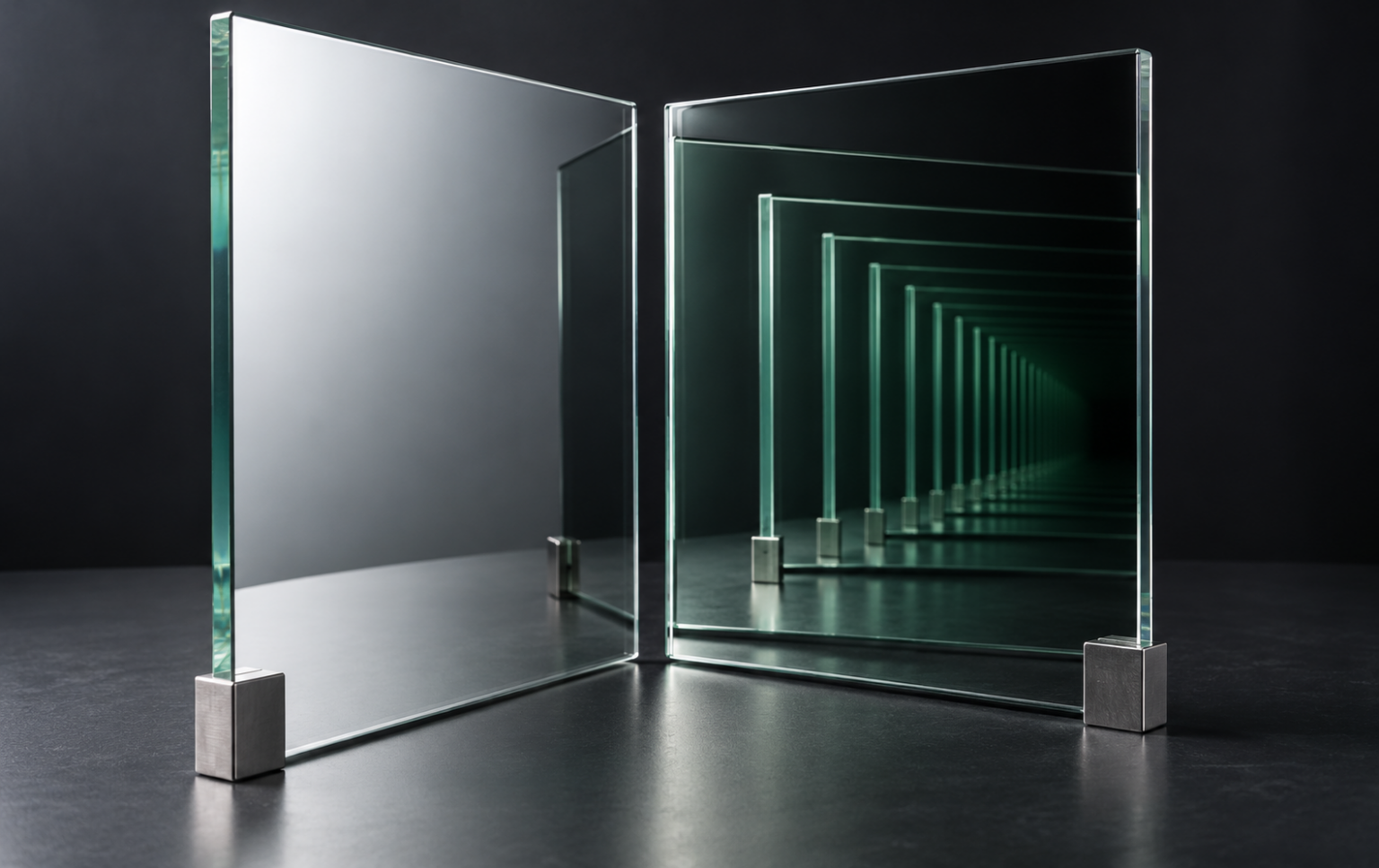
A mirror is technically white — a perfect mirror reflects every wavelength of visible light equally, and light with all colors mixed together reads as white. But real mirrors aren’t perfect. They carry a very faint green tint, because the soda-lime glass and metal backing reflect green wavelengths (roughly 495–570 nanometers) slightly more efficiently than the rest.
So the honest one-line answer is this: a mirror is white in theory and faintly green in practice. That’s also why “what color is a mirror” works so well as a riddle — the obvious guesses (silver, clear, no color at all) are all technically wrong.
Why Mirrors Aren’t Actually Colorless
Color is just a story your eye tells about which wavelengths of light bounce back to it. A lemon looks yellow because it absorbs most wavelengths and reflects yellow ones. A perfect mirror would reflect 100% of every color equally — so instead of picking one hue, it would look like a bright, neutral white light source pointed back at you.
Real mirrors fall short of perfect. The glass and the reflective coating absorb and reflect unevenly, and they happen to favor green. It’s a tiny bias — you’d never notice it glancing at your bathroom mirror — but it’s measurable and consistent.
Here’s the misconception worth clearing up: mirrors are not “silver.” Silver is the color of the backing material — the thin metal layer you glimpse at a chipped or cracked edge. That’s the metal itself, not the color of the light being reflected. The reflected image takes on the faint green cast of the glass, not the gray of the coating.
Key Facts and Context
The science here traces back to a 2004 study by researchers Raymond Lee and Javier Hernández-Andrés, who measured the average color of what a mirror reflects and landed on a specific point in the green range — a soft, pale green they nicknamed after the shade. Their finding is the citation nearly every explainer on this topic leans on.
Three things drive the green cast:
- The glass itself. Most household mirrors use soda-lime float glass, the same everyday glass in windows. It contains trace iron oxide impurities, and iron absorbs red and blue light slightly more than green — leaving green to dominate what comes back.
- The path length. Light passes through the glass, hits the backing, and passes back out. The more glass it travels through, the more the green bias adds up.
- The backing. The reflective layer (aluminum in most modern mirrors, silver in older or higher-end ones) does the actual reflecting, but the glass in front of it is where the color shift happens.
This is the same reason a thick pane of ordinary glass looks green on its edge. Look at the cut edge of a glass tabletop, an aquarium wall, or a stack of window panes and you’ll see it plainly — the green you’re seeing there is the exact same effect, just concentrated. If you’re the type who enjoys these small physics puzzles, our explainer on how fast clouds actually move scratches the same itch.
How to Actually See the Green Tint Yourself
Most articles tell you mirrors are green and stop there. You can verify it in about thirty seconds.
- The two-mirror tunnel. Hold two mirrors facing each other — a compact mirror and a bathroom mirror both work — and look into the “tunnel” of infinite reflections. Each bounce passes the light through the glass again, compounding the green bias. By the fifth or sixth reflection the tunnel visibly deepens into green. This is the clearest DIY demonstration there is.
- The glass edge test. Find any thick piece of clear glass and look at its cut edge straight on. That green is the iron-oxide tint, undiluted.
- Compare a low-iron mirror. Photographers, filmmakers, and high-end optics makers use low-iron (“true color” or “optically clear”) mirrors that strip out most of the iron. Set one beside a standard mirror and the standard one looks noticeably warmer-green by comparison.
Not every mirror behaves the same way, either. A polished metal mirror (like a stainless steel gym mirror) has no glass in front, so it skips the green shift and can look slightly warmer or grayer. A two-way mirror is a lightly coated pane that reflects and transmits at once. A black mirror uses a dark backing for a moody, low-reflectance look. “What color is a mirror” doesn’t have one universal answer — it depends on what the mirror is made of.
The Riddle, the Joke, and the Vsauce Answer
“What color is a mirror” spread as a viral riddle largely thanks to a Vsauce video, and it’s a genuinely good trick question. It sounds like it should have a simple answer — clear! silver! — and every gut response is wrong. The satisfying reveal is that a mirror is white in principle and a specific pale green in reality.
Vsauce’s take lines up with the science above: a mirror isn’t a color-free window, it’s an imperfect reflector with a measurable green bias. So if someone hits you with it as a joke, the technically-correct comeback is “faintly green” — and now you can explain why. It’s the same kind of language-and-meaning curiosity we dig into with pieces like what star 67 actually does when you dial it.
Florida Relevance: Where to See It in Person
If you want the effect on a dramatic scale, Florida’s attractions do it better than any compact mirror. Orlando in particular is packed with venues built around infinite reflections. The Museum of Illusions Orlando features an infinity room, and mirror-maze and mirror-tunnel exhibits around the ICON Park entertainment complex on International Drive let you walk straight into the two-mirror trick at room scale — each reflection deepening the green tint down the tunnel.
One practical tip if you’re photographing a mirror maze on your trip: that green cast can quietly throw off your white balance, tinting skin tones and whites slightly cool. Nudge the temperature warmer in your phone’s editing tools afterward and the shots snap back to neutral. Planning an Orlando visit anyway? Our guide to the hottest clubs in Orlando covers what to do once the sun goes down.
The Bottom Line
A mirror is white in theory, faintly green in practice, and never really “silver” — that’s just the backing. The green comes from iron in ordinary glass reflecting green wavelengths a touch more than the rest. Stack two mirrors, peer down the tunnel, and you’ll see the proof for yourself. For more everyday science and plain-English explainers, browse our Technology section.
FAQs
What color are mirrors, really?
Mirrors are technically white, because a perfect mirror reflects all visible wavelengths equally. In reality they carry a faint green tint from iron in the glass, which reflects green light (495–570nm) slightly more efficiently than other colors.
What is the color of a mirror?
The most accurate answer is a very pale green. In theory a mirror is white, but the soda-lime glass and its metal backing give real mirrors a subtle green cast you can see when you stack two mirrors face to face.
Is a mirror white or silver?
White. “Silver” is the color of the reflective backing you glimpse at a cracked edge — it’s the metal coating, not the color of the light the mirror reflects back at you.
Why do mirrors look silver if they’re actually green?
The green bias is extremely subtle, so a single glance reads as neutral. The silver look comes from the aluminum or silver backing showing through. You only see the green when reflections compound, like in a mirror tunnel.
What did Vsauce say about mirror color?
Vsauce popularized the answer that a mirror isn’t colorless — it’s white in principle but a specific faint green in practice, because it’s an imperfect reflector that favors green wavelengths. That reveal is what makes it a classic riddle.
Do all mirrors have the same green tint?
No. Standard glass mirrors are faintly green, but low-iron “true color” mirrors minimize it, polished metal mirrors skip the glass entirely, and specialty two-way or black mirrors reflect differently. The tint depends on the materials.