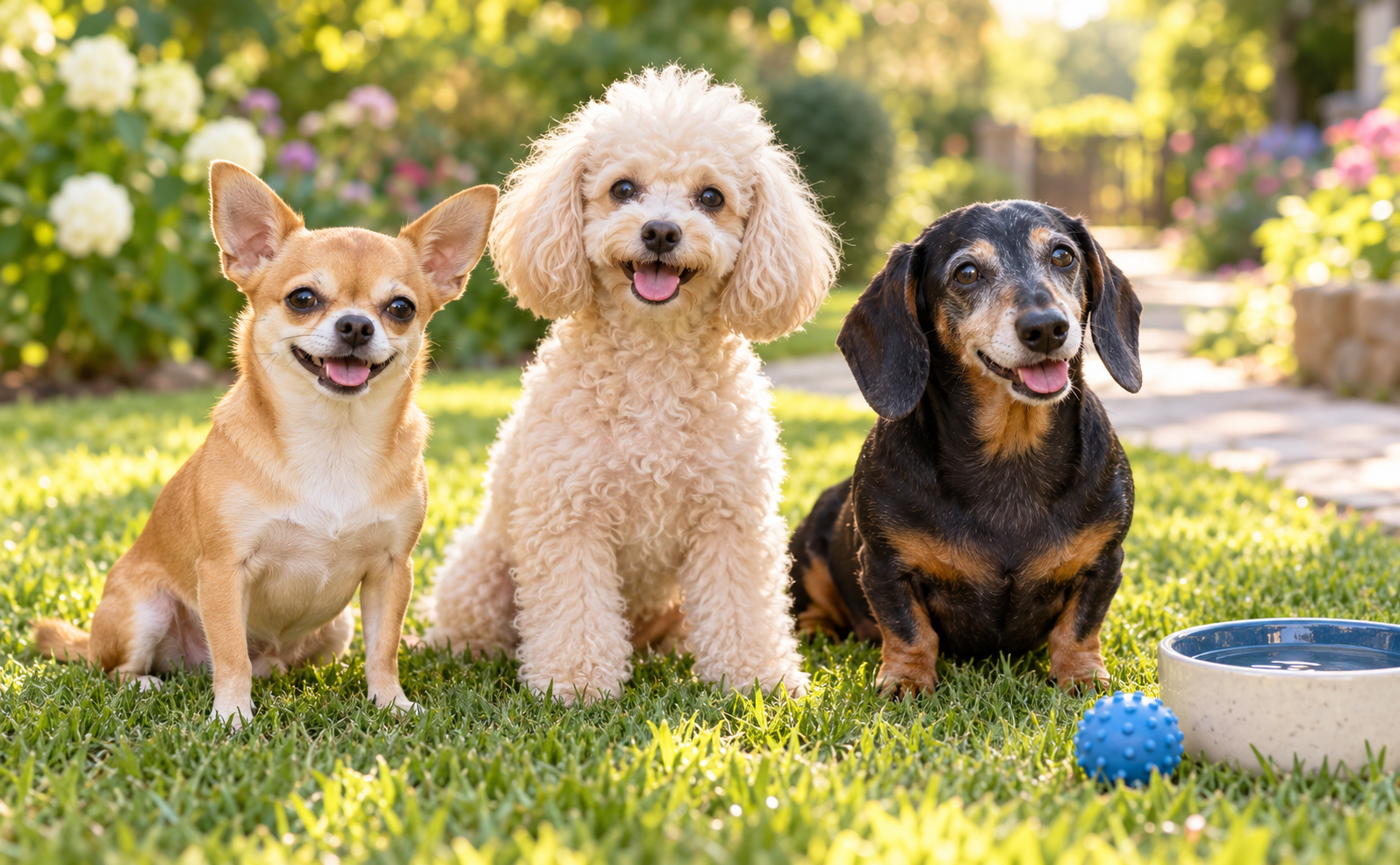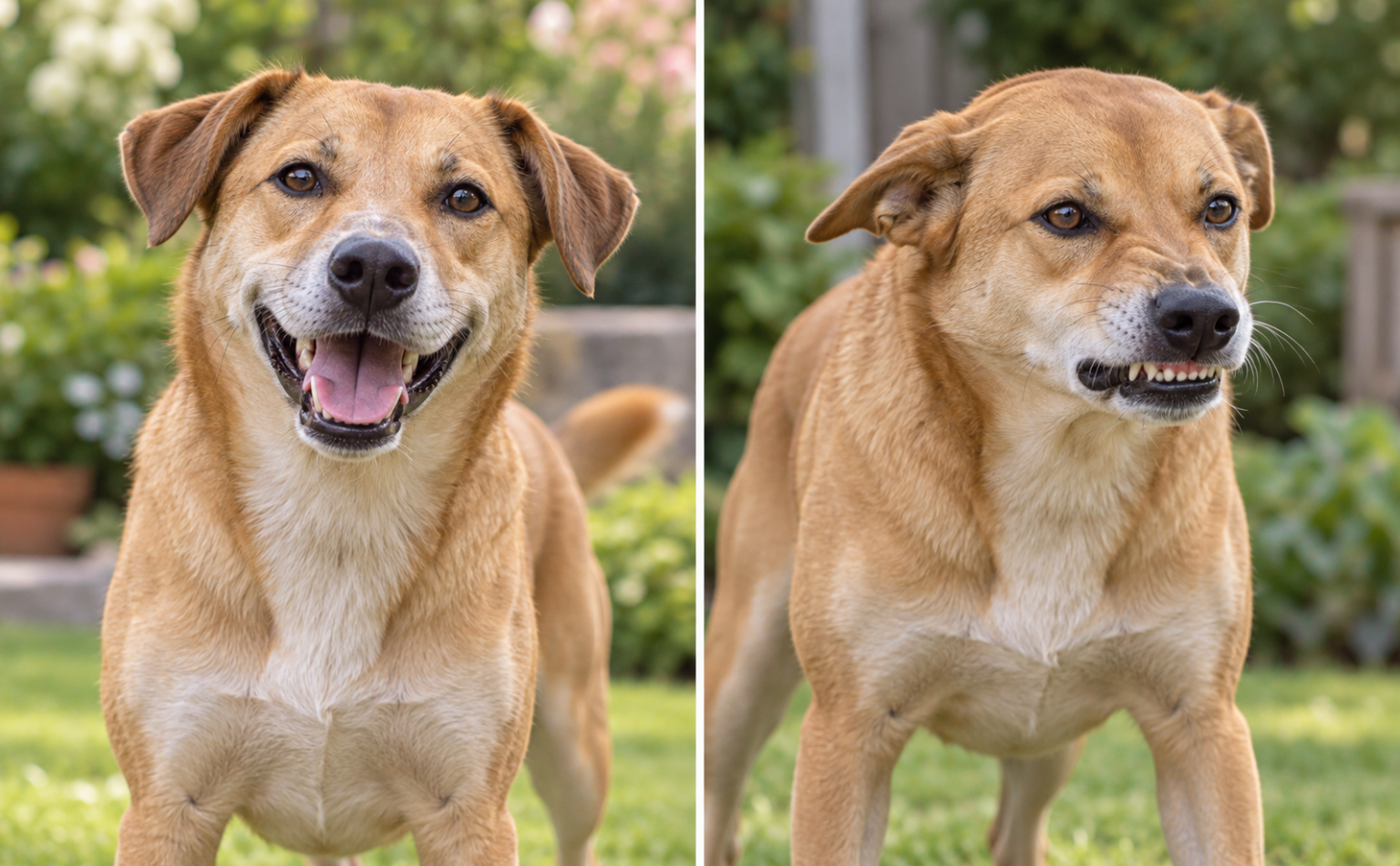
A dog smiling with teeth is usually being friendly. Most of the time it’s a relaxed open-mouth grin or a submissive (appeasement) grin, which is a polite “I mean no harm” signal. The same teeth can also be a warning, so the mouth alone won’t tell you much. Look at the rest of the dog. A loose, wiggly body means friendly. A stiff, frozen body with a hard stare means back off. Heavy panting is usually just cooling down, not a smile.
Is a dog smiling with teeth happy or warning you?
Use this three-point rule before you reach out your hand:
- Loose and wiggly = friendly. Soft eyes, a curvy body, a low or sweeping tail wag, maybe a squint.
- Stiff, frozen and staring = back off. Weight shifted forward, a closed or tense mouth pulled tight over the teeth, and often a growl.
- Panting is not a smile. A wide-open mouth with the tongue out after exercise or in heat is the dog cooling off.
| Type | What you see | What it usually means |
|---|---|---|
| Relaxed happy grin | Open mouth, soft eyes, loose body | Content, comfortable |
| Submissive grin | Front teeth shown, ears back, squinting, wiggly low body | Appeasement, “we’re friends” |
| Play face | Open mouth, play bow, bouncy movement | An invitation to play |
| Panting | Wide mouth, tongue out, fast breathing | Cooling down, exertion, sometimes stress |
| Warning snarl | Lips pulled up, wrinkled muzzle, hard stare, stiff body | “Stop now” |
What it means when a dog shows teeth in a smile
The relaxed happy grin
This is the look most people mean by a dog smile. The mouth is open, the lips are slack, and you may see the teeth and tongue. The eyes are soft and the dog is loose. It can last for minutes, for example while you scratch the dog’s chest.
The submissive or appeasement grin
This is the one that worries owners. The dog pulls the lips back horizontally (sometimes vertically too) and shows the front teeth, often in a full toothy display. A few breeds, Dalmatians in particular, are well known for it. The difference from a snarl is the context. The dog squints or blinks, holds the ears back, lowers or curls the body, wags, and may lick its lips, turn its head or sneeze. It’s a peace offering. Many owners see it at the front door.
The play face
An open, loose mouth, a play bow (front end down, rear up) and bouncy, exaggerated movement. Dogs that play rough can also show teeth while mouthing. That’s normal as long as both dogs take turns and stop to reset now and then.
Panting that looks like a grin
A panting dog’s mouth corners pull back, which can look like a big smile in photos. Panting after a walk is normal. Panting while the dog is resting in a cool room, or with pacing and yawning, can signal stress or pain.
The “guilty” smile
If your dog grins when you scold them, they aren’t confessing. In a well-known 2009 study, canine cognition researcher Alexandra Horowitz found that dogs showed the “guilty look” most when their owners scolded them, whether or not the dog had actually broken the rule. The dog is reacting to your tone and posture and trying to calm things down. That toothy grin during a scolding is usually appeasement.
Smile vs. warning: a body-language checklist
Check at least four of these signals before you decide what the dog is telling you:
| Signal | Friendly grin | Warning |
|---|---|---|
| Eyes | Soft, squinty, blinking, looking away | Wide, hard, fixed stare; whites showing (“whale eye”) |
| Ears | Relaxed or softly back | Pinned flat or stiffly forward |
| Body | Loose, curvy, wiggly, may lower | Stiff, frozen, weight forward, hackles up |
| Tail | Low-to-mid sweeping wag or helicopter wag | High and stiff, or tucked tight; slow, rigid wag |
| Mouth | Lips pulled back horizontally, muzzle smooth | Lips lifted vertically, muzzle wrinkled, canines showing |
| Sound | Quiet, snorts, happy whines | Low growl, or dead silence before a snap |
| What to do | Greet calmly, keep it low-key | Stop, look away, give space, move away slowly |
If the teeth come with a stiff body, a hard stare or a growl: stop what you’re doing. Don’t stare back, don’t lean over the dog and don’t run. Turn sideways and calmly put distance between you. Then think about what caused it, such as a food bowl, a sore spot, being cornered or a stranger reaching over the dog’s head.
Never punish the growl or the snarl. They’re warnings, and dogs that get punished for warning often learn to bite without one. Deal with whatever caused the reaction instead.
Rule out pain. If a dog starts showing teeth when touched, picked up or groomed, or around the mouth, see your vet first. Dental disease, ear infections, arthritis and injuries are common, overlooked causes of a dog that suddenly turns “grumpy.”
Key facts and context: why dogs smile with teeth
- It’s a social signal. Researchers at the University of Portsmouth reported in 2017 that dogs made more facial expressions when a person was facing them than when the person turned away. That suggests the expressions are at least partly aimed at us.
- It’s often learned. If grinning at the door gets laughter, petting and attention, many dogs will do it more. That’s harmless if the grin is the friendly kind.
- Breed tendencies exist, but individuals vary. Dalmatians are famous for the toothy submissive grin. Huskies, Samoyeds, Corgis, Shibas and many pit bull-type dogs often get labeled “smilers” because of their face shape and expressive lips. Plenty of dogs in these breeds never grin, and mixed breeds do it all the time.
- The labels are debated. Behaviorists disagree about whether “smile” is the right word at all. Some argue the appeasement grin has more to do with conflict avoidance than with joy. The practical point is the same either way: read the whole dog, not just the teeth.
Examples and use cases: dog smiling with teeth memes, GIFs, photos and AI images
Why the memes and GIFs go viral
Toothy dog memes work because the expression looks so human and so over the top. In most viral clips, such as the dog that grins every time its owner walks in, you’re watching a submissive greeting grin: wiggly body, squinting eyes, a tail going nonstop. Plenty of people read the clips as “scary” because they only see the teeth. Watch the body and you’ll usually see a happy, slightly overexcited dog. Meme captions, like text slang, rarely tell you what’s actually going on.
Reading a single photo or commercial shot
One frame can mislead you. A dog caught mid-pant, mid-sneeze or mid-yawn can look like it’s grinning or snarling. Commercials often use trained dogs on cue, or shots chosen from hundreds of takes. Don’t judge a dog’s personality, or a breed, from one still image.
Spotting AI-generated toothy dogs
AI images of dogs smiling with teeth are everywhere now. Common giveaways:
- Too many teeth, or human-like flat front teeth instead of incisors and canines
- Teeth that blend into the gums or tongue
- Lips pulled up into a perfect human “U” shape
- Fur that melts into the background, odd paws or mismatched eyes
Real dogs have six small incisors up front with a long canine on each side. A mouth that looks like a toothpaste ad probably isn’t real.
How to photograph a natural happy-dog smile
- Shoot right after a short game or walk, when the dog is relaxed and lightly panting (not in the heat of the day).
- Get down to the dog’s eye level and use burst mode.
- Use a squeaky toy or a treat held above the lens to get attention, then reward.
- Don’t hold the lips up, restrain the dog or tease them to get a reaction. A stressed dog may give you a toothy face that’s actually a warning, and that’s how bites happen.
Common questions about dogs smiling with teeth
Why does my dog smile with teeth when I come home?
That’s almost always a greeting grin. It’s appeasement and excitement mixed together, and attention often reinforces it. Keep greetings calm and the grin usually stays but the frenzy fades.
Can I teach my dog to smile on cue?
Some trainers do this by “capturing” a natural grin with a marker word and a treat. Do it carefully. Only reward the soft, wiggly version, and never prompt it by stressing the dog. Remember that strangers may misread the trick as a snarl.
When should I call a vet or trainer?
Call if the teeth display is new or sudden, happens when the dog is touched, or comes with growling, snapping or guarding. Start with your vet to rule out pain, then work with a certified behavior professional, such as a CPDT-KA trainer or a veterinary behaviorist.
Florida relevance: heat, panting and when to get help
In Florida, many “smiling” dog photos are really heat panting. Overheating can turn into an emergency fast, especially for flat-faced breeds like Bulldogs and Pugs and for older or overweight dogs. Watch for:
- Heavy, frantic panting that doesn’t slow down in the shade
- A wide, flattened tongue that is bright red or dark
- Drooling, stumbling, vomiting or glazed eyes
Walk early in the morning or after sunset, and check the pavement with the back of your hand. If it’s too hot for you to hold for seven seconds, it’s too hot for paws. If you suspect heatstroke, move the dog somewhere cool, wet them with cool (not ice-cold) water and get to a vet right away.
If a dog is acting aggressively or a bite happens, contact your county’s animal services agency. In Florida, Chapter 767 of the Florida Statutes lets local animal control investigate and classify a dog as dangerous. For a bite, wash the wound, get medical care and report the bite as your county requires.
Have a small dog that grins at everyone? See our guide to how long small dogs live and how to add healthy years, and browse more pet and everyday stories in our News & Lifestyle section.
FAQs
Do dogs really smile with their teeth?
Yes, in their own way. Dogs show a relaxed open-mouth grin when content and a toothy submissive or appeasement grin when greeting or trying to defuse tension. Researchers still debate whether ‘smile’ is the right label, but both are real, friendly social signals when the body is loose.
Is my dog smiling or showing aggression?
Check the body, not just the teeth. A smile comes with soft or squinting eyes, a loose wiggly body and a smooth muzzle. Aggression comes with a stiff or frozen body, a hard stare, a wrinkled muzzle, lips lifted over the canines and often a growl.
What is a submissive grin in dogs?
It’s an appeasement display. The dog pulls the lips back to show the front teeth while lowering the body, squinting, holding the ears back and wagging. It signals ‘I’m no threat’ and often shows up during greetings or when the dog senses you’re upset.
What dog breeds smile with teeth?
Dalmatians are best known for the toothy submissive grin. Huskies, Samoyeds, Corgis, Shiba Inus and pit bull-type dogs are often called smilers too. Breed is only a tendency, though. Any dog, including mixed breeds, can grin, and many dogs of ‘smiling’ breeds never do.
Do dogs smile when they are being scolded?
Many do, and it’s appeasement, not guilt. Research by Alexandra Horowitz found that the ‘guilty look’ was driven mainly by the owner’s scolding rather than by whether the dog had actually misbehaved. The grin is the dog’s attempt to calm you down.
Is it bad if my dog shows teeth when happy?
No. A toothy grin paired with a loose, wiggly body is harmless. Just warn visitors so they don’t misread it. Get it checked if the teeth display is new or appears when your dog is touched, since pain can be the cause.