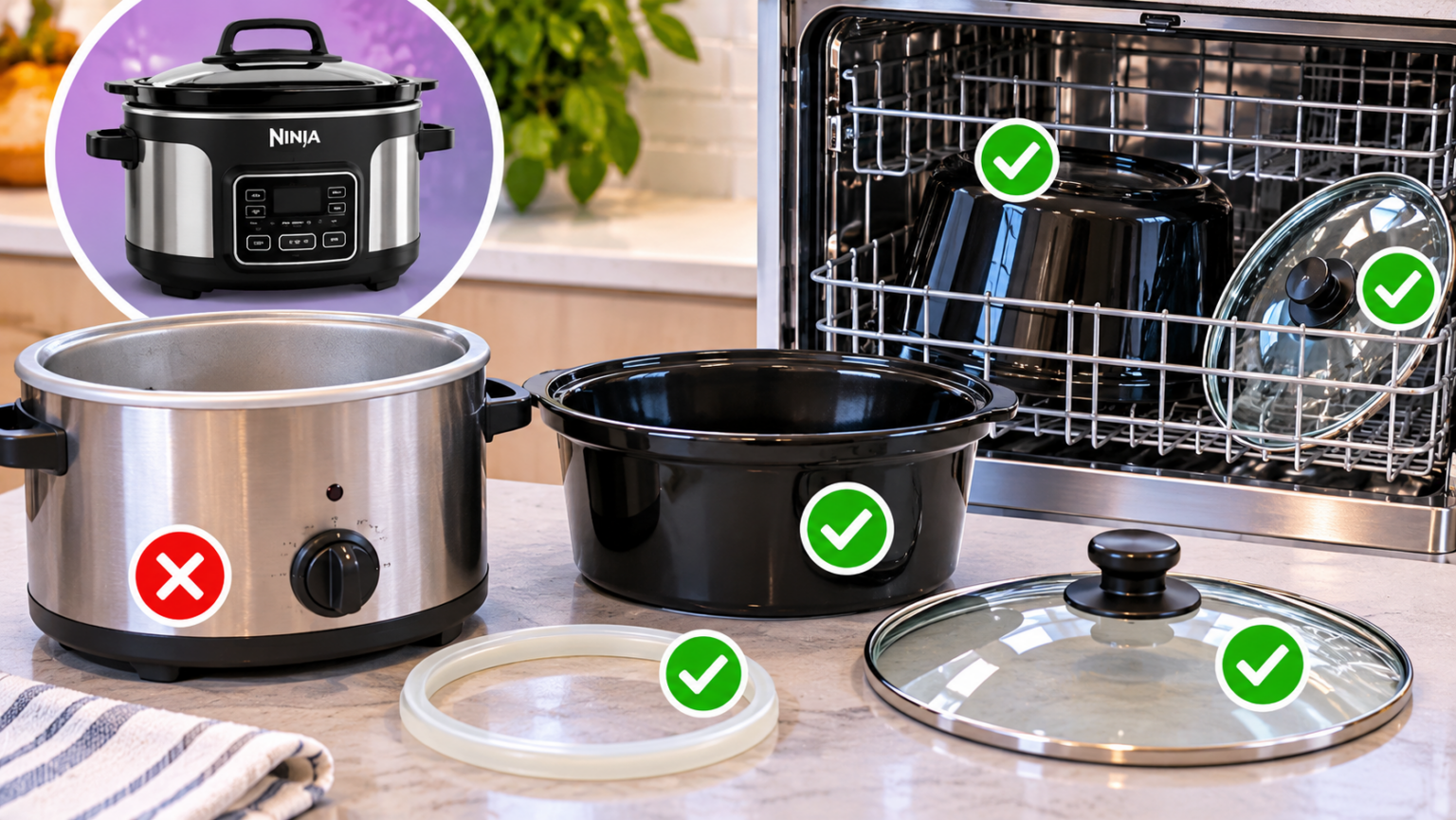
Yes, for the removable stoneware insert and the glass lid on most models. Never for the electric heating base. If you’re asking “can you put a crockpot in the dishwasher” about a standard Crock-Pot, Hamilton Beach or similar slow cooker, the crock and lid can usually go in. The base with the heating element and controls gets wiped down by hand, and that’s it. The answer to “can you put a crock pot in the dishwasher” changes for multi-cookers, metal or non-stick inserts, rubber gaskets and older crocks, so check your manual for those.
Short version of what to do:
- Let the insert cool completely first. Thermal shock is the most common way stoneware cracks.
- Put the insert on the bottom rack and the lid on the bottom rack or the top rack, depending on its size.
- Hand wash anything with a crack, crazed glaze or a non-stick coating.
- Never submerge the base or run it through any wash cycle.
What it means for each part of your slow cooker
Sources disagree because “the crock pot” is really four or five separate parts, each made of different materials. Here’s the breakdown.
| Part | Dishwasher? | Notes |
|---|---|---|
| Stoneware/ceramic insert | Yes (most models) | Cool it fully first. Bottom rack. |
| Tempered glass lid | Yes (most models) | Pull off any rubber rim first if it’s removable. |
| Metal or plastic lid with locking clips | Check the manual | Clips and hinges may be hand-wash only. |
| Rubber or silicone gasket | Often yes, top rack | Heat wears it out faster. Hand washing makes it last longer. |
| Aluminum or non-stick insert (multi-cookers, sear-capable models) | Check the manual | Many are rated dishwasher safe, but hand washing preserves the coating. |
| Stainless steel inner pot (pressure/multi-cookers) | Usually yes | Confirm with the model number. |
| Heating base, cord, control panel | Never | Contains electrical parts. Wipe with a damp cloth only. |
| Disposable slow cooker liner | No | Single use. Throw it away. |
The base is off-limits for an obvious reason: water gets into the heating element, wiring and controls. Even if it seems to dry out, moisture inside can cause corrosion or a short later on. If it ever gets soaked, unplug it and contact the manufacturer before using it again.
What “dishwasher safe” actually means
A dishwasher-safe label means the manufacturer has tested that the part survives normal cycles. It doesn’t promise the part will look new after 300 washes. Hot water, strong detergent and heated drying slowly dull glazes, turn gaskets cloudy and wear down non-stick coatings. Safe and good for longevity are two separate questions.
Key facts and context: why sources disagree
Crock-Pot’s own guidance says the stoneware and glass lid are dishwasher safe, and KitchenAid, Hamilton Beach and most other major brands say the same for their crocks. So why do some outlets put “don’t” in the headline?
- Glaze wear. Over years of cycles, harsh detergent can dull the finish. A dull glaze makes food stick more.
- Crazing on older crocks. Fine hairline cracks let water seep into the ceramic. Hot cycles make them worse.
- Gasket degradation. Rubber seals harden, warp and hold onto odors faster when they go through heated drying.
- Space. A 6- or 7-quart oval crock takes up a lot of the bottom rack and can block the spray arm. That leaves the crock half-clean and the rest of the load unwashed.
Thermal shock: the real crack risk
Most cracked crocks aren’t caused by the dishwasher. They’re caused by a sudden temperature change. Stoneware heats and cools slowly, and a hot insert hit with cold water, or set down on a cold wet counter, can crack outright. Crock-Pot manuals warn against exactly this. Let the insert come to room temperature before you wash it, by any method. The same rule applies in reverse: don’t move a crock from the fridge straight into a preheated base.
How to confirm your model
The model number is usually on a sticker or stamp on the bottom of the base. Search the brand’s support site for that number plus “manual”. Most brands host PDFs going back many years. If you can’t find anything, treat the stoneware and glass lid as dishwasher safe, and hand wash everything else.
How to wash a crock pot insert in the dishwasher, step by step
- Cool it. Leave the insert out until it’s at room temperature.
- Scrape and rinse. Remove food with a silicone spatula. Dishwashers handle residue, not half a cup of dried chili.
- Remove the extras. Take off the gasket and any lid fittings that come apart.
- Load it smart. Put the insert on the bottom rack, open side down and angled toward the spray arm. Make sure the arm can still spin freely.
- Pick a gentler cycle. A normal cycle without high-temp sanitize or heated dry is enough and puts less stress on the glaze.
- Dry fully. Air-dry with the lid off before you store it.
When to hand wash instead
Skip the dishwasher if:
- The glaze is cracked, chipped or crazed.
- It’s a vintage crock from before the 2000s. Older glazes are less durable, and you have no current manual to check.
- The insert is non-stick or aluminum, unless the manual specifically says otherwise.
- The lid has printed decoration, wooden handles or a rubber seal that doesn’t come off.
To hand wash, use warm soapy water and a nylon brush or non-scratch sponge. Never use steel wool or abrasive powders on glazed stoneware.
How to get burnt food off a slow cooker
- Soak: Fill the cooled crock with warm water and a few drops of dish soap and leave it for an hour.
- Baking soda paste: Mix baking soda with a little water, spread it over the burnt ring, wait 15 minutes and scrub with a nylon brush.
- The slow-cooker soak: Fill the crock with water to above the residue, add about 1/4 cup baking soda (or 1 cup white vinegar for odors and film), put it in the base, and run it on LOW for 1 to 2 hours. Let it cool, then wipe. Don’t combine vinegar and baking soda in a closed pot.
Examples and use cases
Classic oval Crock-Pot stoneware
Verdict: dishwasher safe. This is the most common case. Cool it, scrape it and use the bottom rack.
Ninja and other multi-cooker pots
Verdict: usually yes, but confirm. Can you put a Ninja crock pot in the dishwasher? Most current Ninja and Crock-Pot Express inner pots are listed as dishwasher safe, but many are non-stick, and hand washing makes the coating last much longer. Sealing rings are usually top-rack safe. They hold odors, though, so many owners keep a separate ring for savory dishes.
Slow cooker liners
Verdict: no. Liners are single-use plastic bags. Lift it out, tie it off and throw it away. The crock underneath usually just needs a quick rinse.
Three real scenarios
- Chili with burnt-on edges: A dishwasher cycle won’t remove that ring. Do a baking soda soak first, then wash it by either method.
- Greasy pot roast: Pour off and discard the cooled fat (not down the drain), wipe the crock with a paper towel, then put it in the dishwasher. It comes out clean.
- Sticky BBQ pulled pork: Sugar sauces caramelize hard. Soak in warm water for 30 minutes, scrape, then wash.
Common questions about putting a crockpot in the dishwasher
Can you put a crock pot lid in the dishwasher?
Yes, a standard glass lid can go in. Remove any detachable rubber rim. Lids with locking clips or built-in seals need a check of the manual.
Can you put a ceramic crock pot in the dishwasher?
Usually yes. The ceramic crock, bowl or dish is the part the dishwasher-safe guidance is written for. Hand wash it if the glaze is damaged.
Why is my stoneware cloudy after the dishwasher?
That’s usually mineral film from hard water or detergent residue, not damage. Wipe it with white vinegar, or do the vinegar soak described above, then rinse.
Florida relevance: humidity, storage and odors
Florida’s humidity means a crock stored with the lid on and a little moisture inside can start to smell musty quickly. Dry both pieces fully and store the lid upside down or slightly offset so air can circulate. Much of the state also has hard, mineral-heavy water, which is why Florida kitchens see cloudy stoneware so often. A rinse aid in the dishwasher, plus an occasional vinegar wipe, takes care of it.
Related reading
Before you buy a replacement crock or a new multi-cooker, check whether your appliance shows up in our roundup of products at Walmart and Amazon recalled over safety issues. For more practical kitchen guides, see how to choose a honeydew melon. If you’re planning a holiday potluck, our guide to Christmas markets in the US covers dates and costs.
FAQs
Can you put a Crock-Pot insert in the dishwasher?
Yes. The removable stoneware insert on most Crock-Pot and similar slow cookers is dishwasher safe. Let it cool to room temperature first, scrape out the food, and put it on the bottom rack where it won’t block the spray arm.
Is the base of a slow cooker dishwasher safe?
No. The heating base holds the electrical element and controls, so you should never submerge it or put it in the dishwasher. Unplug it, let it cool, and wipe it with a damp cloth.
Can you put a hot crock pot insert in the dishwasher or under cold water?
No. A sudden temperature change can crack stoneware (thermal shock). Let the insert cool completely before you wash it by any method, and never run cold water over a hot crock.
Can you put a Ninja slow cooker or multi-cooker pot in the dishwasher?
Most current Ninja and Crock-Pot Express inner pots are listed as dishwasher safe, but confirm with your model number. Many are non-stick, and hand washing helps the coating last longer.
Why does my Crock-Pot stoneware look cloudy after the dishwasher?
Cloudiness is usually mineral film from hard water or detergent residue, not damage. Wipe the crock with white vinegar, or soak it in water with about a cup of vinegar, then rinse. A rinse aid helps prevent it.
Can slow cooker liners go in the dishwasher?
No. Slow cooker liners are single-use plastic bags. Let the food cool, lift out the liner, tie it off and throw it away.