I recently had the chance to try a pair of shoes that genuinely feel like they belong to a different era of footwear design. They are called the PulsePodz, created by the footwear startup Syntilay, and according to the brand, these shoes could not exist without a combination of advanced 3D printing and artificial intelligence.
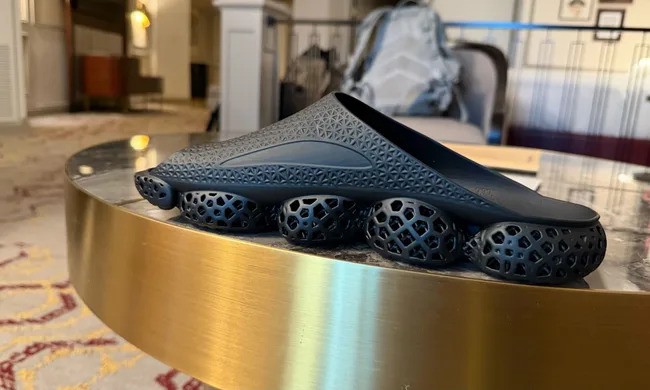
Unveiled during CES 2026, the PulsePodz are recovery slides that look unlike anything you would normally see on a store shelf. Instead of a flat or foam-based sole, the base of the shoe is made up of nine separate pods. Each pod contains an intricate lattice structure with varying densities, all designed to support different pressure points across the foot.
Syntilay explains that this pod-based layout creates a subtle pulsing sensation when walking. The idea is to reduce stress in areas that typically absorb the most impact, while still keeping the shoe lightweight and flexible. According to the company, this balance would be extremely difficult, if not impossible, to achieve using traditional manufacturing methods.
The brand recently discussed the PulsePodz on the Digital Trends Trending Forward podcast, where it shared more insight into how the shoes came to life. At CES, I was also able to briefly try the slides myself. Unfortunately, the sample pair was not quite my size, which limited the full experience. Even so, the sensation underfoot was noticeably different. Pressure was clearly distributed across multiple points rather than concentrated in one area, making the sole feel active rather than static.
Ben Weiss, co-founder of Syntilay, described the core design goal as creating a shoe that delivers varying levels of pressure as the wearer moves. As the foot shifts while walking, the structure responds by dispersing force rather than absorbing it in a single zone.
Weiss also highlighted that airflow was a major focus of the design. The hollow internal structure allows air to move freely in multiple directions, which helps keep the shoe light and breathable. This level of internal complexity is one of the main reasons Syntilay leaned so heavily on 3D printing.
“These kinds of structures just cannot be produced with standard manufacturing techniques,” Weiss explained. “3D printing gives us access to shapes and internal geometry that would otherwise be off limits for mass production.”
Looking closely at the PulsePodz makes that claim easy to believe. While many modern running shoes already feature visible pods, grooves, and sculpted soles, the difference here is in the detail. Inside each pod are countless small structural elements, layered and interconnected in a way that feels almost organic. It is hard to imagine these designs being molded or cut using conventional processes.
Artificial intelligence also played a role in refining the shoe. Syntilay used AI-assisted simulations to fine-tune airflow throughout the sole. This approach helped the team test and optimize different structural variations digitally before producing physical prototypes, speeding up development while reducing waste.
Syntilay positions the PulsePodz as part of a long lineage of footwear innovations focused on air-based cushioning. The company compares its technology to iconic designs such as the Nike Air Max, which introduced visible air cushioning in the 1980s, and the CloudTec sole from On Running, known for its hollow, pod-like construction. Syntilay even goes as far as calling PulsePodz the first major advancement in air-based cushioning systems in over 15 years.
That is a bold claim, especially given that 3D printed footwear is still in its early stages. However, the statement underscores the brand’s belief that alternative manufacturing methods open doors that traditional approaches simply cannot.
For now, the PulsePodz structure is exclusive to recovery slides, but Syntilay has already confirmed plans to expand the technology into sneakers and performance-focused designs. The long-term goal is to introduce more people to 3D printed shoes by starting with comfort-oriented products that highlight flexibility and feel.
One potential challenge is perception. Many people still associate 3D printed shoes with stiffness or rigidity, especially when they appear to be made from a single piece.
Weiss acknowledged this concern, explaining that education and real-world experience are key. Syntilay wants people to physically handle and wear the shoes so they can see how much flex is built into the design.
“When people first see a 3D printed shoe, they often assume it will be hard,” he said. “That is why showing flexibility and movement is so important.”
During earlier discussions on the podcast in 2025, Weiss also talked about the broader potential of 3D printed footwear. Beyond structural innovation, he believes this manufacturing approach could make it easier to integrate technology directly into shoes. Concepts such as temperature regulation, adaptive support that responds to movement, or even embedded displays for customization were all mentioned as future possibilities.
Whether this represents the early stages of a shift in how shoes are designed and sold remains to be seen. The idea of footwear tailored precisely to an individual’s foot shape, movement pattern, and support needs is certainly appealing, especially for runners and athletes who often struggle to find the perfect fit.
The PulsePodz slides are currently available for pre-order at a price of $149 directly from Syntilay.com. They are offered in multiple colors, including black and white, along with brighter options such as pink, green, and orange. Shipping is expected to begin approximately 90 to 120 days after the pre-order period ends.