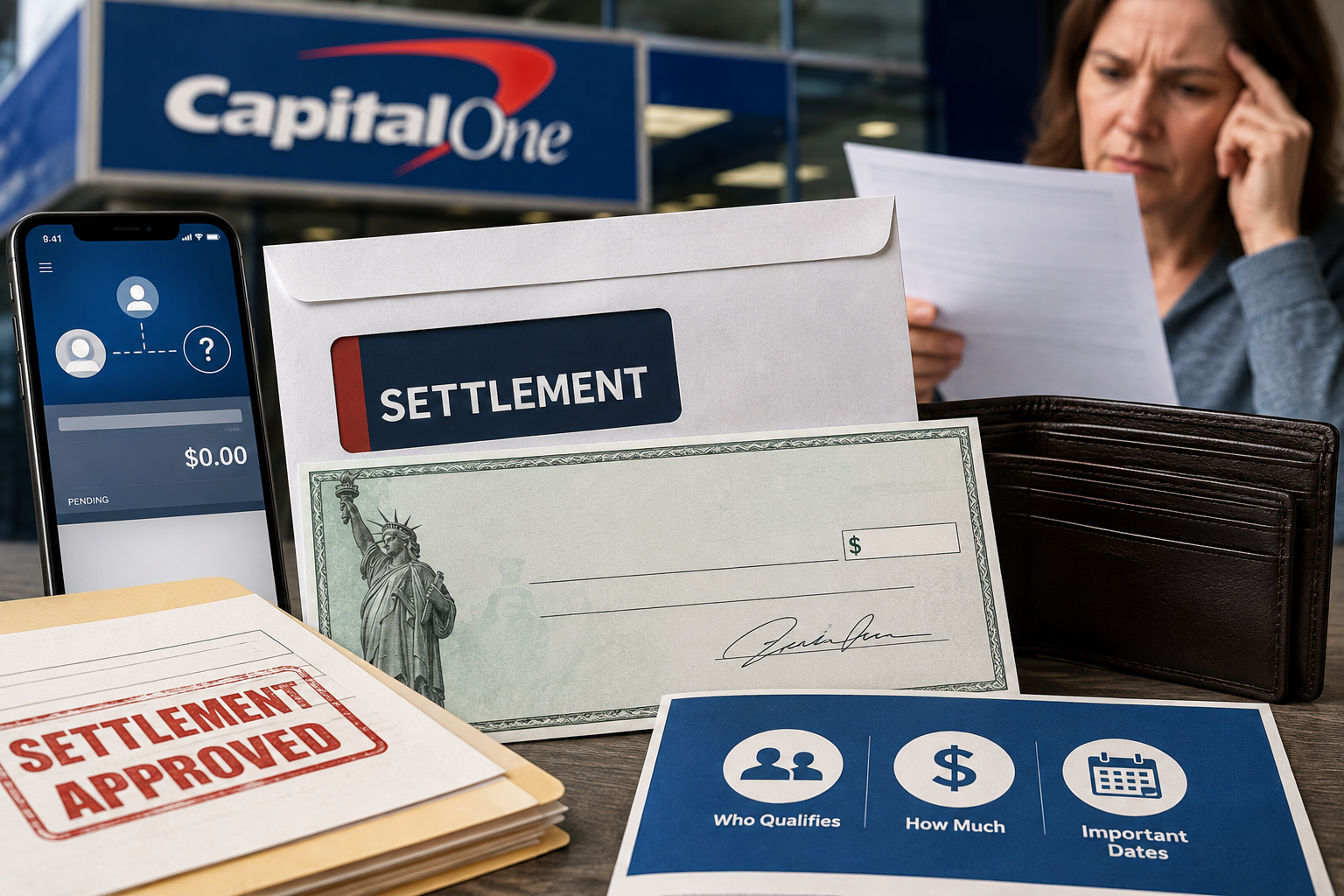
A federal judge has approved Capital One’s $425 million settlement over claims the bank misled savers by paying rock-bottom interest on one account while a nearly identical account earned far more. If you held a Capital One 360 Savings account at any point in the last several years, you’re likely owed money — and you don’t have to file anything to get it.
There’s one catch that most of the older coverage misses: the checks aren’t coming when they were supposed to. An appeal filed in June 2026 has, in the settlement administrator’s own words, “substantially delayed” payouts. Below is the full picture — who qualifies, how the money is calculated, and the real reason your payment hasn’t shown up yet.
What happened
On April 20, 2026, a judge in the U.S. District Court for the Eastern District of Virginia gave final approval to the settlement in In re: Capital One 360 Savings Account Interest Rate Litigation. It wasn’t a rubber stamp — the same court rejected an earlier version of the deal back in November 2025 and sent the lawyers back to strengthen the terms for customers.
The core allegation: Capital One ran two savings products with confusingly similar names. The older 360 Savings account saw its rate drift down to as low as 0.30%, while the newer 360 Performance Savings account — marketed to fresh money — paid as much as 4.35%. Plaintiffs argued longtime savers were quietly left behind while a near-twin account paid roughly ten times more. Capital One denies wrongdoing but agreed to settle.
The full $425 million goes to affected customers. Going forward, Capital One has also agreed to keep the two accounts’ rates aligned, so the gap that started this whole thing doesn’t reopen.
Who is affected
You’re a class member if you held a Capital One 360 Savings account between September 18, 2019 and June 16, 2025. That includes joint account holders and co-owners — not just the primary name on the account.
- Eligible: Anyone with a 360 Savings account during that window, even if you’ve since closed it.
- Not eligible: Customers who only ever held a 360 Performance Savings account. That’s the product that already paid the higher rate.
- Opt-outs: The deadline to exclude yourself passed in October 2025. If you did nothing, you’re automatically in.
Because Capital One is one of the largest deposit banks in the country, this reaches a lot of people who don’t think of themselves as “class-action” types — including plenty of Florida households who opened a 360 Savings account years ago and forgot the exact product name.
Product or service details: how much you’ll actually get
No competitor page we reviewed lays out the math plainly, so here it is. Your payment is pro-rata, meaning it’s proportional to how much you kept in the account and for how long the rate gap hurt you. The rough formula:
Your average daily balance × the interest-rate gap × the time you held the account
A worked example: say you kept about $10,000 in a 360 Savings account earning 0.30% while the Performance version paid roughly 4.30% — a gap of about 4 percentage points. Over one year, that gap is worth roughly $400 in foregone interest. Hold a smaller balance or a shorter time, and your share shrinks accordingly; hold more for longer, and it grows. Most individual payouts are expected to land in the tens to low hundreds of dollars, with the largest, longest-tenured balances higher.
| Factor | Effect on your payment |
|---|---|
| Higher average balance | Larger payout |
| Longer time held (2019–2025) | Larger payout |
| Wider rate gap during your holding period | Larger payout |
The settlement fund is administered so that these individual shares are calculated automatically from Capital One’s own account records — which is why there’s no claim form.
What consumers should do
For most people, the honest answer is very little — but not nothing.
- Don’t file a claim. Eligible customers are paid automatically. Any site or text demanding a “claim fee” or your Social Security number to “release” your payment is a scam.
- Update your mailing address. This is the big one. If you closed the account or moved since 2019, Capital One may be mailing a paper check to an old address. Retirees and snowbirds who relocated to Florida — or who split time between two states — are especially exposed here. Make sure the administrator and the bank have your current address.
- Know the elections have passed. The window to choose electronic payment closed March 30, 2026, and small payments under $5 required a separate election. If you missed those, a paper check is your default.
- Verify before you trust. Scammers piggyback on real settlements. Capital One and the administrator will never call to demand payment or gift cards. When in doubt, go directly to the official site rather than clicking a link in a text.
If you’re tracking more than one of these, it’s worth bookmarking our breakdown of the Bank of America fee settlement and our Sam’s Club decoration recall refund guide — the same “no action, but verify” playbook applies to both.
Refund, remedy, and contact options — and why your check is late
Here’s the update that makes most of the April 2026 coverage stale. Payments were originally expected to go out around July 27, 2026. That date is off the table.
In June 2026, an appeal was filed seeking to unwind the settlement. Under standard procedure, an appeal freezes disbursement until it’s resolved — the money can’t safely go out while an appellate court could still order it clawed back or recalculated. The administrator now describes the payout as substantially delayed, and appeals of this kind commonly run a year or more, which realistically pushes checks into mid-2027 or later.
What happens next depends on the appeal:
- If the appeal fails (the most common outcome for approved settlements), the deal stands and payments resume — just later than planned. You keep your place in line; you don’t need to re-enroll.
- If the appeal succeeds, the terms could be renegotiated or the timeline reset further. Even then, class members generally aren’t left with nothing — the litigation continues.
Either way, no action on your part speeds it up. The best thing you can do is keep your address current and ignore anyone claiming they can “expedite” your money for a fee.
Official channels: Check status at the settlement website, capitalone360savingsaccountlitigation.com, or call the administrator at 1-888-832-2704. Those are the only sources we’d trust for your case and payment status.
For readers thinking about the bigger picture — a few hundred dollars is nice, but it’s the balance you keep parked at low rates that really adds up over time. Our guide on how long $1.5 million lasts in retirement walks through why even a one- or two-point rate difference compounds into serious money, which is exactly the harm this settlement is trying to fix.
The bottom line
The Capital One $425 million settlement for misled customers is approved and real. If you held a 360 Savings account between September 2019 and June 2025, you’re in line for an automatic payment — no form, no fee. Just don’t expect it this summer. Thanks to the June 2026 appeal, the smart move is patience: confirm your address, guard against scams, and watch the official administrator site for the updated payout date.
FAQs
Do Capital One customers need to file a claim, or will they receive automatic payments from the approved settlement?
No claim is required. Capital One customers will receive automatic payments from the approved settlement based on the bank’s own account records. Eligible 360 Savings account holders are paid automatically — any request for a fee or your Social Security number to ‘release’ a payment is a scam.
Who qualifies for the Capital One $425 million settlement?
Anyone who held a Capital One 360 Savings account between September 18, 2019 and June 16, 2025, including joint and co-holders. Customers who only ever had a 360 Performance Savings account do not qualify, since that product already paid the higher rate.
How much money will I actually receive?
Payments are pro-rata, based roughly on your average daily balance times the interest-rate gap times how long you held the account. Most payouts fall in the tens to low hundreds of dollars, with larger, longer-held balances receiving more.
Why haven’t I received my Capital One settlement payment yet?
Payments were originally expected around July 27, 2026, but a June 2026 appeal seeking to unwind the settlement has substantially delayed disbursement. Appeals like this can take a year or more, potentially pushing checks into mid-2027 or later. No action on your part speeds it up.
What if I closed my Capital One account or moved?
You’re still eligible if you held a qualifying 360 Savings account during the class period, even if the account is now closed. The key step is making sure Capital One and the settlement administrator have your current mailing address so a paper check reaches you — especially important if you relocated to Florida.
Is the Capital One settlement payment taxable?
Settlement payments that represent lost interest are generally treated as taxable income, similar to the interest you would have earned. If your payment is large enough, you may receive a tax form. Consult a tax professional for your specific situation.