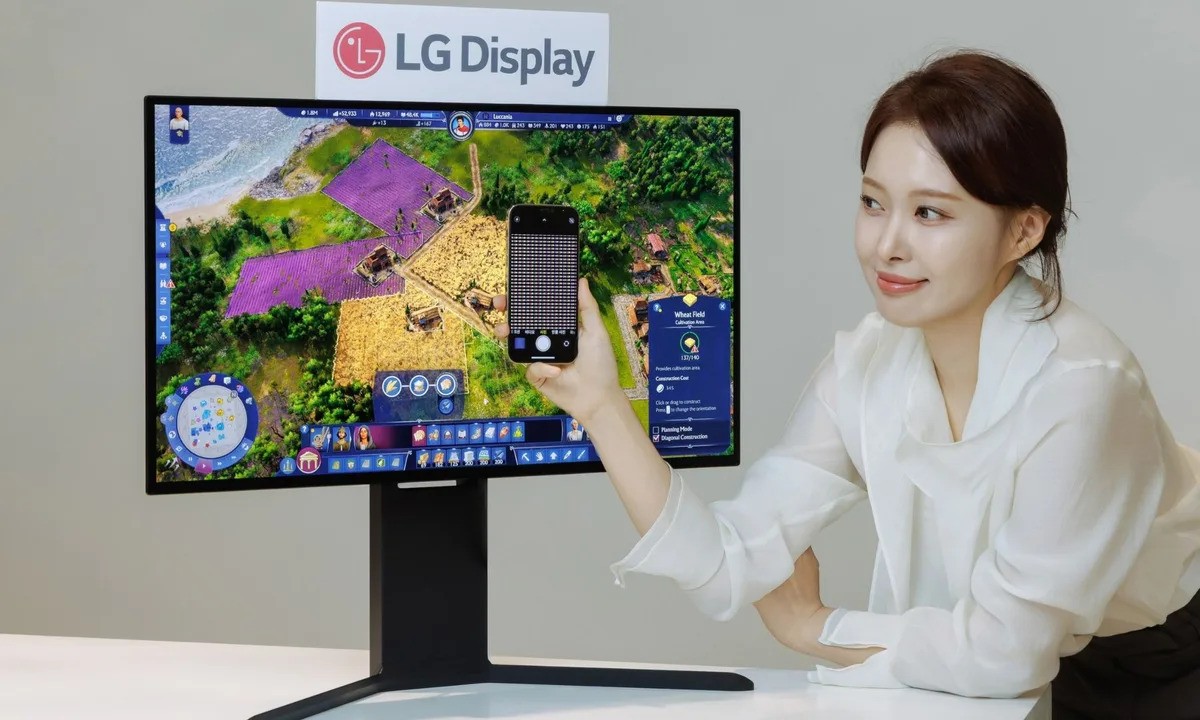
LG Display is getting ready to make a major statement at CES 2026, where it plans to showcase a new 27-inch 4K OLED monitor panel that could reshape expectations for both gaming and professional displays. This upcoming panel combines a traditional RGB stripe subpixel layout with a high 240Hz refresh rate, a pairing that has been difficult to achieve at this size and resolution until now.
The announcement comes as part of LG Display’s broader push to advance monitor technology at CES 2026. According to details shared ahead of the show, the company will present what it describes as the world’s first 27-inch 4K OLED panel to use a true RGB stripe configuration while still supporting ultra-high refresh rates. More information on LG Display’s CES plans can be found through its official announcements on sites like PR Newswire.
For years, OLED monitors have delivered stunning contrast, deep blacks, and vibrant colors, but they have struggled in one specific area that matters to everyday users: text clarity. Many OLED panels rely on alternative subpixel structures, which can cause color fringing and fuzzy edges around fonts, especially on Windows-based systems. This issue has made some users hesitant to adopt OLED for productivity-focused setups.
The RGB stripe layout directly addresses that problem. By aligning red, green, and blue subpixels in a straightforward horizontal pattern, this design matches what most operating systems are optimized for. As a result, text, user interface elements, and fine details appear sharper and more consistent. This layout has long been considered the gold standard for desktop monitors, but until recently, it was limited to lower refresh rates that made it impractical for gaming.
LG Display appears to have overcome that limitation. The new panel is designed to run at 4K resolution with a 240Hz refresh rate, bringing smooth motion and fast response times to a format that previously topped out at 60Hz when using an RGB stripe structure. Achieving this required a significant redesign of the panel’s internal pixel circuitry.
According to LG Display, engineers improved the aperture ratio of each pixel, essentially increasing the light-emitting area within the same pixel size. This change allows the panel to deliver higher brightness and faster switching speeds without sacrificing image quality. The result is a display that balances speed, clarity, and visual precision in a way that has not been possible with earlier OLED monitor panels.
Beyond standard operation, the panel also supports Dynamic Frequency and Resolution technology. This feature gives users the option to switch between different performance modes depending on their needs. At full 4K resolution, the display can operate at 240Hz, making it suitable for immersive gaming, creative work, and everyday multitasking. When resolution is lowered to 1080p, the refresh rate can jump to an impressive 480Hz, catering to competitive gamers who prioritize motion clarity and responsiveness.
This dual-mode capability effectively allows one monitor to serve multiple roles. Fast-paced esports titles benefit from the extreme refresh rate at lower resolutions, while single-player games, content creation, and professional applications can take advantage of the sharpness and detail offered by 4K output. It is a flexible approach that reflects how diverse modern monitor usage has become.
The benefits extend well beyond gaming. With a pixel density of around 160 pixels per inch, the panel delivers a level of sharpness comparable to high-end IPS displays commonly used in office and creative environments. Because the RGB stripe layout aligns with how most fonts are rendered, documents, spreadsheets, and design tools appear crisp and easy on the eyes. At the same time, users still get the hallmark advantages of OLED, including near-infinite contrast and precise color control.
LG Display’s move also highlights growing competition in the OLED monitor market. Rival technologies, such as QD-OLED panels developed by Samsung, have gained attention for their brightness and color performance. By refining its own OLED approach and solving long-standing usability concerns, LG Display is positioning itself strongly against these alternatives. More background on OLED display technology can be explored through resources like Digital Trends’ OLED monitor coverage.
The company already supplies roughly 30 percent of OLED monitor panels worldwide, and this new RGB stripe design is expected to roll out first across its premium gaming and professional product lines. CES 2026 will serve as the platform where LG Display sets a new benchmark for what high-end monitors can deliver, particularly for users who refuse to compromise between visual quality and performance.
As monitor demands continue to evolve, with users expecting one display to handle work, entertainment, and competitive gaming, LG Display’s upcoming panel reflects that shift. By combining a proven subpixel structure with cutting-edge refresh rates and flexible operating modes, the company is aiming to define the next generation of OLED monitors showcased at CES 2026.