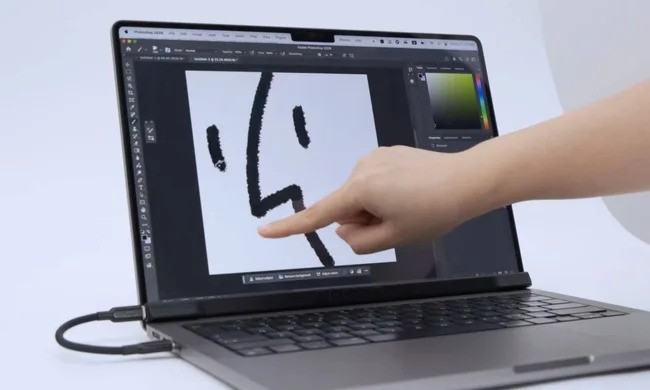
Apple’s next-generation MacBook Pro could be closer than many expected. New reports suggest that OLED display panels intended for future MacBook Pro models may have already entered production. If accurate, this would mark a major milestone for Apple’s laptop lineup and signal the most noticeable display upgrade in years.
According to information shared by a Korean industry blog, manufacturing of OLED panels designed specifically for upcoming MacBook Pro models has reportedly begun. The displays are said to be produced by Samsung, one of the world’s leading OLED suppliers and a long-time partner in Apple’s display supply chain. Even more notably, the report claims the production timeline is running ahead of the original schedule, which had targeted the second quarter of the year.
If this timeline holds, it suggests Apple has already finalized key decisions around display technology, panel size, and other specifications. That level of readiness aligns well with ongoing rumors pointing toward a 2026 launch window for the first OLED-equipped MacBook Pro models.
Inside the manufacturing shift behind Apple’s OLED MacBooks
The report states that Samsung Display has begun mass production of what are described as 8.6-generation OLED panels at its advanced manufacturing facility in Asan, South Korea. Unlike OLED panels used in smartphones, these panels are produced on larger glass substrates, allowing multiple laptop-sized displays to be cut from a single sheet.
This approach significantly improves production efficiency and yield rates while also helping reduce manufacturing costs. These factors are especially important for OLED laptops, which have traditionally been more expensive to produce than LCD-based alternatives.
The same production line is reportedly capable of producing tandem OLED panels with touch support. Tandem OLED technology uses two stacked OLED layers instead of one, enabling higher brightness levels, improved power efficiency, and longer panel lifespan. Apple has already adopted this dual-layer OLED approach in its latest iPad Pro models, where it has delivered noticeable gains in display performance.
By combining two OLED layers, tandem panels can achieve stronger peak brightness without compromising longevity. Power consumption is also reduced compared to traditional single-stack OLED displays, which is a critical advantage for battery-powered devices like laptops.
Samsung’s role and what it means for other laptops
The source also suggests that the first deliveries from this production line are intended specifically for the new Apple MacBook Pro. This implies Apple may have secured early priority access to these panels through an agreement with Samsung. If true, it would allow Apple to debut this OLED technology on its own hardware before similar panels become widely available to other laptop manufacturers.
Once Samsung fulfills its initial commitments to Apple, the same OLED panel technology could eventually make its way into high-end Windows laptops and other premium devices. This pattern would mirror previous display transitions where Apple was among the first to adopt new panel technologies at scale.
For users who have been waiting for an OLED MacBook Pro, the timeline may be shorter than expected. With display production reportedly underway, availability could align with Apple’s broader Mac roadmap over the next year or two.
How this fits into Apple’s broader Mac roadmap
Apple is widely expected to refresh the MacBook Pro lineup with more powerful M-series chips in the near future. Reports suggest that new models featuring M5 Pro and M5 Max chips could arrive as early as the beginning of next year. Those systems, however, are still expected to rely on existing display technology.
The OLED MacBook Pro models are more likely to coincide with a later generation of Apple silicon, potentially built around an M6 chip. That timing would give Apple room to introduce both a major performance upgrade and a significant display improvement in the same product cycle.
An OLED touchscreen MacBook Pro would represent a notable shift for Apple, especially given the company’s long-standing position on touch input for macOS laptops. If the reports prove accurate, Apple may be preparing to rethink some long-held design boundaries as OLED technology matures and becomes more efficient at laptop scale.
With production reportedly already in motion, the next phase will be confirming whether these panels make their way into final consumer devices on the expected timeline. Until Apple makes an official announcement, the OLED MacBook Pro remains unconfirmed, but current signs suggest it is moving steadily from rumor to reality.