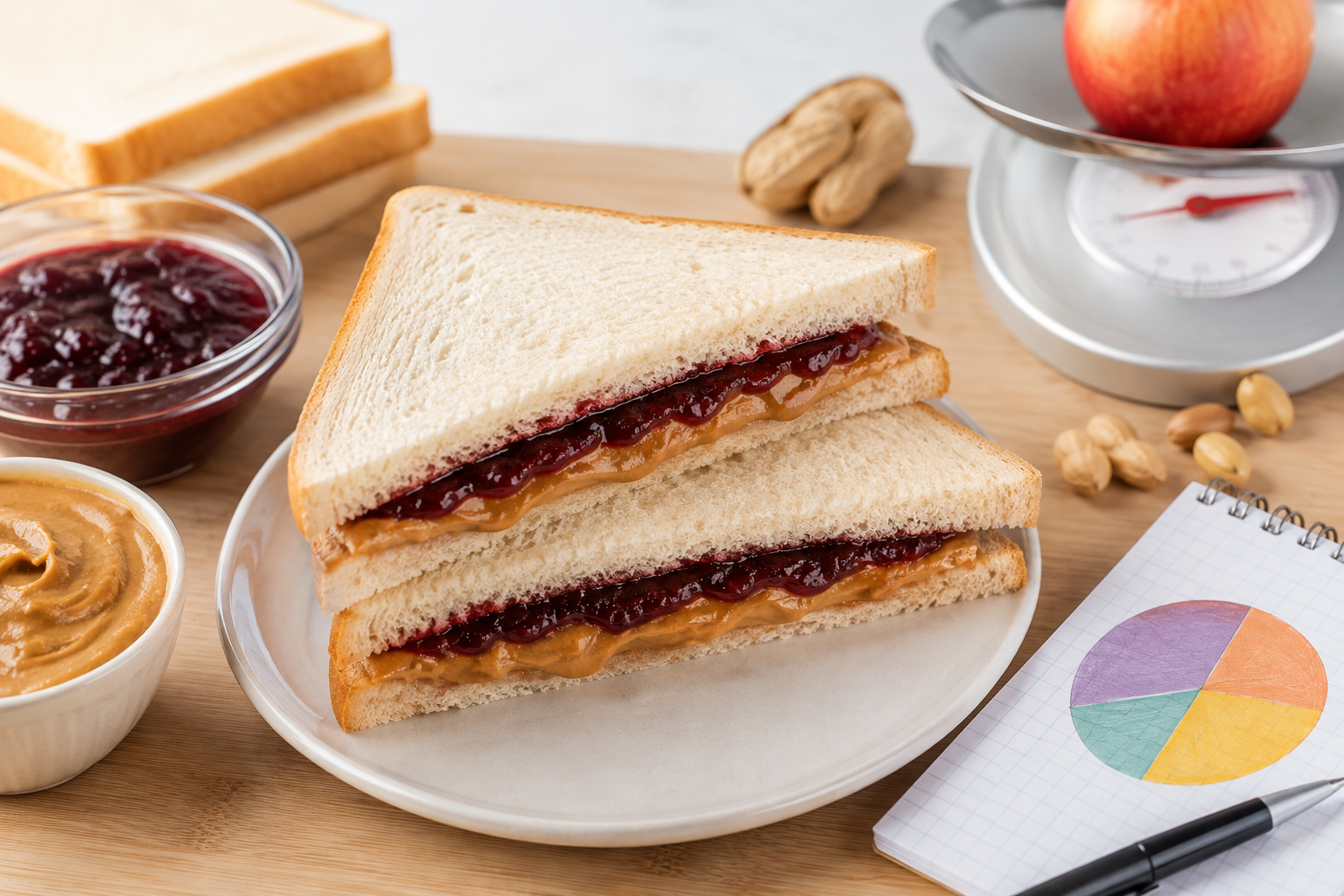
A standard peanut butter and jelly sandwich — two slices of bread, 2 tablespoons of peanut butter, and 1 tablespoon of jelly — comes to about 350 to 400 calories. Most fall right around 380 calories. The realistic range is wider than people expect: roughly 300 to 500 calories depending on your bread and, more than anything, how heavy your hand is with the peanut butter.
Those figures line up with the underlying values in the USDA’s FoodData Central database, which is the source most nutrition apps quietly pull from. Below we’ve consolidated the numbers those apps make you hunt for across a dozen separate pages.
What goes into the calorie count
A PB&J has just three parts, and each one moves the total in a predictable way.
- Bread (2 slices): ~130 to 185 calories, depending on type and slice thickness.
- Peanut butter (1 to 2 tbsp): ~95 to 190 calories. This is the single biggest variable.
- Jelly, jam, or preserves (1 to 2 tbsp): ~50 to 100 calories, almost all from sugar.
Here’s the part no database page explains: peanut butter portion size swings the total more than your bread choice does. Going from 1 tablespoon to 2 adds nearly 95 calories on its own — more than the difference between white bread and dense sourdough. If you eyeball your peanut butter with a butter knife, you’re almost certainly using closer to 2.5 tablespoons than 2, which is how a “350-calorie” sandwich quietly becomes a 450-calorie one.
Calories by bread type: white, wheat, sourdough, rye, and more
This is what searchers actually want and what no single top-ranking page gives you. Every row below assumes the same filling — 2 tbsp peanut butter and 1 tbsp jelly — so the only thing changing is the bread. That lets you compare cleanly.
| Bread (2 slices) | Calories | Protein | Carbs | Fat |
|---|---|---|---|---|
| White | ~370 | 12 g | 45 g | 18 g |
| Wheat | ~380 | 13 g | 46 g | 18 g |
| Whole wheat | ~400 | 16 g | 48 g | 18 g |
| Honey wheat | ~390 | 13 g | 48 g | 18 g |
| Sourdough | ~425 | 14 g | 56 g | 18 g |
| Rye | ~405 | 14 g | 50 g | 18 g |
| Potato | ~410 | 13 g | 52 g | 18 g |
A few takeaways:
- On white bread, a PB&J is about 370 calories — the leanest of the common options, and the classic lunchbox number.
- On wheat or whole wheat, you land around 380 to 400 calories, but you also pick up several grams of fiber and protein, which is the better trade.
- On sourdough or potato bread, the sandwich climbs toward 410 to 425 calories, mostly because those slices are denser and carrier more carbs — not because they’re “worse” for you.
For a side-by-side on another cookout staple, our complete guide to the calories in a hot dog and bun uses the same component-by-component approach.
Protein, carbs, and fat: the macro breakdown
People search “how much protein is in a PB sandwich” almost as often as they search the calories, so here’s the direct answer: a standard PB&J delivers about 12 to 15 grams of protein, most of it from the peanut butter, with a few grams from the bread.
The typical macro split for a standard sandwich:
- Protein: 12–15 g
- Carbohydrates: 45–56 g
- Fat: 14–20 g (largely the heart-healthy unsaturated fats in peanuts)
- Fiber: 2–5 g, higher with whole-grain bread
- Sugar: 10–18 g, and this is worth watching — most of it is added sugar from the jelly
That protein-and-fat combination is why a PB&J actually holds you over, unlike a plain jam sandwich. The added sugar in the jelly is the one number to keep an eye on if you’re tracking, because two heavy tablespoons of grape jelly can quietly double it.
Lighter and heavier versions
The “standard” sandwich is a starting point. Here’s how real versions shake out:
- Kid’s lunchbox version (thin-sliced bread, 1 tbsp each of PB and jelly): ~250 calories.
- Classic adult sandwich (2 tbsp PB, 1 tbsp jelly, standard bread): ~380–400 calories.
- Double-decker or three-slice version with a generous peanut butter layer: ~550–600 calories. This is where a “snack” becomes a full meal and then some.
- Higher-protein swap (whole-grain bread, natural peanut butter, low-sugar preserves): ~300–330 calories with 12–14 g protein and noticeably less sugar.
That last version is the sweet spot if you’re being deliberate: swap the jelly for reduced-sugar preserves or mashed berries, use natural peanut butter, and pick a whole-grain bread. You lose almost nothing in taste and gain fiber while cutting added sugar.
Is a peanut butter and jelly sandwich healthy?
It’s more balanced than its reputation suggests. Dietitians quoted in mainstream coverage — including USA Today‘s look at the sandwich — generally land in the same place: a PB&J is a legitimately decent, affordable meal, with a couple of easy upgrades.
What’s working in its favor: real protein, unsaturated fats, and quick carbohydrate energy, which is exactly why endurance athletes swear by it as fuel. What to watch: added sugar from the jelly and refined carbs if you use plain white bread. Neither is a dealbreaker; both are easy to dial back.
Per the Dietary Guidelines for Americans, keeping added sugars modest and leaning on whole grains are the two levers that matter most here — and a PB&J responds well to both. Choose whole-grain bread, natural peanut butter, and reduced-sugar preserves and you’ve addressed the only real critiques in one move. (This is general nutrition information, not medical advice — check with your doctor or a registered dietitian for guidance specific to you.) For more in this vein, browse our Health section.
The Florida angle
There’s a reason the PB&J is a fixture of Florida summers: it’s a no-cook, no-refrigeration, no-melt lunch that survives a beach bag or a school backpack in August heat far better than anything with mayo or deli meat. For a cooler-free day on the sand, it’s hard to beat on cost, calories, and staying power.
The bottom line: plan on roughly 350 to 400 calories for a standard peanut butter and jelly sandwich, adjust up or down mostly by your peanut butter portion, and use the table above to pin the exact number for your bread of choice.
FAQs
How many calories are in a peanut butter and jelly sandwich on white bread?
About 370 calories, using two slices of white bread, 2 tablespoons of peanut butter, and 1 tablespoon of jelly. That makes white bread the leanest of the common options and the classic lunchbox figure.
How many calories are in a peanut butter and jelly sandwich on wheat bread?
Around 380 calories on regular wheat bread and closer to 400 on dense whole wheat. Whole wheat costs you a few extra calories but adds fiber and protein, which is the better trade for most people.
How much protein is in a PB&J sandwich?
A standard peanut butter and jelly sandwich has about 12 to 15 grams of protein, most of it from the 2 tablespoons of peanut butter, with a few grams from the bread. Whole-grain bread pushes it toward the higher end.
Is a peanut butter and jelly sandwich good for weight loss?
It can be, in moderation. The protein and healthy fats make it filling, but the calories add up fast if you’re heavy with the peanut butter or jelly. For a lower-calorie version, use thin-sliced whole-grain bread, natural peanut butter, and reduced-sugar preserves to land near 300 calories.
How many calories are in just a peanut butter sandwich without jelly?
About 300 to 340 calories for two slices of bread and 2 tablespoons of peanut butter. Skipping the jelly cuts roughly 50 calories and, more importantly, removes most of the added sugar.
How many calories should a sandwich have for a meal versus a snack?
As a general guide, a snack-sized sandwich runs about 150 to 250 calories, while a meal sandwich typically lands between 350 and 500. A standard PB&J at 350 to 400 calories sits squarely in meal territory.