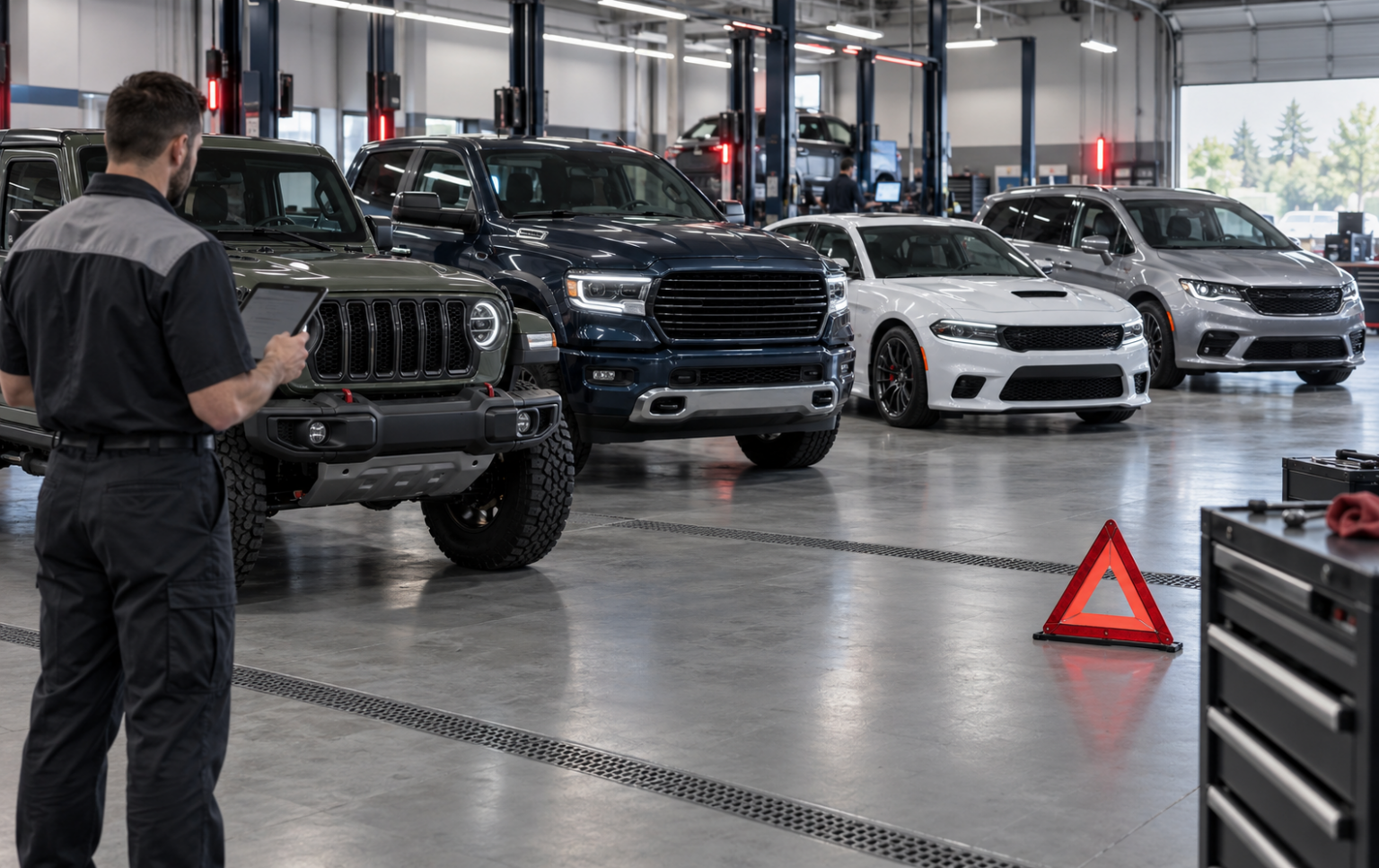
If an FCA US vehicle recall notice just landed in your mailbox — or you keep seeing the term in the news and aren’t sure whether your Jeep, Ram, Dodge, or Chrysler is on the list — here’s the short version: a recall means the manufacturer or federal regulators found a safety defect, and the fix is free, by law, at any authorized dealer. This page pulls the current 2026 recalls into one place, shows you how to confirm whether your exact vehicle is affected, and walks you through getting it repaired without paying a cent.
What Happened: FCA US, Stellantis, and the 2026 Recall Wave
First, the name confusion. FCA US LLC stands for Fiat Chrysler Automobiles US — the company behind the Chrysler, Dodge, Jeep, Ram, and Fiat brands in North America. FCA merged into Stellantis in 2021, but the legal entity that files recalls with regulators is still “FCA US LLC.” That’s why your official letter and the NHTSA database say FCA US even though you bought a Jeep or a Ram.
A recall gets triggered when FCA or the National Highway Traffic Safety Administration (NHTSA) identifies a defect that creates an unreasonable safety risk or fails to meet a federal safety standard. FCA is then legally required to notify registered owners by first-class mail and repair the problem at no charge.
Several separate FCA US recalls are active right now, and they’re being mailed in waves — which is why two neighbors with the same model can get notices weeks apart. The largest and most talked-about campaigns in 2026 are:
- Rearview camera software — a software glitch that can prevent the backup camera image from displaying, affecting roughly 848,000 Chrysler, Dodge, Jeep, and Ram vehicles.
- Instrument panel display defect — about 20,000 Jeep Wagoneer S and Dodge Charger EV models whose center or gauge display can go blank.
- Takata airbag “stop-drive” advisory — older vehicles with defective Takata inflators that FCA urges owners not to drive until repaired.
These are distinct campaigns with distinct remedies. Getting one notice doesn’t mean you’re clear on the others — always check your VIN against all open recalls.
Who Is Affected: Models, Years, and the VIN Check That Settles It
A recall covers specific build ranges, not entire model lines, so the only definitive answer comes from your VIN. Here’s a scannable snapshot of the current campaigns:
| Recall | Affected vehicles | Approx. count |
|---|---|---|
| Rearview camera software | Select 2022–2025 Chrysler, Dodge, Jeep & Ram models | ~848,000 |
| Instrument panel display | 2024–2025 Jeep Wagoneer S, Dodge Charger EV (Daytona) | ~20,000 |
| Takata airbag (stop-drive) | Older Dodge, Chrysler & Ram models with Takata inflators | Varies by region |
How to look up a recall by VIN: Grab your 17-character Vehicle Identification Number — it’s on the driver’s-side dashboard where it meets the windshield, on the door-jamb sticker, and on your registration and insurance card. Then:
- Go to nhtsa.gov/recalls and enter your VIN. This is the federal database and covers every manufacturer, not just FCA.
- Cross-check at mopar.com (the official FCA/Stellantis owner site) using the recall lookup tool for FCA-specific campaign details and dealer scheduling.
If either tool returns “0 open recalls,” you’re currently clear — but recalls are announced continuously, so it’s worth checking a couple of times a year.
Do recalls apply to used vehicles?
Yes. This is the question autocomplete asks most, and the answer surprises people: a recall follows the vehicle, not the buyer. If you bought a used Jeep from a dealer, a private seller, or an auction, the free repair still applies. You don’t need the original paperwork or to be the person the letter was addressed to — the dealer verifies eligibility by VIN. The only catch with used vehicles is that FCA mails notices to the registered owner on file, so if the title hasn’t caught up, you may need to check your VIN yourself rather than wait for a letter.
Product or Service Details: What’s Actually Wrong, in Plain English
Rearview camera software. A software fault can cause the backup-camera image to fail to appear on the screen when you shift into reverse. A blank camera view increases the risk of a low-speed crash and violates federal rear-visibility standards. The remedy is a free software update — often quick, sometimes deliverable over-the-air depending on the vehicle.
Instrument panel display. On the affected Wagoneer S and Charger EV models, the digital display can go blank, hiding critical information like your speed, gear position, or warning lights. Driving without those indicators raises crash risk, which is why NHTSA flagged it. Dealers correct it with a software or hardware fix at no cost.
Takata airbag — and why “stop-drive” is different. A standard recall says: get this fixed soon, but you can keep driving in the meantime. A “stop-drive” (or “do not drive”) advisory is the serious tier — FCA is telling owners the risk is high enough that the vehicle should not be driven until repaired. Defective Takata inflators can rupture and send metal fragments into the cabin, and the risk grows with age and humidity — which makes Florida’s climate especially relevant. If your VIN returns a stop-drive Takata recall, call FCA about free towing or mobile repair rather than driving to the dealer.
What Consumers Should Do: A Simple Action Checklist
- Check your VIN at nhtsa.gov/recalls and mopar.com. This takes two minutes and is the single most important step.
- Read the notice if you’ve received one. It names the defect, the risk, the remedy, and whether parts are available yet. FCA sometimes mails an “interim” notice before the fix is ready, followed by a second letter when you can schedule.
- Schedule the free repair at any authorized FCA dealer — you don’t have to return to the one you bought from. Mention the recall campaign number from your letter or VIN lookup.
- Haven’t gotten a letter but your VIN shows a recall? You don’t need to wait. Call the FCA Recall Assistance Center or your dealer and book the service using the campaign number.
- Dealer can’t fix it in a reasonable time? If parts are on backorder or you’re being stalled, file a complaint at nhtsa.gov or call the NHTSA Vehicle Safety Hotline. Manufacturers are obligated to remedy recalls without unreasonable delay.
For a sense of how these consumer-alert processes tend to play out, our coverage of the Sam’s Club decoration recall and the Glenmark bisoprolol fumarate recall walks through similar refund-and-remedy steps for other products.
Refund, Remedy, or Contact Options
Is an FCA recall repair really free? Yes — parts and labor are covered in full. A dealer cannot charge you for a recall remedy, and “are car recalls mandatory” for the manufacturer to fix? Also yes: federal law requires FCA to provide the repair at no cost.
Already paid out of pocket? If you paid for a repair that later became a recall, you may be reimbursed. FCA runs a reimbursement process at fcarecallreimbursement.com, where you can submit your claim and receipts online, or mail in documentation. Keep every receipt and expect a processing window of around 60 days. Checking your FCA recall reimbursement status is done through that same portal or the phone number on your claim confirmation.
Key contacts:
- FCA Recall Assistance Center — for campaign details, scheduling help, towing on stop-drive recalls, and reimbursement questions.
- NHTSA Vehicle Safety Hotline: 1-888-327-4236 — to confirm recalls, report a defect, or escalate an unresponsive dealer.
Florida note: Because Takata airbag ruptures are tied to heat and humidity, Florida owners should treat any stop-drive Takata notice as urgent. If a dispute isn’t resolved through FCA or NHTSA, you can also file a complaint with the Florida Attorney General’s consumer protection division or the Florida Department of Agriculture and Consumer Services. For a similar consumer-rights walkthrough, see our explainer on the Capital One $425 million settlement.
Bottom line: an FCA US vehicle recall notice isn’t a sales pitch and it isn’t optional busywork — it’s a free safety fix you’re entitled to. Check your VIN, book the repair, and if you already paid, claim your money back.
FAQs
What is a vehicle recall notice?
A vehicle recall notice is an official letter — required by federal law — telling you that your vehicle has a safety defect or fails a federal safety standard. It names the problem, the safety risk, and the free remedy. FCA US (now part of Stellantis) mails these to the registered owner and must repair the issue at no charge.
How do I know if my car has an FCA recall?
Enter your 17-character VIN at nhtsa.gov/recalls and cross-check at mopar.com. Your VIN is on the driver’s-side dash, the door-jamb sticker, and your registration. The lookup tells you exactly which open recalls apply to your specific vehicle — don’t rely on the model name alone.
Do recalls apply to used vehicles?
Yes. A recall follows the vehicle, not the owner, so a free repair applies whether you bought new, used, from a dealer, or in a private sale. You don’t need the original paperwork — the dealer verifies eligibility by VIN. Just check your VIN yourself, since notices are mailed to the registered owner on file.
Are car recalls mandatory and is the repair free?
The manufacturer is legally required to fix a safety recall at no cost to you — parts and labor included. You are not required to get it done, but you should, because it’s free and addresses a genuine safety risk. Dealers cannot charge you for a recall remedy.
How do I check my FCA recall reimbursement status?
If you already paid for a repair later covered by a recall, submit your receipts at fcarecallreimbursement.com or by mail. You can track your claim through that same portal or the phone number on your confirmation. Processing typically takes about 60 days, so keep copies of all documentation.
What happens if I ignore an FCA recall notice?
There’s no fine for ignoring it, but the safety defect remains — which can mean a failed backup camera, a blank instrument display, or, in Takata stop-drive cases, a serious airbag rupture risk. Recalls generally don’t expire, and an unfixed recall can also lower resale value and complicate a future sale.