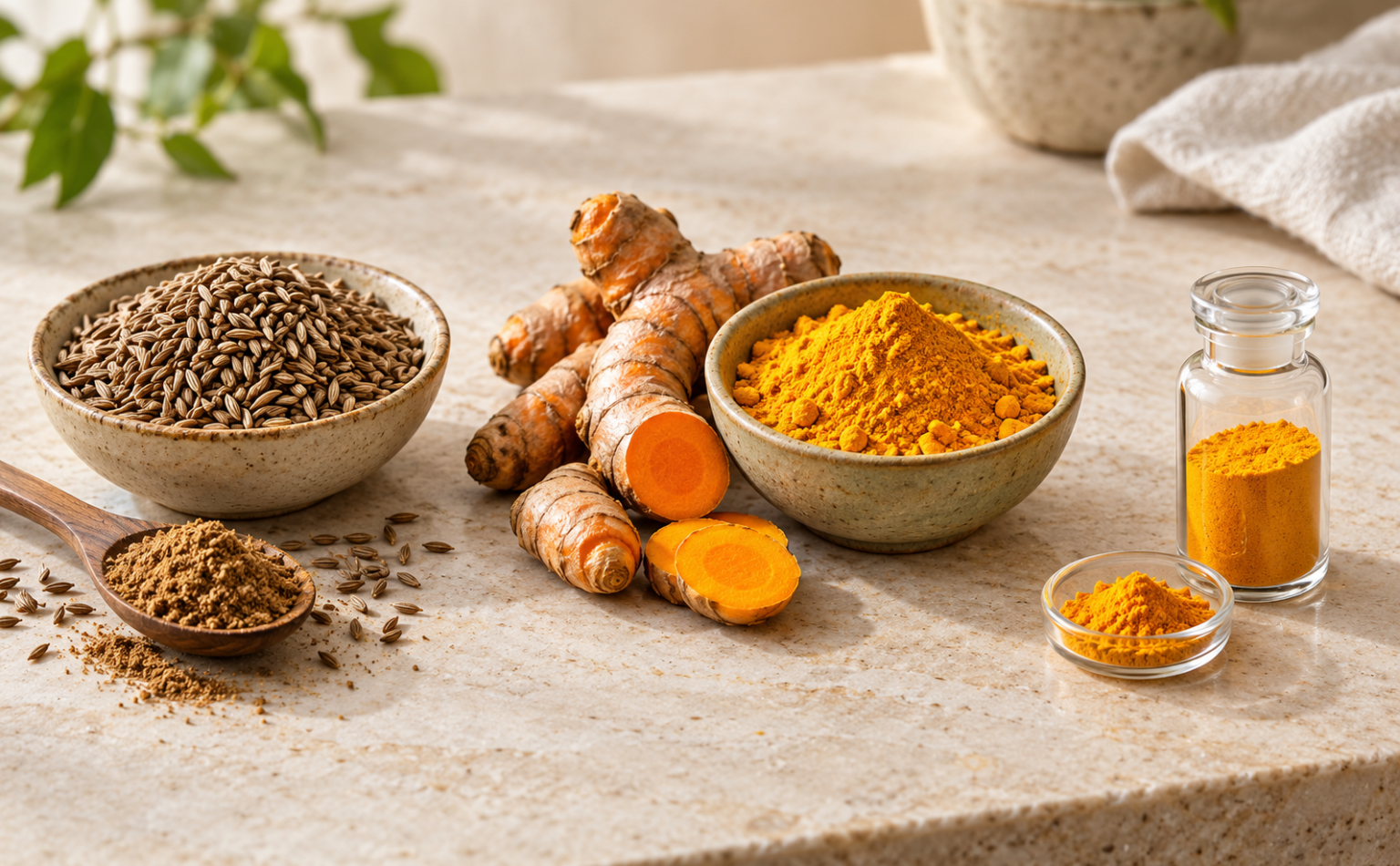
No, cumin and curcumin are not the same thing, and they don’t come from the same plant. Cumin is a spice made from the dried seeds of Cuminum cyminum, which belongs to the parsley family. Curcumin is a chemical compound, and it’s the main yellow pigment in turmeric (Curcuma longa), a root in the ginger family. So if you’re wondering whether cumin is the same as curcumin, or curcumin the same as cumin, the answer is no either way. Ground cumin contains no curcumin at all.
The short version: cumin is a spice, turmeric is a spice, and curcumin is a compound found in turmeric. The rest of this guide explains why the names get confused, how to tell them apart on a label, and what the National Institutes of Health says about curcumin supplements.
Is Cumin the Same as Curcumin?
No. The two words sound alike, and both turn up in curry powder, but that’s where the overlap stops.
- Cumin is a whole spice, sold as seeds or ground powder. It tastes earthy, warm and a little smoky.
- Turmeric is a separate spice made from a dried, ground rhizome (an underground stem). It’s bright yellow-orange, with a mildly bitter, peppery flavor.
- Curcumin is the best-known curcuminoid, a group of polyphenol compounds in turmeric. You’ll mostly see it as a supplement ingredient or a food coloring, not as a jar on the spice rack.
What It Means: Cumin vs Turmeric vs Curcumin
Most pages on this topic compare only turmeric with curcumin and give cumin one line. Here are all three side by side, because the name confusion involves all three.
| Cumin | Turmeric | Curcumin | |
|---|---|---|---|
| What it is | Spice | Spice | Chemical compound (a polyphenol) |
| Source | Cuminum cyminum, parsley family (Apiaceae) | Curcuma longa, ginger family (Zingiberaceae) | Turmeric root |
| Part used | Dried seed (botanically a fruit) | Rhizome, boiled, dried and ground | Extracted and concentrated from the rhizome |
| Color | Tan to brownish | Bright yellow-orange | Intense yellow-orange |
| Flavor | Earthy, warm, nutty | Earthy, slightly bitter, peppery | Barely matters at supplement doses |
| Signature compound | Cuminaldehyde (gives the aroma) | Curcuminoids, including curcumin | Is the compound |
| Typical form | Seeds, ground spice | Ground spice, fresh root, tea | Capsules, tablets, color additive |
Why People Mix Up Cumin and Curcumin
Three things cause most of the confusion:
- Spelling. “Cumin” and “curcumin” are only two letters apart, and autocorrect doesn’t help.
- Same blends. Most curry powders contain both cumin and turmeric, so people assume they’re related.
- Similar-looking powders. In a dim pantry, a dusty jar of ground cumin and an older jar of turmeric can look close enough to grab the wrong one.
The names really aren’t related. “Cumin” goes back through Latin and Greek to Semitic words for the plant. “Curcumin” comes from Curcuma, the botanical genus that turmeric belongs to.
Key Facts and Context About Curcumin and Cumin
Turmeric Is Only a Few Percent Curcumin
Turmeric powder isn’t the same as curcumin, either. Curcuminoids make up only a small share of the spice by weight. Analyses commonly put it around 3%, and published figures range from roughly 2% to 8% depending on the variety, growing conditions and processing. A teaspoon of turmeric in your rice therefore delivers far less curcumin than a capsule labeled “standardized to 95% curcuminoids.”
Cumin Has No Curcumin
Ground cumin is not the same as curcumin, and it isn’t a weaker version of it. Cumin’s main aroma compound is cuminaldehyde. If a product says “cumin” and nothing else, it contains no turmeric or curcumin.
Curcumin Is Poorly Absorbed on Its Own
The body doesn’t absorb curcumin well, and it breaks it down quickly. For that reason, many supplements add black pepper extract (piperine), which slows that breakdown. A small, frequently cited 1998 study reported a roughly 20-fold increase in blood levels when piperine was added. Other products use fat-based or other specialized formulations. Better absorption isn’t automatically a good thing, though. Piperine can change how the body processes some medications too.
What the Evidence Actually Says
Here is where we part ways with supplement-brand pages. The NIH’s National Center for Complementary and Integrative Health (NCCIH) says that although turmeric and curcumin have been studied for many conditions, the evidence is limited and doesn’t firmly support using them for any specific health problem. Lab and animal results often don’t hold up in people, partly because absorption is so poor.
Keep in mind that in the U.S., dietary supplements don’t need FDA approval for safety or effectiveness before they go on sale. The FDA’s supplement guidance explains how that system works.
Examples and Use Cases: Kitchen, Labels and Supplements
Can You Substitute Cumin for Turmeric?
Not really. If you swap one for the other, you’ll change the dish.
- Cumin works in chili, tacos, black beans, picadillo, hummus, falafel, dry rubs and many Indian dals, where whole seeds are often toasted in oil first.
- Turmeric works in yellow rice, curries, golden milk, egg dishes and pickles. It also gives American yellow mustard its color.
If a recipe asks for turmeric mainly for color, a small pinch of paprika or saffron is a better substitute than cumin. If it asks for cumin and you’re out, ground coriander or a little chili powder (which usually contains cumin) will get you closer. Just leave it out rather than reach for turmeric.
How to Read the Label
- “Cumin” or “comino”: cumin seed spice. “Comino” is the Spanish word, and you’ll see it on many Latin-brand jars.
- “Turmeric” or “cúrcuma”: whole ground turmeric root, with naturally low curcumin.
- “Turmeric extract” or “95% curcuminoids”: a concentrated supplement ingredient. Check the milligrams per serving.
- “Curcumin” in a food ingredient list: often used as a natural yellow color (labeled E100 in Europe).
- “With BioPerine” or “black pepper extract”: contains piperine to boost absorption.
If You’re Shopping for a Curcumin Supplement
We don’t recommend specific brands, but these checks separate a carefully made product from a marketing exercise:
- Look for a stated curcuminoid amount per serving, not just “turmeric 1,000 mg.” Those aren’t the same thing.
- Look for a third-party seal such as USP Verified or NSF Certified. These confirm the label matches what’s in the bottle and screen for contaminants. They don’t confirm that the product works.
- Be wary of disease claims. Supplements can’t legally claim to treat or cure a disease.
- Bring the bottle to your pharmacist if you take any prescription medication.
Who Should Talk to a Clinician First
Turmeric in normal food amounts is generally considered safe. Concentrated supplements are a different matter. According to NCCIH and MedlinePlus, check with a doctor or pharmacist before using turmeric or curcumin supplements if you:
- Take blood thinners or antiplatelet drugs, because turmeric may slow blood clotting
- Have gallbladder problems such as gallstones
- Are pregnant, since medicinal amounts may not be safe
- Have a liver condition. NCCIH notes rare reports of liver injury linked to turmeric supplements
- Take diabetes medications, or have surgery scheduled
The most common side effects reported are digestive, such as nausea, diarrhea or an upset stomach. Pay attention to how you feel, and stop and call your clinician if something seems off.
Common Questions: Is Curcumin and Cumin the Same Thing?
No. One is a spice, and the other is a compound from a different spice. Here are the variations people search for:
- Is curcumin the same as cumin powder? No. Cumin powder is ground cumin seed and contains no curcumin.
- Are cumin and turmeric the same spice, or the same plant? No. Cumin is a seed from the parsley family. Turmeric is a root from the ginger family.
- Is turmeric the same as curcumin? Not exactly. Turmeric contains curcumin, but turmeric is the whole spice and curcumin is a small part of it.
More questions are answered in the FAQ below.
Florida Relevance: Comino, Curry and the Spice Aisle
In Florida, cumin is part of everyday home cooking. Cuban black beans, picadillo and many mojo marinades rely on it, and in Miami-Dade, Hillsborough and Orange counties, supermarket spice aisles often stock it as comino, sometimes next to cúrcuma (turmeric). If you’re reading a Spanish-language label, those are the two words to know.
Florida’s large Jamaican, Trinidadian and Guyanese communities cook with turmeric-heavy curry powders, which usually include cumin as well. That’s one reason people here end up comparing the two jars. Remember that a curry powder is a blend, not a source of meaningful curcumin.
If you’re considering a curcumin supplement and take regular prescriptions, any Florida-licensed pharmacist can check it for interactions at no charge when you pick up your medications.
Related Reading
For more evidence-based food and wellness explainers, browse our Health section. You may also like How Many Calories in a Mandarin? USDA Numbers by Size and our realistic, CDC-backed plan for how to get toned.
This article is for general information and isn’t medical advice. Talk with a qualified health professional before starting any supplement.
FAQs
Is cumin the same as curcumin?
No. Cumin is a spice made from the seeds of Cuminum cyminum, a parsley-family plant. Curcumin is a yellow polyphenol compound found in turmeric, a root in the ginger family. Cumin contains no curcumin.
Is cumin and turmeric the same thing?
No. They come from different plants and different plant parts. Cumin is a seed with an earthy, warm flavor. Turmeric is a ground rhizome that is bright yellow-orange with a mildly bitter, peppery taste. Many curry powders contain both, which is why people confuse them.
Is ground cumin the same as curcumin?
No. Ground cumin is simply powdered cumin seed, and its main aroma compound is cuminaldehyde. If you want curcumin from food, the source is turmeric, and even turmeric is only a few percent curcuminoids by weight.
Can I substitute cumin for turmeric in a recipe?
It isn’t a good swap, because the flavors and colors are very different. If you need turmeric for color, a pinch of paprika or saffron is a closer match. If you’re out of cumin, ground coriander or chili powder works better than turmeric.
What is curcumin found in?
Curcumin occurs naturally in turmeric root (Curcuma longa). It is also extracted for dietary supplements and used as a natural yellow food coloring. It is not found in cumin, ginger powder or black pepper.
Are curcumin supplements safe?
Turmeric in food amounts is generally considered safe. According to NIH’s NCCIH and MedlinePlus, people who take blood thinners, have gallbladder or liver conditions, or are pregnant should talk to a clinician before using concentrated curcumin supplements. NCCIH also notes rare reports of liver injury.