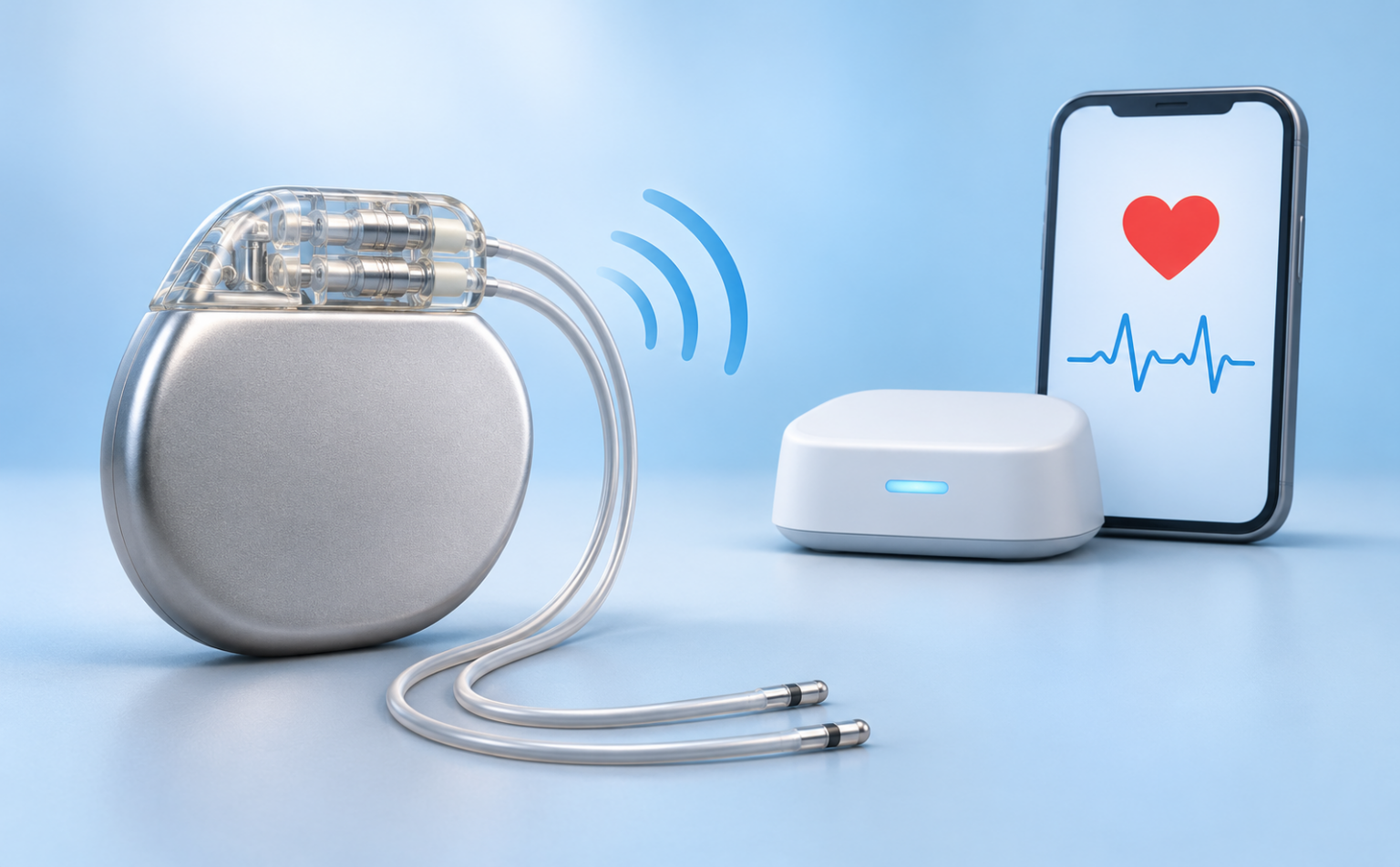
No. You can’t track a pacemaker’s location the way you track a phone. A pacemaker has no GPS receiver and no cellular radio, and it can’t report where it is to anyone. That covers every version of the question: by GPS, remotely, or through an app. Medtronic, one of the largest manufacturers, says plainly that its heart devices don’t communicate with satellites. USA Today’s reporting on the Nancy Guthrie case reached the same conclusion: the devices can’t be used to find a person.
There is one real caveat. A pacemaker that pairs with a smartphone app or a bedside monitor leaves a record of when it was last in range of that phone or monitor. That record can help with a timeline. It can’t give you a location.
What it means: why a pacemaker isn’t a tracker
A pacemaker has one job: sense your heart’s rhythm and send a small electrical pulse when the rhythm is too slow or skips. Everything else about the hardware supports that job.
- No GPS chip. Finding a position by satellite takes a receiver and an antenna that can hear faint signals from space. A pacemaker has neither.
- No cellular radio. It can’t connect to a cell tower, so it can’t send anything over long distances by itself.
- A tiny battery that has to last. Most pacemaker batteries last roughly 7 to 15 years, and replacing one means surgery. Running GPS or a cellular modem would drain it in days or weeks, so engineers keep the radio as small and quiet as possible.
Three words get mixed up here, and the difference matters:
- Monitoring means your care team reviews health data from the device. Pacemakers do this.
- Tracking means following someone’s position over time. Pacemakers can’t do this.
- Locating or tracing means finding where a device is right now. A pacemaker can’t do this on its own. At most, it shows whether it was close to a paired phone or monitor.
Key facts and context: how pacemakers communicate
The clinic programmer: inches away
In the device clinic, a technician uses a programmer to read and adjust your settings. Older systems use a wand placed directly over the device, which works at a range of a few inches. Newer systems use short-range radio, which still only reaches a few feet across an exam room.
Home monitor or smartphone app: how far away can you track a pacemaker?
Many patients have a bedside monitor. Newer models instead pair with a manufacturer app on the patient’s phone over Bluetooth Low Energy. In everyday use, that link usually works within about 10 to 30 feet. Walls, bodies and phone settings shrink that distance. Past that point, the phone can’t hear the device at all.
That means the best answer to “how far away can you track a pacemaker” is about as far as the next room. Even inside that range, the link only tells you the device is near the paired phone. The phone is the part that knows where it is, if it has location services turned on.
What data actually gets sent
The monitor or app collects data from the device and sends it over the internet to a secure clinic portal. A typical transmission includes:
- Heart rhythm recordings and any arrhythmia episodes
- Heart rate trends and how often the device paced
- Battery status and estimated time until replacement
- Lead measurements, which show whether the wires are working properly
- Device settings
- Activity level, from a built-in motion sensor
GPS coordinates are not on that list. The phone app may collect its own data under the app’s privacy policy, but the pacemaker isn’t the source.
How device types differ
| Device | How it talks | Realistic range | Can it share a location? |
|---|---|---|---|
| Traditional pacemaker with bedside monitor | Short-range radio to monitor; monitor uses cellular or Wi-Fi | A few feet to one room | No |
| Bluetooth/app-connected pacemaker | Bluetooth Low Energy to phone app | Roughly 10–30 feet | No. Only shows it was near the paired phone |
| Leadless pacemaker | Clinic programmer; remote monitoring varies by model | Very short | No |
| ICD (implantable defibrillator) | Same as above, depending on model | Few feet to one room | No |
Each manufacturer works a little differently, and so does each model. Your device clinic can tell you exactly how yours connects.
Examples and use cases: remote monitoring and the Nancy Guthrie case
What clinics do with remote data
Most clinics schedule an automatic transmission every three months or so. The device can also send an alert when something important happens, such as a long arrhythmia or a lead problem. Major cardiology societies recommend remote monitoring because it catches problems earlier and saves patients many in-office checks. A nurse or technician reviews the data and calls if something needs attention. Nobody is watching a map.
What the Guthrie case did and didn’t show
Nancy Guthrie, the mother of TODAY co-anchor Savannah Guthrie, was reported missing from her Arizona home in early February 2026. According to news reports, her pacemaker lost its connection to the app on her phone at about 2:28 a.m. on Feb. 1.
That detail mattered to investigators because it was a timeline clue. It suggested when the device moved out of Bluetooth range of the phone. It did not show where she went, and it couldn’t. After the connection dropped, nothing nearby could hear the device.
Some coverage mentioned trying to pick up the device’s signal from aircraft or with specialized receivers. Experts quoted in those reports said this was a long shot, because the signal is very weak and range is measured in feet. It isn’t routine police practice, and you shouldn’t expect it in a missing-person case.
A lost connection doesn’t mean the pacemaker stopped
Families often worry about this. If the phone dies, the monitor gets unplugged or the patient walks out of range, the pacemaker keeps pacing normally. It stores data and sends it the next time it reconnects. The connection is for monitoring, not for keeping the device running.
What to do if someone with a pacemaker is missing
- Call 911 immediately. Tell the dispatcher about the pacemaker and any other conditions, such as dementia, diabetes or medications the person needs.
- Use tools that actually track location. Phone location sharing, Find My (Apple), Google’s Find Hub, a car’s connected app or a GPS wearable can all show a position. The pacemaker can’t.
- Call the cardiology clinic. Staff can check the time of the last remote transmission. That can help police build a timeline, though it won’t give them a location.
- Plan ahead. If a loved one has memory problems, set up location sharing or a GPS medical-alert device now, before you need it.
This is general information, not medical or legal advice. For anything about your own device, ask your cardiologist or device clinic.
Common questions about tracking a pacemaker
Can police or strangers track a pacemaker?
Not in any practical way. Police can request records, like the phone’s location history or the manufacturer’s connection logs, through legal process. Someone would have to be within a few feet to even detect the device, and that still wouldn’t tell them who you are or where you’re going.
Can a pacemaker be hacked?
Researchers have shown weaknesses in some devices. In 2017, the FDA announced a firmware update for about 465,000 Abbott (formerly St. Jude) pacemakers to fix one. Since 2023, federal law has required new connected medical devices to meet FDA cybersecurity requirements, including a plan for security patches. The FDA says it has no confirmed reports of anyone being harmed by a hacked pacemaker. Keep the app and your phone updated, and let the clinic install firmware updates when they’re offered.
Why can’t you track a pacemaker?
Because it was never built to. With no GPS, no cellular radio and a battery that has to last for years, it can only send short-range signals for health monitoring.
Florida relevance: monitors, storms and Silver Alerts
Florida has one of the oldest populations in the country, so a lot of households here include someone with an implanted heart device. Hurricane season brings two practical concerns:
- Power outages: A bedside monitor stops sending data when the power or internet is out. The pacemaker keeps working. If you evacuate, take the monitor or phone and charger with you, then plug it in at your destination so transmissions can catch up. Our guide to what “isolated t-storms” means in a forecast can help you read the warnings early.
- Missing seniors: Florida’s Silver Alert program, run by FDLE together with local law enforcement, broadcasts information about missing older adults with dementia or other cognitive impairment. Call 911 first. Police decide whether to issue an alert.
For more plain-English explainers, see our guide to what Shared Focus Status means on an iPhone and our breakdown of John Cena’s Demodex blepharitis diagnosis.
FAQs
Can you track a pacemaker location?
No. A pacemaker has no GPS or cellular radio, so it can’t report where it is. A Bluetooth-connected model can only show whether it was within roughly 10 to 30 feet of its paired phone or monitor, and when that connection dropped.
Can you track a pacemaker with GPS or remotely?
Not with GPS. Pacemakers don’t communicate with satellites. Remote monitoring does exist, but it sends health data to your clinic, such as rhythm, battery and lead status. It does not send your location.
How far away can a pacemaker connect?
Not far. A clinic programmer works at inches to a few feet. Bluetooth links to a phone app or bedside monitor usually reach about 10 to 30 feet, and walls make that shorter.
Can you monitor a pacemaker remotely?
Yes. Most patients send automatic transmissions to their clinic every few months, plus alerts when something important happens. The data covers heart rhythm, pacing, battery, lead function, settings and activity level.
What happens if the pacemaker loses connection to the phone or home monitor?
The pacemaker keeps working normally. It stores its data and sends it when the connection comes back. Losing the link only interrupts monitoring, not pacing.
Can police use a pacemaker to find a missing person?
Only indirectly. Investigators can ask for connection records that show when the device was last near a paired phone, which helps build a timeline. Phone location data and searches are what actually find people.